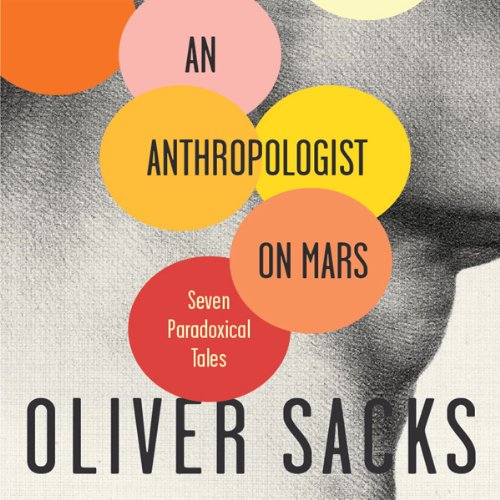
Oliver Sacks's audiobook An Anthropologist on Mars, narrated by Jonathan Davis, sits among the most important medical writing of the twentieth century, which makes stating that plainly at the start the most honest approach this review can take. Published in 1994, now part of the broader Sacks canon that includes Awakenings and The Man Who Mistook His Wife for a Hat, this collection of seven neurological case studies represents a refinement of everything Sacks developed in his earlier work: the integration of clinical precision with biographical depth, and the insistence on treating each patient as a person whose condition illuminates rather than diminishes them.
How An Anthropologist on Mars Holds Up
The title comes from Temple Grandin's description of her own experience navigating social interaction as an autistic person. She observes human behavior the way an anthropologist studies a foreign culture, with scientific attention but without native fluency. Sacks uses that image to anchor the collection's central argument: neurological conditions do not simply subtract from a baseline normal self. They create different selves, different modes of perceiving and processing experience, and the people living with these conditions have often organized their entire identities around what medicine tends to frame only as deficit.
The seven case studies range from a colorblind painter who finds his new monochromatic world strangely preferable, to a surgeon with Tourette's syndrome who controls his tics in the operating room only to unleash them elsewhere, to Grandin herself, whose chapter is the book's centerpiece. Sacks's method in each case is to gather clinical history, conduct extensive personal interviews, and then follow each subject into their daily environment: the painter's studio, the surgeon's operating theater, Grandin's farm equipment design practice. The result is a form of case study that is also biography, and the chapters function simultaneously as medical documents and portraits of extraordinary adaptive intelligence. One reviewer described Sacks's approach as filling each chapter with a precise description of symptoms and a sense of genuine awe, which is accurate to how the writing operates across all seven portraits.
Why An Anthropologist on Mars Works as an Audiobook
Jonathan Davis's narration is the right vehicle for Sacks's particular voice, which is precise but never cold, and frequently moves from neurological description into something approaching lyrical observation without losing its clinical anchor. Davis does not impose emotional editorializing on the text; instead, he allows Sacks's own amazement to surface through pacing and emphasis rather than affect. The listening length of eleven hours and forty-two minutes reflects the depth of each chapter. These are not short sketches; the surgeon's story alone runs to significant length, and Davis sustains the necessary concentration across the longer pieces without the narration becoming monotonous.
The audiobook format suits this material particularly well because Sacks's writing is conversational at its foundation. He is reporting back from encounters, translating what he witnessed for a general audience without condescending to that audience. Davis handles the transition between clinical terminology and personal narrative without jarring shifts. Sacks noted that some changes were made to the original manuscript with his permission; listeners familiar with earlier editions may notice minor adjustments, but these do not affect the core of the work.
Weak Spots in An Anthropologist on Mars
The case-study format means this audiobook is episodic rather than cumulative in its narrative structure. Each of the seven chapters is self-contained, which creates a thematic rather than chronological architecture. Listeners who want a single sustained arc will not find one. The chapter on the man who has his sight restored after forty-five years of blindness is among the most disorienting pieces of writing in Sacks's entire body of work, because the experience he describes, sight as destabilizing rather than liberating, runs so directly against expectation that it requires a moment of recalibration from the listener. Davis handles this chapter with appropriate care. A related difficulty is the Tourette's chapter, which requires the listener to hold simultaneously the surgeon's exceptional professional competence and the involuntary, often graphic behavior of his tics in uncontrolled settings. Sacks resists the easy framing of this as a simple inspiring story about overcoming obstacles; the tics do not go away in moments of triumph. The condition is simply organized differently in different contexts, which is the book's central argument made concrete. The internationally reaching readership Sacks built speaks to how widely these ideas travel, and Davis's narration delivers that breadth in a format suited to the material's depth and patience.
The Right Listener for An Anthropologist on Mars
Listeners with a prior interest in neurology, psychology, or disability studies will find this book challenging their frameworks productively. Readers who came to Sacks through The Man Who Mistook His Wife for a Hat and want more depth will find this collection more structurally ambitious; the case studies here are longer and the biographical immersion deeper than in the earlier collection. Davis's narration is appropriate for listeners who value control and precision over emotional expressiveness in their audiobook narrators. This is not a light listen and is not designed to be; the ideas require attention, and the case studies reward listeners who bring curiosity rather than looking for quick conclusions. Anyone approaching autism, Tourette's, or colorblindness primarily through medical frameworks will find Sacks shifting those frameworks substantially. The note about manuscript changes made with Sacks's approval is also worth taking seriously: these are not arbitrary editorial interventions but revisions the author participated in, which gives the audio version the same authority as the most current print editions.
Common Questions
Do I need to have read The Man Who Mistook His Wife for a Hat before this audiobook?
No prior Sacks is necessary. An Anthropologist on Mars is self-contained. That said, listeners familiar with his earlier case-study collections will recognize the format and appreciate how this one extends it.
Is this audiobook appropriate for listeners without a medical or scientific background?
Entirely. Sacks writes for general readers, and Davis's narration makes the clinical passages accessible. The cases are explained through personal narrative and observed behavior, not technical jargon.
Which of the seven case studies in this audiobook is considered the most significant?
The Temple Grandin chapter is generally regarded as the collection's centerpiece and is directly connected to the book's title. Her description of navigating social interaction as an anthropologist on Mars anchors the entire collection's argument.
How does Jonathan Davis handle the more disorienting clinical material in this audiobook?
Davis maintains a measured, precise delivery throughout rather than dramatizing the content. He allows Sacks's own sense of wonder to emerge through pacing rather than imposed affect, which is the correct approach for material this substantive.