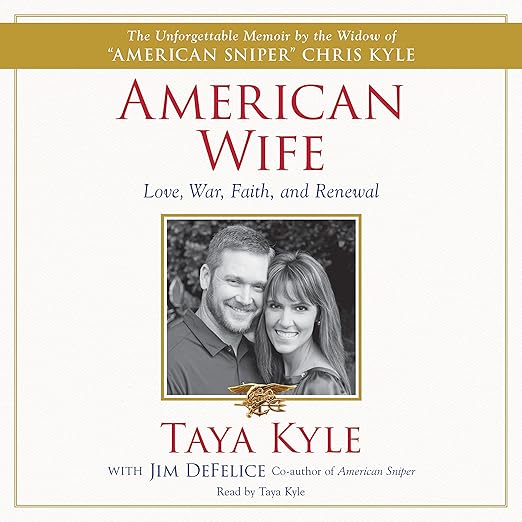
I set aside a full morning for American Wife and finished it in that single session, which is not always how I listen. Taya Kyle's voice makes it difficult to step away. Not because the writing is showy or the story is arranged for maximum impact, but because the honesty of it is continuous. She does not modulate her experience to make it more comfortable for the reader. The difficult parts of her marriage to Chris, the silences that accumulated across four Iraq deployments, the moments when she was furious at him for being gone and furious at herself for resenting the service, are all present and unadorned.
American Wife began circulating as a cultural object largely because of Clint Eastwood's film American Sniper, which brought Chris Kyle's story to an audience far beyond those who had read his memoir. Taya contributed sections to that memoir; this book is her account. The story of how they met, the courtship, the early years of marriage, and the long stretches of operational deployment that defined their relationship is told in a register that is both intimate and structurally honest about what that life costs.
The book does not arrive at Chris Kyle's death on February 2, 2013, until the reader has spent considerable time understanding what Taya was losing. That sequencing is deliberate and effective. When she describes the hours and days after his murder, the weight of it has been established through accumulated specific detail rather than announced as tragedy. One reviewer, an Army wife herself, described finding the material deeply relatable in ways that have nothing to do with Chris Kyle's specific fame. The experiences of managing a household alone during deployments, of children asking questions there are no good answers to, of love that cannot sustain the pressure it is being asked to bear and then somehow does, are universal to a particular kind of life.
Taya does not write a hagiography. She is honest about her husband's flaws, about the hard places in the marriage, about the anger she felt and the difficulty of receiving someone back after extended absence. That honesty is what makes the book something other than a celebrity memorial. It is, as one reviewer noted, written from the heart and unwilling to cover the hard questions with grace notes.
The Best Parts of American Wife
Self-narration here is not a production choice but a necessity. No one else could carry this material with the same weight. Taya Kyle's voice does not perform grief. It simply contains it. The moments where she is clearly working through something difficult as she speaks are part of the book's texture, not interruptions of it. Professional narrators are trained to maintain consistent vocal control, which would be exactly wrong for a book that is partly about the inability to control what happens to you and the people you love.
At just under ten hours, the memoir is appropriately sized. It does not overstay its welcome and does not compress material that deserves space. The closing sections, about her path toward renewed purpose through supporting military and first-responder families, are handled without false resolution. She is not healed. She is continuing.
Before You Commit to American Wife
Readers expecting a straightforward tribute book will find something more complicated. Taya is not interested in producing a monument. She is interested in telling the truth, which includes the parts of a military marriage that are not cinematic. Listeners who watched American Sniper and want an extended version of that experience will find this book partially fulfills that expectation and partially challenges it. The real story is harder and more ordinary than a film can accommodate.
The closing sections on faith and purpose reflect Taya Kyle's personal religious convictions, which are central to how she describes surviving. Listeners who find faith-based frameworks for grief alienating may find those passages more difficult to engage with. They are not preachy, but they are sincere and substantial.
Should You Listen to American Wife?
Strongly recommended for military families and anyone with experience of long operational separations. Also appropriate for readers interested in honest grief memoirs that do not offer easy resolution. Fans of American Sniper looking for Taya's perspective will find this more personal and more demanding than the film. Not the right book for listeners looking for an uncomplicated tribute or a feel-good recovery narrative.
At a Glance
- Narration: Taya Kyle narrates her own memoir, which is the only way this book could work; the grief and love are unmistakably real in her voice.
- Themes: Military marriage across deployments and distance, grief and rebuilding after violent loss, faith as a survival mechanism
- Mood: Raw, honest, and ultimately forward-looking, though it will require emotional reserves from the listener
- Verdict: A memoir about military life and loss that earns its emotional weight through honesty rather than sentimentality.
Do you need to have read Chris Kyle's American Sniper to understand American Wife?
No. Taya Kyle provides sufficient context about Chris's military career and the events leading to his death for new readers. Those who have read American Sniper or watched the film will have additional context, but it is not required for the memoir to be fully understood.
How does Taya Kyle's self-narration hold up over the full length of the audiobook?
Listeners consistently find it more powerful than a professional narration would have been. The moments where her voice reflects genuine emotion are integral to the book's impact. She is not a trained voice actor, but she is telling her own story in her own voice, and that authenticity is the book's primary asset.
Does American Wife address the controversies surrounding Chris Kyle's public reputation?
Taya acknowledges that battles to protect her husband's legacy were part of her experience after his death, but the book is not primarily a rebuttal of criticism. She writes from inside the marriage and the grief, not from a defensive position. Listeners looking for an engagement with public debates about Kyle's legacy will find limited material on that subject.