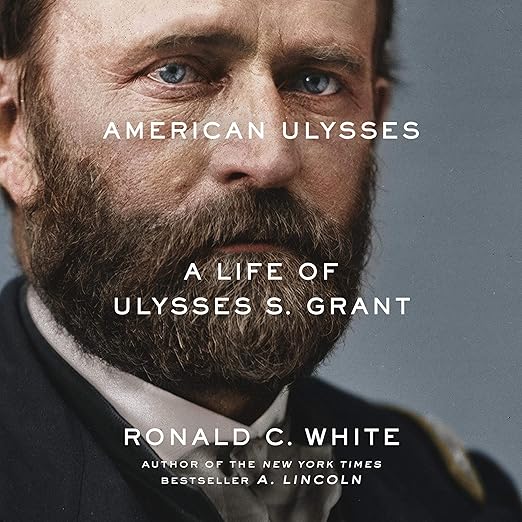
Six hundred pages of text and a hundred pages of end notes, according to the first review on this page. That is a description of a physical book, sitting on an audiobook that runs twenty-seven hours and thirty-five minutes. Both facts are true of the same work and both are useful, though only one of them tells you what you would be committing to. Rivermanmiss counted pages. Brilliance Audio counted minutes. Anybody weighing a credit against Ronald C. White's Grant needs the second figure and will meet the first one first. That inversion runs through the entire page.
The Verdict, Briefly
Grant is the reason the book exists, and the description sets its terms in one clause: among America's greatest and most misunderstood military leaders and presidents. Misunderstood is the operative word. The claim, per the copy, is a major new interpretation built on seven years of research with primary documents, some of them never tapped before. That last phrase does the selling, and Rivermanmiss is the reviewer who expands on it, naming full access to a thirty-three volume edition of Grant's papers that had only just been completed.
Ronald C. White arrives with a track record the reviewers care about more than the description does. The copy mentions the earlier A. Lincoln, and its bestseller standing, in passing and then moves on. Sotto voce turns it into the entire argument, calling that earlier biography simply magnificent and describing White as a biographer to pay attention to for what the review labels twenty-first-century socio-rhetorical high fidelity of nineteenth-century history. A strange sentence, sincerely meant, and a signal that the method here is rhetorical analysis as much as narrative. You are being told, in advance, that the pleasure will be argumentative.
GATTU, reviewing from India, produced the most compact summary of this book anybody has managed, and did it without using a single space. Ninety-four characters, one continuous word, covering the Civil War general who went on to become the eighteenth president of the United States for two terms. Unreadable and entirely accurate at once. Five stars awarded. If you want the premise in one breath, that is the premise. Everything White spent seven years on has to fit inside that arc, and the arc has two very different halves.
What Makes American Ulysses Worth Hearing
Arthur Morey is credited for the full twenty-seven hours and thirty-five minutes, unaccompanied. Civil War biography sets a specific test: place names, regimental designations, quoted correspondence from dozens of contemporaries, and constant movement between a subject's own words and a historian's argument about those words. Sotto voce notes that White folds in the writing of an extensive number of Grant's real-time contemporaries so a reader can weigh every side. In a recording, each of those voices arrives in the same one.
Rivermanmiss declares a bias before delivering a verdict, which almost nobody does and which I appreciate: an admission of being Grant intoxicated, in company with Mark Twain, and of considering him a great general and a great American. The same review reports that White was the first biographer granted full access to the completed papers, and that this is a newly published life by a Princeton PhD already known for work on Lincoln. Concrete, checkable, and entirely about a printed object.
Sotto voce and Rivermanmiss supply nearly all the substance in this column between them, and both were writing about the book itself. The remaining three entries are enthusiasm at assorted lengths. Pf, from Australia, offers seven words: appears to be well researched and informative. bigmuzza, in the United Kingdom, had previously read only about the main American presidents, names Washington, Lincoln and Kennedy, and came away impressed by US Grant. Warm, brief, and completely blind to format. Not one of the five names the narrator, the runtime or anything that would distinguish a recording from a hardback.
Points to Consider
Brilliance Audio's description runs to four sentences, which for a twenty-seven-hour recording is remarkably little. It names the subject, the previous book, the research base and the ambition, then stops. No structure is indicated anywhere. Nothing divides the war years from the presidency, and nothing suggests whether the fighting or the two terms in office takes the larger share of the running time. On a commitment this size, that omission matters more than it first appears, because the decision you are really making is which twenty-seven hours you want.
Nobody should take the badge at face value either. The counter stops at two votes, though five separate people filed written responses, and no pair of whole-star votes averages out to 4.7. Two fives give five. A five and a four give 4.5. Two fours give four. Nothing lands on 4.7. Meanwhile every visible grade in the column is a five, so the number sits below every reader you can actually consult on this page.
Twenty-seven hours and thirty-five minutes deserves a paragraph of its own, because it is the most consequential fact on this listing, and not a single reviewer touches it. It is also why the page-count entry matters more than it looks. Six hundred pages of text plus a hundred pages of end notes means the scholarly apparatus is substantial, and nothing here indicates whether those notes were recorded, summarized or left out. For a book sold on primary documents, that is not a small gap.
The Right Listener for American Ulysses
History listeners with the stamina for a full-length life should start here, and the tags on this record point the right way for once: historical, military, politics and activism, every one of them earned by the subject. Anyone who read A. Lincoln and wants the same treatment applied to a harder man has an obvious next step. Listeners who enjoy a biography that quotes its sources at length will get exactly that, delivered in a single voice, with the quotations and the commentary sharing one register throughout.
Walk away if you want a campaign history, because the copy sells an interpretation of a person and the reviewers answer the person. Walk away too if twenty-seven hours is more than you can hold in your head, since this is a work of accumulation and skipping ahead does real damage to it. And treat the star badge as decoration, sitting as it does beneath every grade underneath it. Twenty-seven hours is a long commitment to a man most people meet in a paragraph.
In Brief
- Narration: Arthur Morey holds twenty-seven and a half hours unaided, quoted correspondence from dozens of contemporaries included.
- Themes: Grant reconsidered, Civil War command, a contested presidency, primary-source biography.
- Mood: Patient, documentary, built for the long haul.
- Verdict: Slow, documentary, and worth all twenty-seven hours if Grant already interests you.
How long is the American Ulysses audiobook?
Twenty-seven hours and thirty-five minutes, narrated by Arthur Morey for Brilliance Audio. That is a long single-reader commitment, and not one reviewer mentions the runtime at all. One entry instead gives a page count for the text plus another hundred for the notes, which is this book measured in paper.
Does this audiobook cover Grant's presidency as well as the war?
The description names him as both a Civil War general and an American president, and promises a new interpretation of the whole life. One reviewer sums the book up as the general who went on to serve two terms as the eighteenth president. No chapter breakdown appears, so the balance between halves is unstated.
Is American Ulysses a good starting point if I have read Ronald C. White's A. Lincoln?
Two reviewers draw exactly that connection. One calls the earlier Lincoln biography simply magnificent and treats it as the reason to trust this one, while the description names A. Lincoln in its opening sentence. If the previous book worked for you, this applies a similar method to a more contested subject.
Should I trust the 4.7 badge on this audiobook listing?
No. Two votes are recorded against five visible written responses, and each of those five carries a full five stars. Under whole-star voting, two votes can only average four, 4.5 or five. The badge sits underneath every reader you can consult, and it cannot be derived from the count displayed beside it.