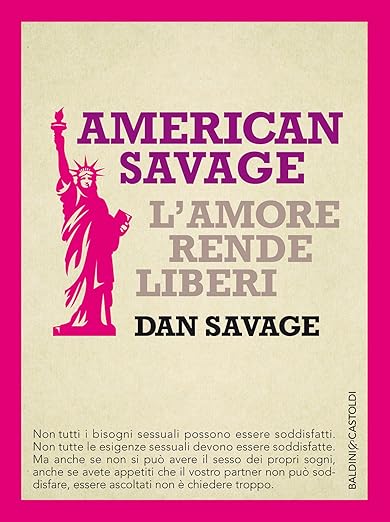
Dan Savage's prose has always been built to be heard rather than silently absorbed, and this audiobook confirms that intuition decisively. American Savage narrated by the author himself, is a collection of essays that argues, provokes, confesses, and satirizes with equal energy. Savage's wit is the vehicle, but the substance beneath it is genuinely serious: a sustained examination of what it meant to be gay in America during a period of rapid and contested change, written by someone who was simultaneously living that history and helping to shape public conversation about it.
The Terry Miller Essays Are the Most Durable
The essays in American Savage range across marriage equality, religious fundamentalism, abstinence education, gun control, and the internal complexity of open relationships, which might sound like a scattershot collection until you notice the thread connecting all of it. Savage is consistently interested in the gap between what American institutions claim to believe and how they actually behave. He applies that scrutiny with equal rigor to religious conservatives, the Republican Party, and the sexual frankness of his own marriage to Terry Miller. Nothing gets a pass, including Savage himself, which is what separates the book from mere polemic.
The personal essays are the collection's most durable pieces. Savage writing about his life with Terry Miller, about the anxieties and negotiations of a long-term committed relationship that does not follow standard scripts, has a specificity that the political essays sometimes lack. He is a better writer when he is confessing than when he is prosecuting, though he is skilled at both. The combination of personal memoir and political argument is the book's defining formal choice, and it works because the personal grounds the political rather than illustrating it.
The essay on marriage equality is worth discussing separately. Savage's argument is not simply that gay people deserve the same rights as straight people, though he makes that case clearly. He also examines what marriage as an institution actually is, stripped of its sentimental and religious overlay, and argues that the debate around marriage equality revealed more about American anxiety over sexuality in general than about gay rights specifically. That analytical move is characteristic of his best thinking.
More Effective in Audio Than in Print
Self-narrated audiobooks live or die on the author's ability to perform their own prose, and Savage is well-suited to this. His speaking voice carries the cadences of his writing naturally, with the timing that distinguishes his humor from pure sarcasm and the emphasis that clarifies his arguments when they become compressed. The audio version of American Savage is simply more effective than the print version for the way Savage's writing actually works; the rhythm of his sentences is built for spoken delivery.
His willingness to name specific hypocrisies with specific names, and to follow the implications of his own arguments to uncomfortable places, gives the essays a quality of intellectual honesty that is genuinely unusual in public commentary. He is not positioning; he is arguing. The distinction matters, and it comes through clearly in the narration. When Savage is uncomfortable with his own conclusions, that discomfort registers in his delivery rather than being smoothed away in editing.
For listeners interested in how the public conversation around LGBTQ+ rights in America actually developed, American Savage is a primary document as much as a book of essays. Savage was not an observer of that conversation; he was one of its most prominent participants, and the essays reflect both the arguments he was making publicly and the private experiences informing them.
A Document of a Specific Political Moment
Savage's voice is combative by nature, and listeners who are not already sympathetic to his positions will find some essays more prosecutorial than persuasive. The political pieces in particular are written for an audience that broadly shares his frustrations; they function better as articulations of a position than as attempts to change minds. Readers looking for genuine engagement with counterarguments will find those moments less developed than the book's best personal writing.
The essays were written and collected during a specific moment in American political life, and some of the cultural references and political targets have dated in the years since publication. The core arguments remain relevant, but listeners should be aware that the book is a document of its time as much as a timeless statement. That historicity is a feature rather than a flaw for readers interested in the period, but it means the book requires some contextualizing for younger listeners less familiar with the specific debates it enters.
The tone varies significantly across essays. Some pieces are comic, some are confessional, and some are angry. The shifts can feel abrupt, though this is a genuine reflection of Savage's range rather than a structural problem. The collection does not build toward a unified thesis so much as accumulate a portrait of a particular kind of American experience.
Why Savage Narrated These Essays Himself
American Savage is the right audiobook for listeners who want a first-person account of what LGBTQ+ political and cultural life looked and felt like from inside it, written and narrated by one of its most distinctive voices. Fans of political memoir and personal essay collections will find Savage's range of registers engaging, and the self-narration makes the audio version particularly alive. Anyone interested in the cultural history of marriage equality, religious conservatism's influence on American politics, or the practical negotiations of non-traditional relationship structures will find the book substantive and direct.
Listeners who already follow Savage's public work will find American Savage both a deepening of familiar arguments and an opening onto the personal life behind his public persona. Those encountering him for the first time will get a compressed and useful introduction to a writer who has been one of the most consequential voices in American LGBTQ+ commentary for decades. The audio format, with Savage narrating his own words, is genuinely the best way to encounter this book.