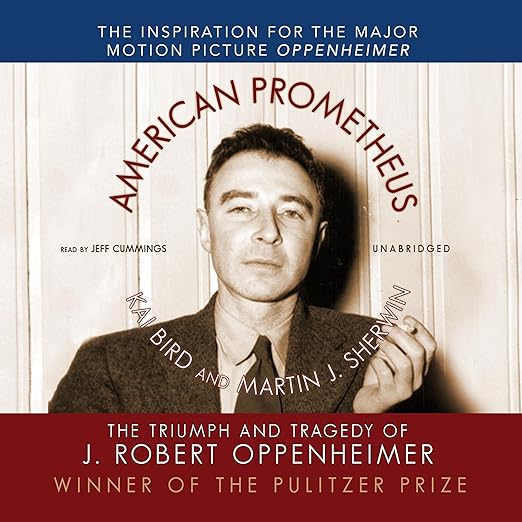
Twenty-six hours and thirty minutes is a long stretch for any audiobook, and American Prometheus never apologizes for the length. Kai Bird's Pulitzer Prize winning biography of J. Robert Oppenheimer is the book that eventually supplied the research behind Christopher Nolan's film, and hearing the full unabridged text explains why a two-hour movie could only borrow fragments of it. Twenty-five years of research sit behind this text, and the audiobook carries that weight in nearly every chapter. Jeff Cummings narrates the whole run solo, and carrying that much material without a second voice to break it up is its own test of stamina. My verdict going in: this is a rewarding listen for anyone willing to sit with density instead of momentum, and a rough one for anyone expecting the movie's pace.
The Synopsis Says Authors, the Site Lists One
The book traces Oppenheimer from a gifted, restless young physicist through his wartime leadership of the effort to build the bomb and into the postwar years, when the same government he had served turned on him during the anti-Communist hysteria of the early 1950s. The synopsis is specific about what triggered that turn: Oppenheimer proposed international controls over atomic materials, opposed development of the hydrogen bomb, and criticized plans for nuclear war, and those positions were enough for powerful advocates of a nuclear buildup to decide he could not be trusted with the country's secrets. Bird's approach favors accumulation over drama: committee testimony, personal letters, and dense biographical detail build up slowly rather than arriving in big set pieces. Listeners who come to this after the film will notice how much material Nolan had to leave out, particularly around the security hearing that stripped Oppenheimer of his clearance. One detail worth flagging for anyone checking the credits: the site lists a single author for this biography, yet the synopsis text itself refers to "the authors" capturing Oppenheimer's life and times, without naming a second contributor anywhere in the record we have. Cummings keeps a steady, unhurried delivery across the full run, and given how much material Bird packs into each chapter, that steadiness matters more than flash would. The scope is the point here: this is not a quick portrait but a full accounting, chapter by chapter, of how a brilliant scientist became a cautionary tale about the limits of loyalty in a fearful political climate.
From Trusted to Build the Bomb to Distrusted
The reviews that discuss the content rather than the physical object agree on what makes the book worth the investment. Charles Salmans calls it the story of "one man's struggle to define morality" against love of country, and frames that struggle as timeless, still active decades after the bombs fell on Japanese cities. A C connects the book directly to Nolan's film, describing it in terms of what one bonus feature calls "The Story of Our Time," while being careful to note that a dramatization, however ambitious, cannot equal the full complexity of the record it draws from. Jbman, who rates the book four stars rather than five, still calls it well researched and confirms the throughline that keeps listeners going: watching a brilliant, useful scientist become politically disposable once the war that needed him had ended. For a biography this dense, the actual narrative engine is that reversal, from the man trusted to build the bomb to the man the same government decided it could no longer trust with its secrets. If the film's compressed version of the security hearing left you wanting more, or you wanted more of the science alongside the politics, this audiobook is built to answer exactly that gap, at the pace and level of detail that a full text allows and a two-hour screenplay cannot. Tags on the listing file this under both biography and history, and the book genuinely earns both shelves: the personal material about Oppenheimer's marriage, friendships, and temperament sits right alongside the institutional history of how the bomb program was run and how the government later turned its own security apparatus against the man who had led it.
A Binding Complaint From a Reader in Turkey
Length is the recurring complaint, and it comes from readers who otherwise rated the book highly. Richard B. Schwartz, who gives it five stars, still opens his review by warning that it runs "the equivalent of approximately three volumes" and calls it a slow, dense read rather than a dull one. Jbman is more pointed, saying the post-war years and Congressional testimony "went on way too long" and needed serious editing. At twenty-six and a half hours, that density is not something the audio format can fix on its own, and a single narrator sustaining that much detail arguably asks more patience than a print reader skimming ahead would need. One of the five reviews here is worth flagging as unrelated to what you are actually buying: a one-star complaint from a reader in Turkey describes pages falling out of the binding every four or five pages. That is a manufacturing problem with a physical copy, and it has nothing to do with this audiobook or with Cummings' narration, but it sits in the same review column as everything else here, so do not let a one-star rating on the page make you think the recording itself is the issue. It is also worth noting that this recording, from Blackstone Audio, first went up in March of 2007, sixteen years before Nolan's film existed, which is why the cover copy now doing double duty as a movie tie-in was clearly added well after the fact rather than written for it. Not one of the five written reviews actually comments on Cummings' pacing or delivery, so the performance itself is something you will have to judge for yourself once you press play.
One Narrator Alone Across Twenty-Six-Plus Hours
This audiobook rewards listeners who already care about the subject matter, not casual true-crime or pop-science browsers looking for a fast overview. If you watched Nolan's film and wanted the fuller record behind it, the science, the politics, and the twenty-five years of research that went into reconstructing Oppenheimer's inner life, this delivers all of it, provided you can commit to twenty-six-plus hours at a dense, unhurried pace. History listeners interested in the Cold War, the making of the atomic bomb, or the mechanics of a security clearance system that turned on its own architect will find this among the more thorough treatments available in audio right now. Anyone hoping for something closer to the film's own runtime, or wary of one narrator carrying such a long, detail-heavy text alone, should look elsewhere. This is a book for the patient, not for anyone hoping the audiobook trims down what the page itself could not.