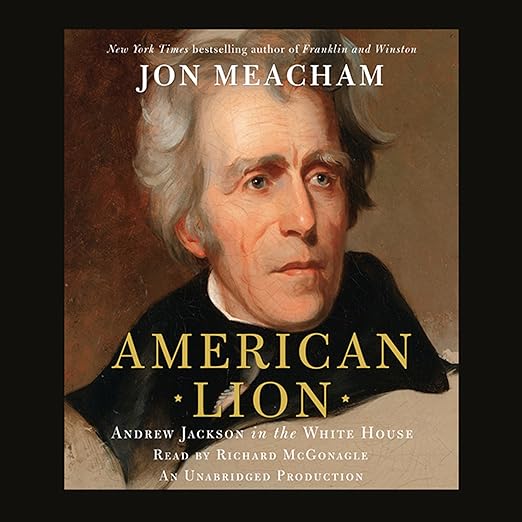
I came to American Lion with less knowledge of Andrew Jackson than I expected to have. I knew the broad outlines: the Battle of New Orleans, the Trail of Tears, the $20 bill controversy, the populist credentials that have made him a reference point for everyone from FDR to contemporary political figures trying to claim a connection to ordinary Americans. What I did not know was the degree to which his presidency was shaped by intimate personal drama, by a dinner party controversy, by his fierce protective instincts toward the woman he loved, and by the particular kind of loyalty he inspired and expected in return.
Jon Meacham's Pulitzer Prize-winning biography focuses on Jackson's White House years rather than attempting a full cradle-to-grave account. That is a deliberate and effective choice. Jackson arrived in Washington already famous as a war hero and frontier fighter. The political story, beginning with his 1828 election and running through his two terms, is dense enough to fill seventeen hours without the biographical exhaustion that comes from trying to cover everything.
Is American Lion Worth Your Time?
The book's greatest contribution is its treatment of Jackson as a genuinely contradictory figure rather than a symbol to be either celebrated or condemned. He was the architect of Indian Removal, a policy of ethnic cleansing whose consequences were devastating and permanent. He was also, by the standards of his era and well beyond them, an unusually direct conduit between ordinary voters and the government that was supposed to represent them. Meacham does not resolve that contradiction because it cannot honestly be resolved. He traces it, documents it, and allows it to stand as the defining complexity of a man who was, as the book's framing suggests, very much like his country.
The Nullification Crisis, in which South Carolina attempted to void a federal tariff and Jackson threatened to send in the army, gets particular attention and is well rendered. The family drama around Peggy Eaton, whose social ostracism by Washington society became a genuine political crisis because Jackson identified her situation with that of his own late wife Rachel, is one of the most surprising sections of the book. That a dinner party controversy could reshape a cabinet and end a vice presidency is either amusing or horrifying depending on your mood, and Meacham presents it with appropriate seriousness.
The Best Parts of American Lion
Richard McGonagle is a dependable choice for this material. He brings the kind of measured authority that presidential biography on audio requires. Meacham writes in long sentences with considerable subordination, and McGonagle navigates the prose without losing the listener in its architecture. At seventeen hours, a narrator who can maintain vocal variety and appropriate emphasis across dense political material is essential, and McGonagle delivers.
The newly discovered family letters and papers that Meacham drew on in researching the book give the personal sections unusual specificity. We see Jackson in his domestic role, as a guardian to his extended family and to the many children he and Rachel raised, alongside the public figure who dominated Washington with the force of his personality. That dual view is what elevates biography above political history.
Before You Commit to American Lion
One reviewer found the density of secondary characters a challenge, and it is a fair warning. Jackson's circle was large and the political figures of the Jacksonian era require some tracking. Listeners with background in antebellum American history will navigate this more easily than those encountering figures like John C. Calhoun, Martin Van Buren, and Henry Clay for the first time. A light supplementary read on the period before starting the audiobook would not be wasted effort.
The book's focus on the presidency means that Jackson's antebellum frontier life, his dueling culture, and his military career are summarized rather than explored in depth. Listeners who want those periods in detail will need additional sources. Meacham's scope is the White House years, and within that scope he is comprehensive.
Should You Listen to American Lion?
Recommended for listeners interested in American political history, presidential biography, or the roots of populist political movements. Also an excellent listen for readers who want to understand the foundational tensions, federal power versus states, democratic expansion versus institutional constraint, that have defined American governance ever since. Less suited to listeners looking for a fast-moving narrative or those new to antebellum American history who would benefit from orientation first.