In Brief
- Read by: Will Damron carries the sole credit across all twelve-plus hours, the standard setup for a single-throughline nonfiction thriller.
- At its heart: Libertarian idealism curdling into authoritarian control, the early dark web, a two-year federal manhunt
- Vibe: Fast-moving and propulsive, grounded in real criminal stakes
- Short version: A strong choice for true-crime fans who can forgive occasionally generic prose for a genuinely fascinating story.
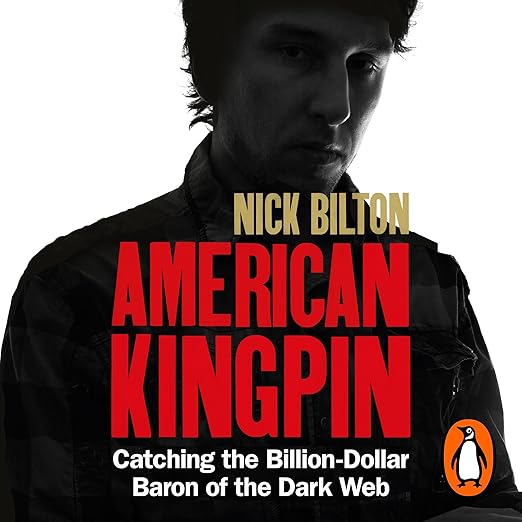
American Kingpin turns the founding and collapse of the Silk Road into a true-crime audiobook, following a twenty-six-year-old libertarian idealist and former Boy Scout named Ross Ulbricht from a small anonymous marketplace into a billion-dollar dark web empire he ran as the self-styled Dread Pirate Roberts.
Damron Narrates a Synopsis Written a Decade Later
Nick Bilton builds the story around Ulbricht's contradictions: a physics student with an interest in crystallography who launched Silk Road, per the synopsis, to prove that legal drug sales could make society safer, then spent years ruling that same marketplace with increasingly authoritarian force, eventually convinced he needed hired men willing to kill on his behalf. Will Damron holds the sole narrator credit across all twelve hours and fourteen minutes, the standard shape for a single-throughline nonfiction thriller carrying one story from a dorm-room idea to a two-year federal manhunt.
One detail worth flagging up front: the listing's synopsis opens by calling Ulbricht 'the man now pardoned by President Trump,' a description that could only have been added years after this audiobook's original 2017 production. The recording itself predates that pardon by close to a decade, so listeners should not expect the narrative to address it directly. Reviewer Camp Runamok reads the pardon as a payoff to libertarian political support, though that is one listener's interpretation rather than anything the book itself argues, since the book ends long before the pardon exists.
Investigators Carry the Same Weight as Ulbricht
The synopsis frames the whole arc as a clash between two worldviews: anonymous, decentralized, libertarian-leaning web culture on one side, and government order and the rule of law on the other. Bilton keeps both federal investigators and Ulbricht himself in view throughout, including agents who, according to the synopsis, were eventually lured into the marketplace's orbit and switched sides.
That dual perspective is part of what separates this from a simple crime chronicle. Rather than treating the federal side as background procedure, Bilton follows individual investigators closely enough that their choices, including the ones that compromised the case, carry the same narrative weight as Ulbricht's own decisions. Publisher Penguin Audio positions this squarely as a downloadable, unabridged edition, so listeners get the full text rather than a condensed version of the manhunt.
Fifty-Two of a Possible Fifty-Five Points
The reviews on file are consistently strong on craft. A McGirr calls it truthful and amazingly well written, and Stinky Greg credits Bilton's meticulous research for a story that moves from what that review calls the depths of the dark web to the highest echelons of the DEA. Michael Mcmenus notes the short-chapter structure makes it easy to stop and start while traveling, a practical point for anyone tackling twelve-plus hours in pieces.
The eleven ratings on file add up to fifty-two of a possible fifty-five, three stars short of a perfect sweep, which lines up with reviewers who are enthusiastic without treating the book as flawless. Several reviewers single out the same arc: Ulbricht's slide from a stated belief in decentralized, government-free commerce into the very kind of unchecked control he originally set out to prove was not necessary.
Michael Mcmenus also draws a comparison worth mentioning for genre fans, placing this alongside stories of counter-espionage and double agents and describing an unexpected thread involving an undercover operator protecting the marketplace's own developer. That kind of twist, layered onto a story already built around a federal manhunt, is part of what keeps several reviewers describing this as reading like fiction even though every event is real.
A Generic Children's Book, But With Swearing
Not every reviewer is fully won over by the prose. George Castillo gave the book four stars and called the writing style a little like a generic children's book but with more swearing, even while still recommending it to anyone interested in law enforcement or radicalism. That is a genuinely mixed read on Bilton's style worth weighing against the more uniformly glowing reviews around it.
The subject matter includes drug trafficking, hired violence, and federal agents who switch sides partway through the manhunt, all handled as true crime rather than softened for a general audience. Anyone sensitive to detailed accounts of real criminal violence should know that going in, even though the book is framed as history rather than sensationalism.
Because the synopsis text was clearly updated after 2017 to reference a much later pardon, it is worth treating any other forward-looking claims in the listing with the same caution: check the actual audiobook runtime and the reviews themselves, which are dated across a wide span of years, rather than assuming the marketing copy reflects the most current state of Ulbricht's case.
That distinction between a book valued for its subject and one valued purely for its prose is a fair way to frame expectations before starting, particularly for a listener drawn in mainly by the Ulbricht name recognition rather than by true-crime writing as a craft.
Moves at a Thriller's Pace Rather Than a Textbook's
True crime listeners, anyone curious about the early internet's libertarian subcultures, and readers interested in how a two-year federal investigation actually unfolds will find plenty here. The 2025 pardon gives the story fresh relevance even though the audiobook itself predates it by years.
It also suits listeners who like their nonfiction to move at a thriller's pace rather than a textbook's; several reviewers describe finishing it quickly precisely because the short chapters and steady escalation make it hard to set down for long. Readers coming to this fresh off the 2025 pardon news will get the origin story that news coverage rarely has room for: how a specific mix of libertarian conviction, technical skill, and personal isolation built Silk Road in the first place.
Pass on this one if uneven or occasionally clunky prose pulls you out of a nonfiction book, since even reviewers who recommend American Kingpin describe the writing as generic in places. For listeners who care more about the story than sentence-level polish, that caveat matters a good deal less.
Frequently Asked Questions
Does the American Kingpin audiobook cover Ross Ulbricht's 2025 pardon?
No. This audiobook was originally produced in 2017, years before that pardon happened, so the narrative ends where Bilton's original reporting ends: with the Silk Road's rise, the federal manhunt, and Ulbricht's capture. The listing's synopsis references the pardon, but the recorded content itself does not.
How long is the American Kingpin audiobook and is it easy to listen to in short sessions?
It runs twelve hours and fourteen minutes. Reviewer Michael Mcmenus specifically praised the short-chapter structure for making it easy to stop and start while traveling, which suggests it holds up well broken into shorter listening sessions rather than long uninterrupted sittings.
Is prior knowledge of the dark web or Bitcoin needed to follow this audiobook?
No specialized background is required. The synopsis and reviews both describe a story built around character and consequence rather than technical explanation, following Ulbricht's personal arc from idealist to marketplace kingpin in terms any true-crime listener can follow without prior tech knowledge.
How many people have rated the American Kingpin audiobook?
Eleven ratings are on file, averaging four point seven, and the underlying numbers add up to fifty-two of a possible fifty-five points, three stars short of every reviewer giving a perfect score. Five written reviews back up that generally strong but not universal reception.