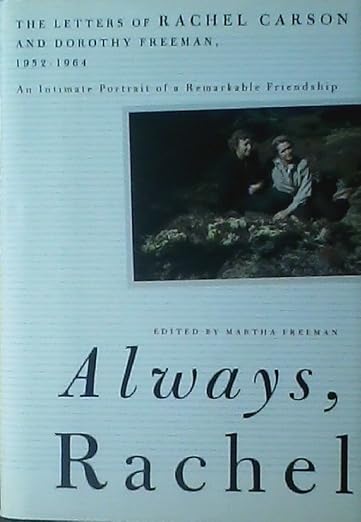
The description field on this audiobook listing is empty. Not thin, not boilerplate, empty. Which means a review has to be a review of the record, and the record is a strange object: a title that is also a sign-off, an author credit reading Martha Freeman, editor, a tag that says Diaries and Correspondence, and thirty-two hours and twenty-six minutes of somebody reading. Three people have rated it and none of them wrote a word. That is the whole of the public evidence for a commitment better measured in days than in evenings.
An Editor Credited, a Correspondent Left Unnamed
Start with the byline, because nothing else on this page tells you half as much, and nothing else is half as odd. The author field reads Martha Freeman, editor. An editor is credited. A writer is not. Set that beside the tag and beside a title that reads like the closing line of a letter, and the shape becomes legible enough: a volume of somebody's letters, gathered and shaped by an editor, where the person who signed them Always, Rachel goes unnamed on the listing. If you want to know whose correspondence you are buying, this page declines to say.
Martha Freeman's name doing double duty in the author slot is a cataloging convention and not a claim of authorship, and it matters because it changes what the recording is. A memoir has a narrating consciousness. A collection of letters has a correspondent, an editor's ordering hand, and usually an apparatus of dates, headnotes and context that a recording either reads aloud or quietly drops. The record takes no position on which choice was made here. Across thirty-two hours, that is not a detail.
Thirty-two hours and twenty-six minutes is an enormous quantity of listening by any measure, and correspondence is the form least likely to generate the momentum that carries you through a long recording, because it resets at every salutation. Letters do not build toward a climax. They accumulate. A listener who wants that accumulation will get it in abundance here, assuming the volume is what its title and its tag imply. A listener who wants narrative drive should look hard at what the tag is actually promising.
Thirty-Two Hours in One Voice, and Total Silence
Callie Beaulieu is the only name attached to the reading, and thirty-two and a half hours in one voice is the largest single fact about this edition. None of the three people who rated the title left a written word, so nothing whatever is publicly known about how the reading goes: whether letters are dated aloud, whether editorial matter is read or skipped, whether the voice shifts between correspondents or holds one register the whole way. On most listings that silence is a minor inconvenience. On thirty-two hours of letters it is the entire question.
Letters were written to be read by one person, silently, and a recording does something the form never anticipated. It puts a third party in the room, speaking. That can be extraordinary, because a voice restores the pauses, the abrupt changes of subject and the warmth of a closing line that print flattens into type. It can also be punishing across what amounts to two full working days of listening, and no part of this page helps you judge in advance which of those you are getting. One practical consequence deserves spelling out. A recording of letters carries no chapter logic a listener can navigate by, or at least nothing here gives any reason to think otherwise, so coming back after a break means either accepting wherever the player left off or hunting through an enormous file for a half-remembered line. People who annotate printed correspondence do it precisely because the form resists reading in a straight line.
Beacon, 1995 is what sits in the publisher field, with an invisible formatting character parked in front of it and the year folded into the value itself. The language field carries the same stray character. The listed release date is January 1, 1995, which is how a catalog records a year when the month is unknown. Read together, those fields describe a print bibliography line that was pasted into an audio record and never tidied afterward.
A Clean Sweep From Three Unanimous Strangers
Everything above concerns the record. Here is what it means for a purchase. You cannot verify the contents, the editorial apparatus, the completeness of the selection, or the quality of the reading from anything on this page. What you can verify is that three people awarded five stars, and because those are whole-star votes the arithmetic pins the total at fifteen of a possible fifteen. A clean sweep, and an empty one at this size, since three unanimous strangers cannot separate a superb recording from a merely serviceable one.
Nothing addresses abridgment either, which on a letters volume is a live question and not a pedantic one. Collections of correspondence are selected by definition, so a recording of a selection is a selection of a selection, and the listing takes no position on whether anything further was trimmed for audio. A buyer who wants a complete correspondence will find no promise here in either direction, and with no written responses at all, no previous listener has ever said so in public.
A Narrow Audience Who Already Knows the Correspondent
This suits a narrow and real audience: someone who already knows whose letters these are, who wants them delivered in a voice, and who has thirty-two hours to give them. Readers of literary correspondence tend to arrive already committed. They know the correspondent, they want the texture, and the length is what draws them in, never what deters them. For that listener, an empty description is close to irrelevant, because they were never shopping on the strength of a blurb in the first place. Students and researchers make up a second genuine audience, with one caveat attached. A recording is a poor place to look something up, and thirty-two hours with no described internal structure is a poor place to look anything up twice.
Assume nothing the page does not state. It does not name the writer of the letters, describe the selection, date the recording itself, or say one word about how Callie Beaulieu handles thirty-two hours of another person's private voice. Anyone expecting a guided edition, with introductions and context read in alongside the letters, should know the listing makes no commitment on that point at all. You are buying a title, a tag, a runtime and a single name, and if that is enough for you, then it is genuinely enough.
Common Questions
What does the Always, Rachel audiobook actually contain?
It never says, because the description field has been left empty. The title, the Diaries and Correspondence tag, and an author credit reading Martha Freeman, editor, together point toward a volume of collected letters with an editor's hand behind the selection. Past those three signals, the page offers nothing at all.
Can the five-star rating be trusted on this audiobook?
It is arithmetically solid and practically useless. The badge rests on three whole-star votes, which can only mean fifteen points from fifteen available. Three people voting in unison cannot tell a fine recording from an adequate one, and no written word from any of the trio survives to explain the grade.