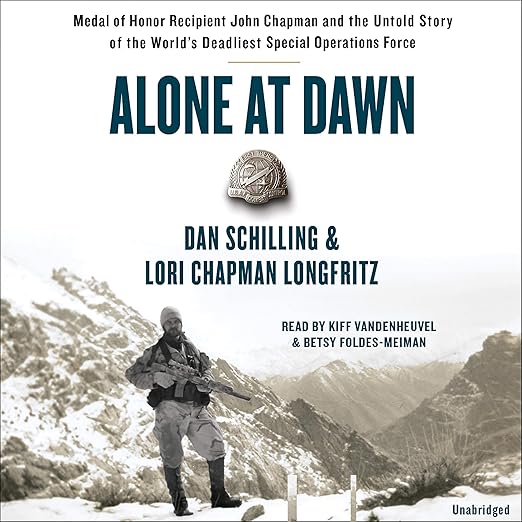
The First Airman Honored in Fifty Years
Dan Schilling builds this audiobook out of firsthand accounts, classified documents, and video footage most listeners will never otherwise see, and the craft shows in how carefully the pieces are sequenced. Alone at Dawn traces John Chapman, an Air Force Combat Controller who fought alongside a small team of Navy SEALs on a mountain in eastern Afghanistan on March 4, 2002, was left for dead after a brutal initial assault, and then, alone and gravely wounded, held off Al Qaeda fighters closing in from three sides to protect the rescue team arriving behind him. Chapman's actions that day earned him the Medal of Honor, awarded posthumously and only after later video review upgraded an earlier commendation, making him the first airman in nearly fifty years to receive it.
Schilling doesn't treat this as a single-battle story. Roughly half the runtime is spent on the history and culture of Air Force Combat Controllers themselves, a special operations community whose members are required to match the physical standards of SEALs and Delta Force operators while also handling air traffic control and precision targeting under fire. That institutional context turns Alone at Dawn into something closer to a dual biography, of one man and of the unit that shaped him, and the eleven-hour runtime earns its length by refusing to rush either half.
Chapman's Medal of Honor was formally presented at the White House in August 2018, sixteen years after his death, following a review that used previously unreleased video and audio evidence to reassess what actually happened on the mountain. That gap between the event and its recognition is itself part of the story Schilling tells, a reminder that even extraordinary heroism can take institutional years to be fully understood, let alone honored, and Alone at Dawn treats that delay with the same care it gives the battle itself.
VandenHeuvel's Measured Delivery on the Mountain
Kiff VandenHeuvel narrates with a measured, unhurried delivery that resists the temptation to oversell material that doesn't need it. The tactical sequences on Takur Ghar move with real clarity, letting listeners track who's where on the mountain without losing the emotional stakes underneath the logistics, and VandenHeuvel doesn't let the audiobook slip into either dry procedural recitation or manufactured melodrama. That balance matters given how much of this story could tip into either extreme in less careful hands.
Reviewers describe the book as difficult to stop listening to despite the subject matter, and one, a listener going by Jim, notes how thoroughly it traces the development of Combat Controllers across decades before ever reaching the events of the bad day on the mountain. That patience pays off. By the time Chapman is fighting alone, you understand exactly what training and institutional culture put him in a position to make the choices he made, which gives his last stand a weight that a more compressed account couldn't match.
Listeners who've read Sean Naylor's Not a Good Day to Die, an account of the broader Operation Anaconda that Takur Ghar was part of, will find useful complementary context here, though Alone at Dawn narrows its lens considerably to focus on Chapman and the Combat Controller community specifically rather than the full operation's command structure. That narrower focus is a strength on its own terms, giving Schilling room to build a genuinely intimate portrait rather than a sweeping operational history.
Unresolved Questions About Choosing to Leave Chapman
This is a combat memoir in the fullest sense, and the detail is graphic where the history demands it. Listeners sensitive to sustained descriptions of battlefield violence, including the specifics of Chapman's wounds and the chaos of a firefight at close range on exposed terrain, should know what they're signing up for. Schilling doesn't sensationalize the violence, but he also doesn't soften it for comfort, and eleven hours is a long time to sit with material this heavy.
The dual focus on Chapman's story and on Combat Controller history overall is a strength, but it does mean the narrative occasionally steps away from the personal thread to cover institutional background that some listeners may find slower going. If you came strictly for a tight, propulsive account of one battle, the broader context sections may test your patience, even though they're doing real work to explain how a special operations unit most Americans have never heard of came to exist in the first place.
The book also draws on interviews with Chapman's family and surviving teammates, and those sections carry a different kind of weight than the tactical reconstruction, one grounded in decades of grief and unresolved questions about the initial decision to leave Chapman for dead. Listeners should be prepared for that emotional register alongside the combat detail; this isn't purely a tactical account, and the interpersonal fallout among the men involved is handled with real sensitivity rather than treated as a footnote to the action.
Honoring a Man Who Can't Tell His Story
Readers of modern military memoir, from Lone Survivor to American Sniper, will recognize the register here, though Alone at Dawn is less interested in a single narrator's perspective and more invested in honoring a man who can't tell his own story. Anyone drawn to Medal of Honor narratives, Afghan War history, or the culture of American special operations will find this among the more thorough accounts available in audio.
Listeners looking for something lighter, or who prefer their military history without extended combat detail, should approach with caution given how unflinching the book gets. But for the audience it's built for, Alone at Dawn earns its length and its praise. Gunner Bob, one of the book's reviewers, calls it difficult to stop listening to despite how rough the material gets, and that tension between difficulty and pull is exactly what this audiobook delivers.
Before You Listen
Does the Alone at Dawn audiobook cover graphic combat detail?
Yes. Dan Schilling doesn't soften the specifics of the firefight on Takur Ghar or John Chapman's wounds, so listeners sensitive to detailed battlefield violence should know what to expect going in.
Who was John Chapman and why does this audiobook focus on him?
Chapman was an Air Force Combat Controller killed in action during a 2002 battle in Afghanistan; he was posthumously awarded the Medal of Honor after later video review upgraded his original commendation, making him the first airman honored that way in nearly fifty years.
Is this audiobook only about one battle or does it cover more?
The book splits its time between the specific events of March 4, 2002, and the broader history and training culture of Air Force Combat Controllers, giving listeners institutional context alongside the personal story.
How long is the Alone at Dawn audiobook?
It runs eleven hours and twenty-three minutes, narrated by Kiff VandenHeuvel.