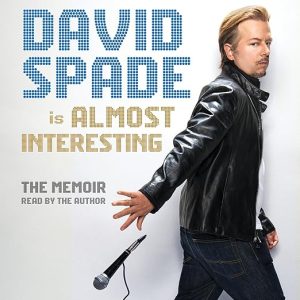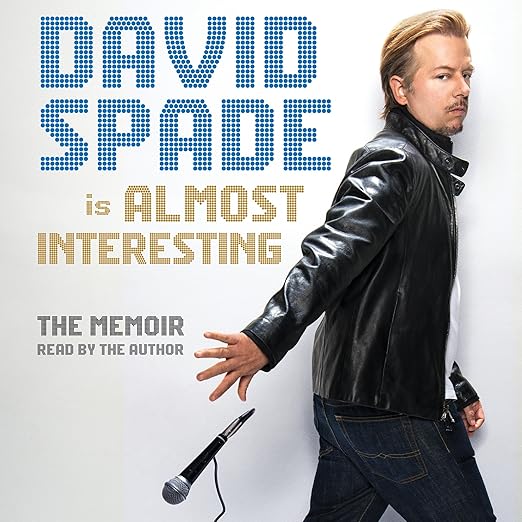
Does a comedian whose entire register is dry understatement gain anything by reading his own memoir aloud? David Spade narrates this audiobook himself, and the best argument for that decision comes from a reader who reports that his "sense of humor translates very well (no ghostwriter, just Spade)." The voice on the page is already his. Putting it in his mouth is less a performance than a delivery of the original.
Spade Narrates His Own Pre-Emptive Deprecation
The title is doing more work than it looks like it is. Spade has built a forty-year career on pre-emptive self-deprecation, and calling your own life story Almost Interesting is that instinct applied to the memoir form itself. The publisher describes it as "A hilarious and biting memoir" and calls him the "comic brat extraordinaire", which is the persona most people know from the harsh Hollywood Minute segments, from Joe Dirt and Tommy Boy, and from seven years as Dennis Finch on Just Shoot Me.
What the book actually covers is more ordinary and more interesting than the persona suggests. It starts with a childhood spent as "a wannabe cool younger brother" in Arizona, moves into years of "low-paying gigs" spent "crisscrossing the country as a comedian" while "dragging along his mother's old suitcase full of props", and only then arrives at the years everyone bought the book for: the 1990s at Saturday Night Live during what the copy calls "the beloved Rock/Sandler/Farley era", including his friendship with Chris Farley. The later chapters cover fame, which in Spade's accounting means "the constant fear of being fired," an ex-assistant who attacked him in his sleep, and a run-in with Eddie Murphy.
The Only Famous Person Who Seems Grateful
Spade is at his best when the story is about failing. The grind chapters, the props suitcase, the years of being mistaken for a child on stage, all of it has a specificity that the celebrity sections cannot match, and it is where the self-deprecating register stops being a defense mechanism and starts being accurate reporting. One reader who has worked through hundreds of famous-person autobiographies calls this "in a lot of ways, this was the most enjoyable", and explains why in a sentence worth quoting in full: "He is the ONLY famous person who comes across as truly grateful for the breaks he's gotten, which was very refreshing." Gratitude is not a common register in comedy memoir. It is what makes this one land.
The reader response splits usefully along fan lines. Somebody who grew up "loving/idolizing Farley, Spade, Sandler, and Rock on SNL" reports that if you "can recite Tommy Boy, line-by-line, this book's for you." But another reader makes the more persuasive case: "You don't have to like David Spade to enjoy this book. It's honest and funny, what a life this guy has had". A third calls it "a funny and casually well-written book," and the casually is the operative word. This is not a memoir with literary ambitions. It is a comedian telling stories in the order they occurred to him, and the looseness is part of the appeal. The publisher's own summary sets the register accurately enough: "Sometimes dirty, always funny, and as sharp as a tack". Two of those three hold up across the runtime, and the third depends entirely on how you feel about jokes made in 2015.
Structure Dissolves Once the Climb Ends
Two complaints recur, and both are fair. The first is structural, and a four-star reader states it precisely: the book "abandons" its narrative "without finishing it." His account is that the first two thirds cover the upbringing, the comedy-club grind and the climb from SNL writer upward, and then the shape simply dissolves. Set against the publisher's own promise of a chronological rise, that is a real defect rather than a matter of taste, and it means the final stretch of the runtime is looser and less rewarding than what precedes it.
The second is about audience. A three-star reader notes that Spade "addresses a younger crowd here and there" while doubting his actual readership skews that way, and places the outer edge of that audience at their own early thirties. That is worth weighing if the SNL era is history to you rather than memory, because a large share of the material assumes you already know who these people were. One more caution for the audio specifically: the same reader says that reading the book, "I could hear his voice and way of speaking", which tells you the prose carries his cadence, but nobody on this listing has commented on the recording itself. The casting is obviously right. The execution is unreviewed.
Worth separating two things the book keeps close together: the persona and the person. Onscreen, Spade traded on a sneer, and one reader admits to having felt beforehand that "Spade was easily replaceable in every movie" they had seen. What emerges over six and a half hours is somebody considerably more anxious and more self-aware than the smirk suggested, which is why the fame chapters keep circling back to "the constant fear of being fired" rather than to the rewards. That gap between the public register and the private account is the most interesting thing in the book, and it is doing quietly what the title jokes about openly.
Give It a Miss for a Farley Reckoning
Who is this actually for? Anyone who watched the Rock, Sandler and Farley years of Saturday Night Live and wants the view from inside them, certainly, and anyone with a soft spot for Tommy Boy will find the book pitched directly at them. Beyond that fanbase, it works for listeners who like show-business memoirs about the climb rather than the summit, since the strongest material by some distance is the decade before anything worked.
Give it a miss if you want a comprehensive account of a career, because the back half thins out and the ending is the weakest thing here. Give it a miss too if the persona grates on you in performance, since six and a half hours of the same register is a commitment, though the reader who insists you do not have to like Spade to enjoy the book is worth taking seriously on that point. And if you are hoping for a reckoning with the Farley story, temper that expectation. The friendship is covered warmly rather than searchingly, which is a choice the book is entitled to make and one some listeners will wish it had not.
Common Questions
Does David Spade narrating his own audiobook work?
The casting is sound. A reader notes the absence of a ghostwriter and says his sense of humor translates very well, and another could hear his voice and way of speaking while reading. The prose was written in his cadence, which is the strongest case for self-narration. No comment on file evaluates the recording directly.
Will this audiobook work if I did not grow up watching Spade?
Partly. One reader argues you do not have to like Spade to enjoy it, calling the book honest and funny. Another notes he sometimes addresses a younger crowd than his actual audience. If the 1990s cast means nothing to you, the club-circuit chapters still land, but a share of the references will pass you by.