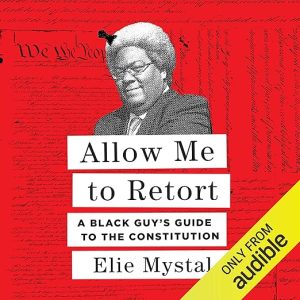
Elie Mystal's Allow Me to Retort is the audiobook equivalent of a great long-form legal argument delivered in the idiom of public advocacy rather than academic jurisprudence. Mystal, MSNBC legal commentator and justice correspondent at The Nation, opens this audiobook in his own voice with a position that is not easy to misunderstand: Republicans are wrong about the law almost all of the time, the Constitution as currently interpreted is inadequate to protect the rights of women and people of color, and these facts need to be stated plainly rather than dressed in the careful hedging that legal discourse normally requires. At nine hours of Mystal narrating his own work, the audiobook delivers exactly what that framing promises, and it delivers it with the rhetorical skill of someone who has spent years making these arguments in front of television audiences that can change the channel instantly if they are bored or lost.
The legal argument Mystal constructs covers several distinct areas in sequence: substantive due process, the constitutional rights of LGBTQ+ citizens, police brutality and qualified immunity, political gerrymandering, and the specific interpretive framework of originalism that conservative justices use to anchor contemporary constitutional questions to the expressed or inferred intentions of eighteenth-century men, a disproportionate number of whom held enslaved people. Each section is introduced with enough foundational explanation that listeners without legal backgrounds can follow the argument's structure and stakes, then developed with the confidence of someone who has been making these cases in public forums long enough to know which objections will arise and how to preempt them.
The blurb from Michael Harriot at The Root, cited in the book's promotional material, captures something real about the experience of listening to Mystal explain complex legal concepts: after this audiobook, you genuinely want him to explain everything you have not yet fully understood, because the combination of genuine expertise and rhetorical clarity is so rare that encountering it is its own kind of pleasure.
Why It Works in Audio
Mystal narrating his own work is not incidental to the experience - it is the experience. The prose was clearly written to be read aloud, with the rhythms and rhetorical escalations of public speaking rather than the denser, more static architecture of academic legal writing. When he explains concepts like substantive due process or the infield fly rule of constitutional law, he uses the same techniques he employs on television: start with the human consequence, establish the legal mechanism, then demonstrate how the conservative interpretation produces outcomes that are either absurd or actively cruel. The audiobook format, with Mystal's own delivery giving each argument its intended weight and timing, is significantly more effective than the printed version would be for listeners whose primary introduction to this material the audiobook represents.
The self-narration also means the humor lands precisely as Mystal intended it. The book is specifically and deliberately funny in places, and that humor is calibrated to cut through the frustration that accumulates when you spend nine hours documenting legal frameworks that have consistently failed to protect the people most in need of legal protection. Mystal's voice carries the weight of genuine anger alongside the wit, and hearing both in the same sentence from the same person who wrote it is qualitatively different from reading those qualities off a page. It also means you understand immediately when irony is operating and when the argument has shifted from critique to prescription.
The sections on the Founding Fathers draw particular attention from reviewers who note that Mystal has no patience for the reverence usually extended to these figures in popular constitutional discourse. His analysis of how the Constitution's specific provisions were shaped by the economic and political interests of slaveholders and landed gentry is historically grounded rather than rhetorically motivated alone, which gives his critique staying power beyond its provocation value. The facts he marshals are not disputed; the conclusions he draws from them are simply more direct than constitutional commentary usually permits itself to be.
Weak Spots in Allow Me to Retort
The political position is explicit and does not change or soften across nine hours. Listeners looking for a balanced treatment of constitutional interpretation, one that presents originalist and living-constitutionalist perspectives with equal sympathy, will not find it here. The audiobook is not trying to provide such balance, and Mystal's argument is that the pretense of balance itself serves a conservative ideological function in constitutional law. If that framing is unpersuasive from the first chapter, the audiobook will not convert you across the runtime. Reviewers who came in skeptical have noted that the substantive legal content is solid regardless of political agreement with the conclusions, but the rhetorical packaging is not separable from the information delivery in the way a more neutral legal primer would allow.
The amendments sections are particularly noted for Mystal's evident comfort with specific constitutional text. He knows these documents in genuine depth, and the audiobook works through them with a specificity that goes beyond political commentary into something more like constitutional literacy education delivered from a specific and clearly stated perspective. For listeners who have always felt uncertain about what the Constitution actually says versus what they have been told it says, these sections offer real learning value.
Who Will Get the Most From It
Listeners who want to understand American Constitutional law from a perspective that prioritizes the rights of those historically excluded from its protections will find this audiobook essential and consistently engaging. People who follow Mystal on MSNBC and want his arguments in extended form rather than in television's segment format will get exactly that, with the depth and continuity of argument that broadcast time constraints prevent. Listeners interested in legal history who are tired of originalist frameworks will find a rigorously argued and clearly stated alternative. Skip this audiobook if you require jurisprudential neutrality or find explicitly partisan legal argument counterproductive regardless of the direction. Mystal is clear that he finds the concept of neutrality itself a political position, and every chapter of the audiobook reflects that conviction fully and without apology.
At a Glance
- Read by: Elie Mystal narrating his own work is essential to the audiobook's impact - his MSNBC-honed delivery turns constitutional law into an experience that is simultaneously infuriating and energizing, depending on where you sit.
- At its heart: Constitutional originalism versus living interpretation, racial justice and the law, progressive legal strategy
- Vibe: Sharp and polemical, with enough humor to cut through the accumulated frustration
- Short version: Allow Me to Retort works best as a politically engaged legal education for listeners who want to understand their constitutional rights from someone who has no patience for the pretense of jurisprudential neutrality.
Does the Allow Me to Retort audiobook require a background in constitutional law to follow?
No. Mystal is specifically working to make constitutional concepts accessible to non-lawyers, and the audiobook builds its legal vocabulary from the ground up. His television background means he knows exactly how to pace explanations for general audiences without oversimplifying the substance.
How does Elie Mystal's narration compare to professional audiobook narrators in terms of production quality?
The production is clean and professional throughout. Mystal's television background means he is accustomed to controlled audio delivery, and there is none of the uneven pacing or diction issues that sometimes affect author-narrated audiobooks. His voice carries the material with confidence across nine hours.
Does the Allow Me to Retort audiobook address recent Supreme Court decisions or does the content feel dated?
The book addresses constitutional frameworks and jurisprudential philosophies rather than specific cases in a news-cycle way, which gives it staying power beyond its publication date. The conceptual arguments remain applicable to Court decisions made after the recording, including the most significant recent rulings.