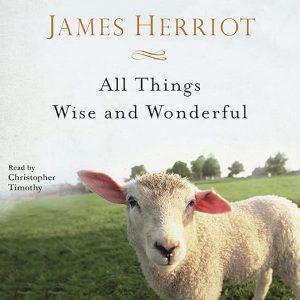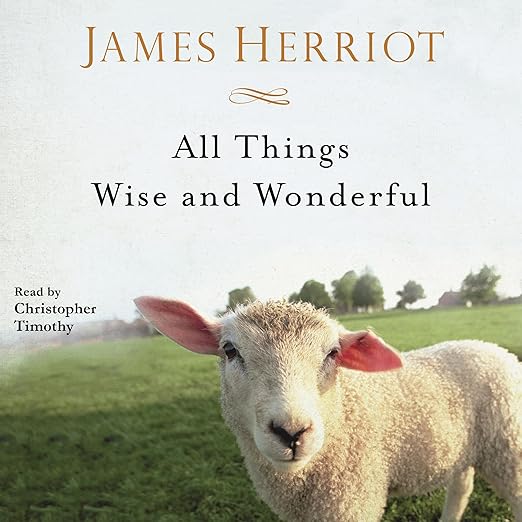
Royal Air Force training is not the setting most people picture when they reach for a Yorkshire vet, and it takes up a good share of this fifteen-hour audiobook. All Things Wise and Wonderful is the third volume of James Herriot's memoirs, written from inside the Second World War: he is in RAF training, getting back to Yorkshire and to his very pregnant wife Helen whenever leave allows, and filling the gaps between with everything the practice taught him before the call-up. Christopher Timothy reads the Macmillan Audio edition.
RAF Service Frames Dales Memories
The structure is the thing worth understanding before buying. Herriot uses wartime service as a frame and hangs the actual book inside it, musing on past rounds through the dales, revisiting old friends, and introducing a fresh supply of clients and animals from memory rather than from the present tense. It is a memoir told in flashback by a man with time on his hands and reason to be homesick, and that circumstance colors everything the practice material does.
Funny and Heartbreaking, Engineered to Land
One September 2025 response puts the appeal in eight words: 'Funny and heartbreaking at the same time.' That reviewer, who came in already knowing All Creatures Great and Small, treats this volume as a continuation rather than a departure, which is right. Herriot's method never changes across the sequence. A case begins as farce, turns without warning into something that costs somebody real money or real grief, and resolves without anyone making a speech about it.
What holds up is the attention to people. Herriot notices how a farmer stands in a doorway, how a client talks about an animal they cannot afford to keep, how the pretense of professional authority survives a night in a freezing byre. The description promises a heartfelt yarn, which undersells the discipline involved: the comedy is engineered tightly enough that the sadness lands before you have braced for it. He is a quiet class observer too, working among people whose livelihood can turn on whether one animal recovers, and he never smooths that away for the sake of a warm ending.
Timothy's Casting and an Interruption-Friendly Structure
Casting is the reason to choose this edition specifically. Christopher Timothy played James Herriot in the long-running television adaptation the description alludes to, which means the credited reader spent years inhabiting the character before ever recording the prose. For anyone who came to these books through the screen, the voice arrives pre-attached. For everyone else, it is simply a reader with an unusually long relationship to the material, and casting of that kind is rare enough to count as a feature of the edition.
Loyalty runs deep in the responses, and the July 2020 one is representative: a reader who has worked through every book Herriot wrote, describing stories that are 'clean, wholesome' and a manner that will 'make you sad one moment and have you chuckling the next.' Wholesome is a loaded word these days, but it is precise here. Nothing in Herriot is coy about death or money, and nothing is cruel either.
Episodic construction makes this an unusually forgiving listen. Chapters close, cases end, and a listener who loses ten minutes to a distraction has lost one anecdote rather than a plot thread. Fifteen hours arrives in small, self-contained portions, which suits kitchen listening, gardening, dog-walking, and anything else that comes with interruptions built in. Very little long-form nonfiction survives that treatment as gracefully. It also makes the book a dependable choice for someone who is ill, grieving, or simply out of patience with plot, since nothing here asks a listener to carry anything in memory between sessions.
More RAF Ground, Fewer Vet Scenes
Donna Hill's four-star response names the volume's one real structural cost. Herriot has to 'cover more ground' here, flitting back and forth between the RAF and the countryside, and that reviewer counts more people stories in this book than in the others. Anyone arriving specifically for calvings, colic, and difficult farm dogs should know the ratio has shifted. The first solo flight, singled out in that same response as a highlight, is not a veterinary scene at all.
Shelving on this listing is genuinely strange. A wartime veterinary memoir sits under home and garden, science and engineering, and sports and outdoors, tagged for pets and animal care, with no memoir or biography category anywhere in sight. The consequence is a discovery problem rather than a quality one: listeners browsing memoir will not meet this book, and listeners browsing outdoor sports will meet it by mistake.
Volume order is left entirely to the buyer. The page carries no series numbering, though the description names both predecessors in its opening line, so nothing stops someone from starting with the third installment. It works as a standalone because the episodes are self-contained, but the marriage, the practice, and the partners who make the running jokes function all arrive already established, and the war frame assumes you know what normal looked like.
Animal Keepers and Wartime Readers Belong Here
Warmth without saccharine is the draw here, which makes the natural audience anyone who keeps animals and understands the economics of a sick one. The book also rewards readers of domestic wartime writing, since the RAF sections capture a specific kind of suspended life: trained, waiting, homesick, and surrounded by strangers. Herriot is a first-rate observer of institutional absurdity, and the service chapters give him fresh material for it. Anyone who has sat up overnight with a sick animal will recognize the particular tiredness he writes from, and anyone who has not will still recognize the jokes about incompetent authority.
Long-standing devotion is what the page mostly records. A five-star response from September 2025, filed under an email address rather than a display name, describes coming to Herriot late, laughing out loud at his earliest fumbling cases, and enjoying the act of passing the stories along. Multiple responses arrived within three weeks of each other that month, decades after publication, which says something about how this material keeps recruiting.
Front-line war memoir is the wrong expectation to bring, and so is modern production polish, since this recording dates from January 2001. Listeners who bounce off gentle, incident-driven storytelling will find fifteen hours of exactly that, with no larger arc arriving to rescue them halfway. Start with the first volume if you have never met Herriot at all, because this one works far better as a third helping than as an introduction.
- Voice: Christopher Timothy, who played Herriot on television, holds the reading credit, so the casting doubles as continuity with the screen version.
- Big ideas: Wartime service and homesickness, veterinary practice in the dales, marriage and impending fatherhood, comedy braided with grief.
- Atmosphere: Warm, episodic, quietly bruising.
- Worth it?: The third helping of Herriot and best taken in order, ideal for listeners who want comfort without sugar.
A Few Questions About All Things Wise and Wonderful
How much of the audiobook is actually about the war?
The RAF material frames the book rather than filling it. Herriot is in training throughout, with leave taking him back to Yorkshire, but the bulk of the content is recollection of practice life from before the call-up. Expect service scenes at the joins and veterinary anecdote in between, with the emphasis firmly on training, homesickness, and waiting rather than on the fighting itself.
Is this audiobook connected to the television adaptation?
Closely, in one specific way. The description gestures at the screen drama these books inspired, and Christopher Timothy, credited here as reader, played the vet himself in that long-running television version. The text is unaltered memoir, so the link lives in the casting rather than in any tie-in material or added content.