Before You Press Play
- Performance: Johaira Michelle Dilauro reads her own guide, so the nurse describing the season and the voice delivering it are one person.
- What it covers: Physical recovery, shifting identity, calming the nervous system, refusing the bounce-back script
- Feel: Warm, unhurried, practical
- Our call: The right voice for the season, though the written exercises at its center still need a paper copy.
Postpartum guides tend to arrive either as clinical checklists or as inspirational posters, and this audiobook is trying hard to be neither. Johaira Dilauro is a postpartum nurse and, by the description's own account, somebody who has been through the season herself, and she reads her own book across five and three-quarter hours. Romero Dilauro Publishing released the recording on October 14, 2025. The promise is restoration rather than a bounce back, and the copy is explicit about refusing that second phrase.
Five Reviews Predate Dilauro's Own Narration
Johaira Dilauro's register is why the book works, and it is the quality the responses keep returning to. Writing on May 22, 2025 at the top grade, one buyer describes a book that reads like a comforting conversation with a trusted friend who genuinely understands, delivering insight with warmth, clarity and compassion from the first chapter onward. That same account credits the material for covering physical, emotional and mental recovery honestly, without flinching away from the hard truths.
Not one of the five reviews on this page was written after the recording existed. They carry dates between May 21 and August 7, 2025, and the audio edition went out on October 14 of the same year. The 4.8 average across fifty-six ratings is therefore a verdict on a book, delivered by people holding one. That takes nothing away from the praise. It does mean none of the praise is about this edition.
Warmth of this kind is difficult to fake and easy to overdo, and the risk with a self-read wellness title is that encouragement flattens into affirmation. The copy hedges against that by naming specifics: sleepless nights, shifting identity, the pressure to bounce back, a nervous system in need of calming. Concrete problems keep a comforting voice honest, and this description is unusually willing to name the unglamorous ones out loud.
Even a Pediatrician Gives This Five Stars
Evidence-based tools is a phrase the copy uses, and for once a credential stands behind it. Writing the day before, on May 21, somebody identifying as a pediatrician gives it five stars and calls the guide well researched and experience-informed, saying that having it at the start of that career would have made them considerably more useful to new and experienced mothers alike. Professional endorsements in this category are usually far vaguer.
Nursing experience is the other half of the authority, and it changes what the book is able to say. A clinician who has also lived the recovery can describe what a bad night actually looks like rather than what the literature reports about sleep, and the description leans hard on that dual position: gentle tools for physical recovery and emotional restoration from a postpartum nurse who has been there herself. The doubling is the whole selling point.
Hours matter more than usual for this particular audience. Under six hours is brief for a guide covering physical recovery, emotional restoration and relationships, and brief is the correct answer here, because the intended listener has fragments of attention and no reliable stretch of time. A book that fits into a week of feeds is a book that will actually get finished, which few parenting titles manage.
Journal Prompts That Don't Survive to Audio
Journal prompts are the format problem, and the listing does not warn you about it anywhere. The description promises guided reflections and journal prompts for quiet in-between moments, and a June 2025 review at the same grade goes further, praising end-of-chapter questions and notes the reader fills in with their own thoughts and experiences. None of that survives the move to audio, and no companion document is mentioned on the page.
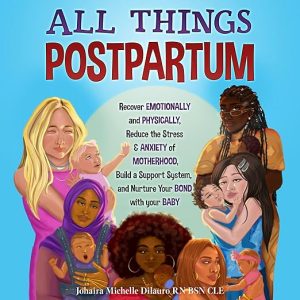
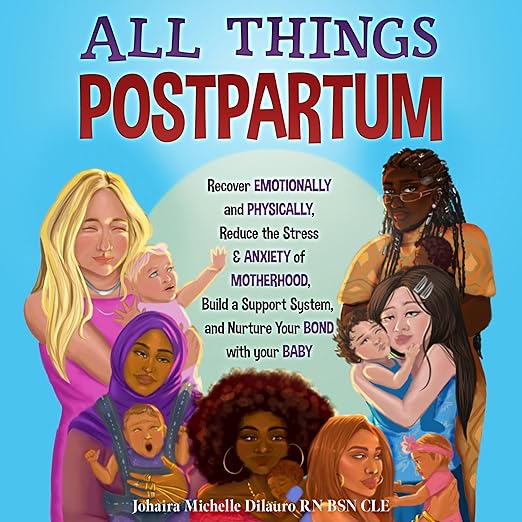
Covers do not read aloud either. The August 2025 review opens by saying the artwork drew its writer in immediately, calling it visually captivating and a beautiful introduction to the message inside, from somebody who bought the book before motherhood rather than during it. That is a genuine response to a physical object and entirely unavailable to a listener. It is also the clearest single sign of where these ratings came from.
Naming conventions are inconsistent enough here to cost you a search. The byline reads Johaira Dilauro, the reading credit reads Johaira Michelle Dilauro, one response writes the surname with a capital L in the middle, and another splits the title into three words rather than two. Add a publisher line carrying the same surname and one book has four written forms attached to it. Match your purchase against the reading credit, which is the fullest.
New Mothers First, Partners a Close Second
New mothers in the first months are the obvious audience and the one the book was built around. A July 2025 review at five stars describes it covering everything from the emotional rollercoaster to the physical recovery to the things nobody mentions out loud, and credits the author for writing like a friend who has been there rather than a doctor handing over a checklist. That is an accurate description of the tone throughout.
Partners and family members are the second audience, and nothing in the material locks them out. It is written to be understood by somebody who is not currently living it, which makes it usable for whoever is handling the night shifts, the meals and the worrying from one step away. Short, plainly written and free of clinical gatekeeping, it has considerably more uses than the shelf label suggests.
Hold off if you want a medical reference, because what is promised here is lived guidance with research behind it rather than a clinical manual. Hold off equally if you need the written exercises, and if you buy the recording anyway, buy a paper copy alongside it. The audio is for the voice and the reassurance. The pages are for the work the book keeps asking you to do.
How is this audiobook classified, and is that the right shelf?
The listing puts it under health and wellness with a Sexual and Reproductive Health tag. That tag is technically defensible and practically misleading, since most of the material concerns identity, sleep, emotional recovery and relationships rather than reproductive medicine. Anyone browsing parenting or self-help categories is unlikely to come across it at all.
What is the running time of the audiobook, and is it chaptered?
Five hours and forty-six minutes. No chapter list appears on the page, though the promise of guided reflections implies a chaptered rather than continuous structure. That running time is deliberately modest for its audience: a book designed to be completed in fragments by somebody with no uninterrupted hours to spare.
Who published it, and does that matter?
Romero Dilauro Publishing, an imprint carrying the author's own surname, released it on October 14, 2025. That makes this an independent production from writing through to reading, which is common in the category and worth knowing: every decision about the recording, including who made it, sat with the same household.