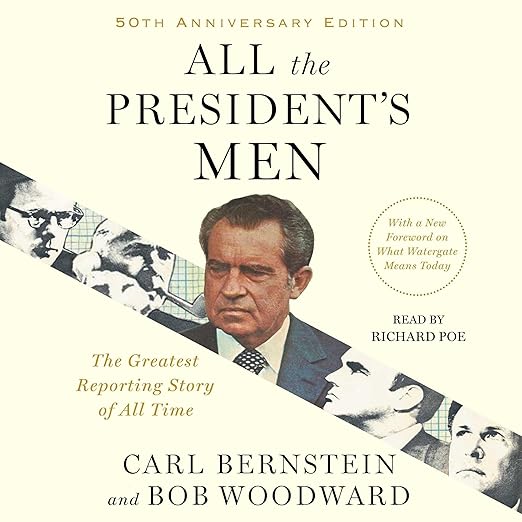
Woodward and Bernstein's All the President's Men arrives in this 50th anniversary audiobook edition with a new foreword addressing what Watergate means today, and that framing update is necessary in ways that were probably not anticipated when the publisher first scheduled it. The book has been a touchstone of American political journalism since its first publication in 1974, and each generation of readers brings different contexts to it. This audiobook edition, narrated by Richard Poe, offers the complete account of the reporting that preceded Nixon's resignation with the added perspective of five decades of retrospect in Woodward's new foreword.
First, the Big Picture
What makes this book still worth reading, or in this case listening to, fifty years after the events it describes is precisely what reviewer DWillis identifies: it succeeds on two distinct levels simultaneously. The first is a detailed and methodical account of investigative journalism practice, the source cultivation, document verification, editorial judgment calls, and institutional pressure that characterize serious investigative reporting at its most demanding. The second is a political detective story in which the full scope of the Watergate scandal is assembled piece by piece from a starting point that seemed, as Woodward and Bernstein's editors apparently also believed, like a relatively minor political burglary.
Reviewer Esther Schindler's observation that the book initially felt slow, even on a first read in the 1970s, because it lacks the AHA NOW WE KNOW moments of traditional crime narrative is worth preparing for. The book is built on the accumulation of information rather than on revelation, and the journalists' process is necessarily methodical, sometimes frustrating, and only retrospectively dramatic. What felt like procedural tedium to a reader in 1974 who did not yet know how the story ended reads differently now, when the endpoint is known and the investigative trail can be followed with the satisfaction of knowing where it leads. The 50th anniversary context makes this retrospective clarity part of the experience.
Richard Poe's narration suits the material in ways that a more emotionally demonstrative performance would not. The book is written in a style that is remarkably restrained for journalism of such historical consequence: Woodward and Bernstein stay close to reported fact and avoid the interpretive editorializing that their subject clearly invited. Poe matches this register. His delivery is steady, measured, and authoritative without being flat, creating an audiobook experience that rewards the sustained attention the procedural content requires. At nearly thirteen hours, this is a commitment, but the runtime reflects the actual complexity of the investigation rather than padding.
Deep Throat, introduced here for the first time as a character in the public record, is one of the most discussed figures in American journalism history, and hearing this audiobook means encountering the original source of that mythology rather than its many subsequent cultural retellings. The mystery of Deep Throat's identity was not resolved publicly until 2005, more than thirty years after this book was published, and the audiobook preserves the figure exactly as Woodward and Bernstein presented him: a source, not yet a legend. For listeners who know the resolution but not the original text, the restoration of uncertainty is interesting in its own right.
Things to Know Before Starting All the President's Men
The new foreword from Woodward on what Watergate means today is worth particular attention. Woodward has spent fifty years watching the story he helped break become a cultural reference point, a historical benchmark, a legal standard, and a political argument, and his perspective on how the meaning of Watergate has evolved is informed by a position that no other living person quite occupies. The foreword is brief relative to the full text, but listeners interested in the contemporary resonance of the events should not skip it.
Listeners who come to this audiobook primarily interested in the historical events rather than the journalism process itself may find the procedural detail more granular than they expected. The book is essentially a journalist's account of how journalism works under conditions of maximum institutional pressure, and the granularity of that account is inseparable from its value as a document. Reviewer DWillis's description of the exhausting thoroughness of the investigation as one of the book's virtues is accurate, but it does mean that listeners looking for a fast-moving narrative will need to adjust their pace expectations. The story moved slowly in real time, and the book honors that slowness.
Is This One for You?
Anyone with a serious interest in American political history, journalism, or the relationship between investigative reporting and institutional accountability will find this audiobook essential. It belongs in the same category as other primary-source accounts that illuminate not just what happened but how it was discovered and documented. For working journalists and journalism students, it remains a foundational text precisely because the practices it describes, source cultivation, verification, managing institutional pushback, have not fundamentally changed even as the media environment around them has transformed beyond recognition.
Casual listeners who want an accessible narrative account of Watergate without the procedural depth of Woodward and Bernstein's reporting record may find the book denser than expected. The film adaptation with Robert Redford and Dustin Hoffman compresses and dramatizes the story in ways that make it more conventionally exciting; the audiobook is considerably more faithful to the way investigative journalism actually unfolds. Those who have seen the film and want to understand what the reporting actually involved will find the audiobook an illuminating expansion. Those who want the excitement of the film in audio form are looking for something different from what this book provides.