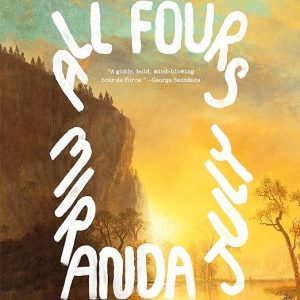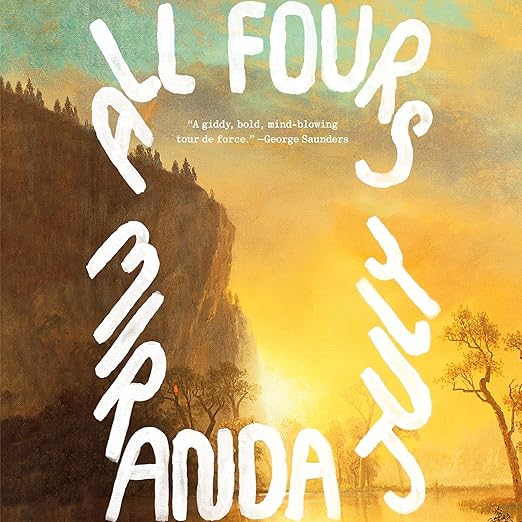
I should tell you upfront that I finished All Fours sometime after midnight on a night I hadn't planned to still be awake. I also didn't entirely like it while I was listening. Miranda July's second novel is the kind of book, and the kind of audiobook experience, that operates through discomfort, that refuses to give you a protagonist you can settle comfortably next to, that keeps pulling the rug out from under the expected emotion. By the end, I was doing what one reviewer described as starting to beg every woman I know to read it. That's not a paradox. It's the experience July has engineered.
The premise is clean enough. A semi-famous artist plans to drive cross-country from Los Angeles to New York. Thirty minutes after leaving her husband and child behind, she impulsively exits the freeway, checks into a nondescript motel, and begins an entirely different journey. What follows involves a fixation on a young man at a car rental counter, an increasingly elaborate and strange relationship that doesn't proceed in any direction you would predict, and a confrontation with perimenopause that is rendered in physical and psychological detail most literary fiction carefully avoids. The New York Times called it a frank novel about a midlife awakening. The Cut described being possessed by it. A Vogue writer described it as riveting. A 56-year-old reviewer who had lived through menopause called it a deep miss. All of these responses are true at the same time, which is part of July's achievement.
First, the Big Picture
The protagonist is a semi-famous artist, never named, whose interiority July renders with a kind of anthropological attention that refuses both flattery and condemnation. The woman is selfish in ways that are recognizable, curious in ways that are genuinely strange, and capable of both acts of real love and acts of bewildering self-absorption. One reviewer described the character as having the potential to be important and unforgettable, to be loving and messy and sexy and fantastic, and then charged that something went wrong, landing the character as immature and unhinged. I think this reading misidentifies the design as a failure. July is not offering a guide to midlife awakening but an extremely honest account of one, including its unbecoming parts.
The novel's relationship to perimenopause is one of its most genuinely original contributions to literary fiction. July treats it not as background medical context but as a central destabilizing event, the body announcing a transition that the culture has no adequate language for, and the mind scrambling to catch up with desires it hasn't examined in years. For female readers who have been through or are approaching this experience, the book has reportedly functioned as something close to a revelation. The whisper network the New York Times documented around this novel reflects that real utility.
The Best Parts of All Fours
Miranda July narrating her own novel is not optional, it's the optimal format for this material. Her reading is composed of deadpan precision and controlled peculiarity, qualities that exactly match what her prose is doing sentence by sentence. July writes with a kind of flat comedy that depends on the gap between the gravity of what is being described and the tone in which it's being delivered, and her own narration controls that gap perfectly. Another narrator would likely either over-perform the strangeness or normalize it; July holds the line exactly where the novel lives.
The format also suits the digressive, associative structure of the book, which moves between the motel, flashbacks, fantasy sequences, and the protagonist's obsessive cataloging of her own emotional states. July's narrating voice maintains a consistency that helps orient the listener when the narrative itself is deliberately disorienting. At just over ten hours, it's long enough to build genuine immersion without overstaying its welcome.
The Caveats
This book is polarizing, and the polarization is built in rather than incidental. The protagonist is designed to resist sympathetic identification, or rather, to make identification uncomfortable, to make the reader aware of their own discomfort with a female character who is allowed to be as messy and transgressive as male literary protagonists routinely are. One reviewer described the reading experience as like wearing an ill-fitting sweater, itchy and uncomfortable, something you want to take off but can't stop wearing. That is a remarkably precise description of what July is going for, and whether you find it illuminating or exhausting will determine whether this book works for you.
The explicit content, sexual and bodily, is present and purposeful rather than gratuitous, but it's not minimal. Readers who are uncomfortable with frank depictions of female sexuality and midlife physical experience should know what they're signing up for. The book's critical acclaim is genuine and well-earned, but it is not universally accessible, and the low average Audible rating relative to its literary reception reflects the fact that literary and popular audiences are sometimes looking for different things from the same book.
Who Should Listen to All Fours
This audiobook is for readers and listeners who want literary fiction that takes female midlife experience seriously enough to render it in all its uncomfortable specificity. If you are interested in Miranda July's earlier work, her first novel, her films, her short stories, this is a logical and rewarding continuation of her particular set of preoccupations. It's also the kind of book that generates excellent conversation, which the book club mentions in multiple reviews confirm. If you want a protagonist who earns your sympathy cleanly, or a narrative that resolves tidily, this is the wrong book. If you want a novel that will stay with you and make you think, probably about things you weren't expecting to think about, this is exactly right.
- Narration: Miranda July reading her own novel is the correct and only tolerable version of this book, her deadpan precision is inseparable from what the prose is doing.
- Themes: Midlife desire and disruption, the cost of domesticity for a female artist, perimenopause and bodily autonomy, obsession as self-discovery
- Mood: Uncomfortable, funny, and deliberately abrasive, one of those books designed to stay in your craw
- Verdict: Divisive by design, with a protagonist built to resist easy sympathy, but more honest about female midlife experience than almost anything else published in 2024.
Is All Fours based on Miranda July's actual life? How autobiographical is the narrator's experience?
July has described the protagonist as semi-autobiographical and deliberately blurred, the character is a semi-famous artist with a similar public profile to July's own, and some of the perimenopause experience and emotional territory comes from her own life. But the novel is fiction, and July has been careful not to position it as memoir. The semi-autobiographical framing is part of what makes the novel's self-critical passages interesting, you can't fully separate the author from the narrator, and July seems to want that ambiguity.
The Audible rating is notably lower than the critical reception suggests. What accounts for that gap?
All Fours was named a top ten book of the year by the New York Times and appeared on numerous best-of-2024 lists. The lower Audible rating reflects a genuine mismatch between literary ambition and popular expectation. The protagonist is deliberately difficult to like, the narrative refuses conventional satisfactions, and the explicit and strange content alienates listeners who came expecting something more accessible. This is a book that generates strong responses in both directions, and the rating reflects that range rather than a failure of the work itself.
Does the perimenopause content in All Fours require personal experience of it to find meaningful?
No, though readers who have been through perimenopause report finding the book particularly resonant and, for some, genuinely validating of experiences they had found invisible in literature. Readers who haven't reached that life stage have found the book meaningful as a broader portrait of how midlife transitions, bodily, domestic, creative, disrupt identity in ways that culture rarely acknowledges. The perimenopause content is central but not exclusionary.