
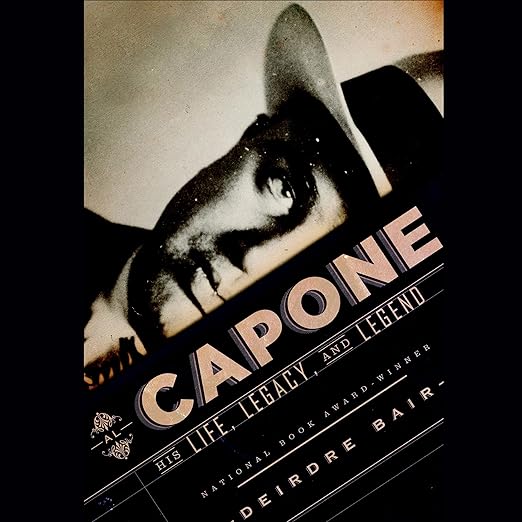
Before You Press Play
- Performance: Rob Shapiro handles Deirdre Bair's dense, research-heavy prose with the gravity and control it requires, keeping a 16-hour biography from becoming a recitation of sources.
- What it covers: The mythology versus the man, organized crime and American capitalism, family loyalty in extremis
- Feel: Rigorous and intimate, with the texture of biography written close to living memory
- Our call: The most authoritative Capone biography produced with family cooperation, and one of the more serious audio biography experiences available for listeners who want depth over dramatization.
Deirdre Bair's approach to biography is built on a specific belief: that the subjects most protected by myth deserve the most rigorous examination of who they actually were. Her work on Samuel Beckett, Simone de Beauvoir, and Carl Jung all involved subjects whose public images had calcified into legend during their lifetimes. Al Capone presents the same challenge at higher volume. The audiobook version of her National Book Award-winning author's first family-cooperated Capone biography makes for 16 hours of genuinely serious historical engagement with a figure who has been mythologized so thoroughly that the real person beneath has nearly disappeared.
What Bair obtained that no previous biographer had is the cooperation of Capone's descendants. Exclusive access to personal testimony and archival documents that had been held privately for decades. This changes what the book can do and what it actually does: rather than building another account of the Chicago bootlegging empire from newspaper archives and FBI files, Bair can move between the documented public criminal and the remembered private man, and the tension between those two portraits is where the biography's most interesting work happens.
Sagaciously Seductive, One Reviewer Lost Sleep
The historical sweep is substantial. From Brooklyn roots through the Chicago operation at the height of Prohibition, the multimillion-dollar bootlegging and gambling empire, the competition with rival gangs that crested in the St. Valentine's Day Massacre of 1929, the media-enabled celebrity that made law enforcement's task simultaneously more and less possible, the FBI's eventual legal strategy built around tax evasion rather than direct criminal charges, Alcatraz, and the quiet Miami years as neurosyphilis progressed: Bair covers each phase with the thoroughness of a biographer doing archival work rather than relying on secondary literature. The coverage is primary-source-driven in a way that has real consequences for the shape of the narrative.
Reviewer Theodor Itten described the writing as "sagaciously seductive" and predicted nights without sleep over Bair's treatment of Capone's complexity. That response makes sense for a biography that refuses to let either the monster or the family man be the complete story. Bair is most interested in the figure who was simultaneously both, and she gives both dimensions full documentation. The private Capone, a genuine family man remembered with affection by his descendants, is not a rehabilitation of his crimes. It is an insistence that simple myths, whether of pure villainy or of glamorized gangster heroism, are historically inadequate.
Shapiro Tracks the Shift From Archival to Personal
Rob Shapiro brings the weight of Bair's prose to life without dramatizing it, which is the correct choice for this material. Bair writes biography not as crime narrative but as historical analysis with a biographical subject at its center, and Shapiro's measured delivery honors that register. At 16 hours the audiobook demands a narrator who can sustain authority across long stretches of research-dense material without losing the listener's attention, and Shapiro manages it through consistent tonal control rather than performance.
The passages dealing with family testimony carry a different emotional temperature than the historical reconstruction sections, and those distinctions come through in the narration. When Bair is working from archival documents, the prose has one density. When she's working from the memories of people who knew Capone personally, it has another texture entirely. Shapiro tracks these shifts without overstating them, which is the right calibration for material this serious.
A Pragmatic Institutional Adaptation, Bair Calls It
The family cooperation that makes this book possible is also a frame worth holding consciously as you listen. Bair is rigorous enough to debunk Capone's own tall tales and the more outrageous newspaper mythology with specificity, and she does that with evident scholarly care. But the access came through descendants who remembered a patriarch with affection. Bair's handling of this tension, between the documented violence and the private humanity, is one of the book's most interesting intellectual achievements, and it rewards active attention rather than passive listening.
The section covering the St. Valentine's Day Massacre and its aftermath is among the strongest in the audiobook. Bair traces how law enforcement and the media elite failed to contain Capone's operation through a combination of institutional corruption, celebrity fascination, and legal structures inadequate to the specific form of organized crime he represented. The tax evasion conviction that finally worked is handled with appropriate complexity. It was a legal compromise that closed the chapter not by meeting Capone on his own terrain but by finding a different terrain where the law had better traction. Bair doesn't present this as triumph so much as pragmatic institutional adaptation.
Reviewer Ellen Hayden accurately noted that the book is very thoroughly researched, sometimes at the expense of narrative pace. That observation is fair. Bair is a biographer who believes in primary documentation and shows her work, which means certain sections accumulate evidence more than they propel narrative. Listeners who prefer the streamlined crime biography format will find some sections denser than they'd choose. For listeners who value a biographer doing the archival work properly, those same sections are exactly what makes this account authoritative.
Best Absorbed in Longer Listening Sessions
Listeners interested in American criminal history who want substance over spectacle will find Bair's approach deeply satisfying. Biography readers who appreciate a writer using primary sources and resisting the pull of mythmaking will find this the most serious treatment Capone has received. Those who come expecting the glamorized gangster of the movies will be surprised by the intimacy of the family portrait and the rigor of the historical methodology. The audiobook is best consumed in longer sessions that allow the accumulation of evidence to build its effect properly rather than in short bursts that lose the thread of Bair's argument.
Skip it if you're looking for fast-paced crime narrative with the Prohibition-era atmosphere romanticized. Bair is not interested in that story. She's interested in who Capone actually was, and at 16 hours she takes the space the subject deserves.
Does this audiobook rely primarily on the family interviews, or does it cover the historical criminal record in full?
Bair covers the complete arc of Capone's life with equal rigor, from the Brooklyn origins through the Chicago empire, the St. Valentine's Day Massacre, the FBI investigation, Alcatraz, and the Miami years. The family access adds the private portrait that was previously unavailable, but it's layered into a thoroughly documented historical account rather than replacing it.
How does this audiobook compare to other Capone biographies in terms of approach and new material?
Bair's explicit goal is the first complete Capone biography produced with family cooperation, which provided exclusive access to personal testimony and archival documents no previous biographer had obtained. The main differentiator is the private portrait of Capone as remembered by his descendants, alongside systematic debunking of the mythology perpetuated by Capone himself and by unscrupulous newspaper accounts.







