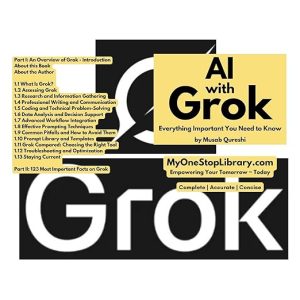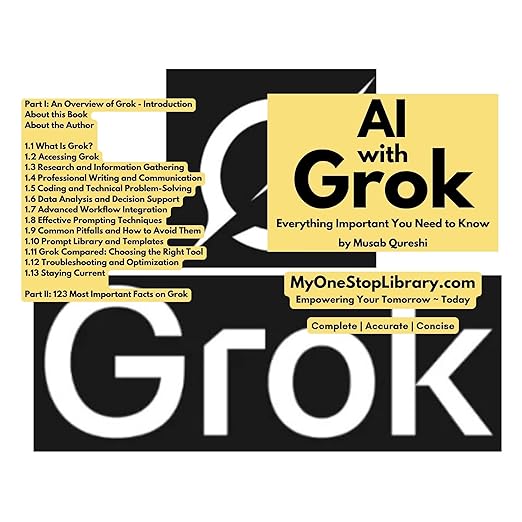
A table of contents pasted into a description field is its own kind of signal. Everything this record offers by way of a summary is a numbered list: 1.1 What Is Grok, 1.2 Accessing Grok, then research, professional writing, coding, data analysis, workflow integration, prompting technique, common pitfalls, a prompt library, a comparison against rival tools, troubleshooting, and finally 1.13 Staying Current. Part II is announced as 123 Most Important Facts on Grok. Musab Qureshi's audiobook runs three hours and twenty-four minutes, published independently in March 2026, and the contents list turns out to be the most informative thing on the page.
Reference Material Read Aloud Is Least Usable
Judge that outline on its merits and it is a competent syllabus for a working professional. Chapters on research, writing, coding, and data analysis map onto what people genuinely use a chatbot for, and putting prompting technique after the use cases rather than before them is the correct order, since prompting only makes sense once you know what you are trying to get. A section on common pitfalls and how to avoid them suggests somebody has watched real users fail rather than simply listing features. Guides to this category divide into two kinds. One kind explains the technology and leaves you no better at using it; the other treats the assistant as an instrument and teaches technique. This outline belongs to the second kind, and the ordering of its chapters is the evidence.
Then comes the format problem, and it is substantial. Section 1.10 promises a prompt library and templates. Templates exist to be copied, edited, and pasted, and none of that is possible from an audio file without pausing, rewinding, and transcribing by hand. The same holds for Part II, which delivers 123 facts as a spoken sequence: a numbered list is a reference structure, and reference material read aloud is the least usable form it can take. Some of this book wants to be a document you keep open in another window.
Section 1.11 Earns Its Three Hours
Orientation is where three hours and twenty-four minutes pays for itself. Plenty of people have opened Grok, typed something, received an answer, and never worked out what else it does, and a structured pass through research gathering, professional communication, technical problem solving, and decision support fixes that gap efficiently. Passive listening suits conceptual material, and the first half is conceptual. What can this tool do, where does it fit, when should you reach for a different one.
Section 1.11 is the one I would keep. Choosing the right tool, framed as an explicit comparison, is the question most guides avoid because vendors dislike the answer and enthusiasts think theirs is obvious. A chapter that says plainly where this assistant is stronger and where something else does the job better is worth more than any prompt list, and it is precisely the kind of judgment that survives being heard once rather than needing to be looked up twice.
Volume Seventy-Three and an Odd Numbering Scheme
Software reading a book about software is at least thematically consistent: this file was produced by Virtual Voice, so the audio is generated rather than performed. For a technical guide the practical question is pronunciation. Product names, command syntax, interface labels, and anything written in code get mangled by synthetic readers with some regularity, and a listener who does not already recognize a term will not always be able to reconstruct it from the sound. Sample a section from Part I where the terminology is thickest.
Currency is the harder issue. This covers a commercial AI product that ships changes constantly, yet nothing in the description names a version, a model generation, or a cutoff date, and the recording was published in March 2026. Chapter 1.2, on accessing the tool, and chapter 1.12, on troubleshooting, are the first to expire when an interface changes. Chapter 1.13, titled Staying Current, is the most perishable of all, which is not the author's fault so much as an occupational hazard of the entire category.
Zero ratings and zero written responses have accumulated since publication, so no independent listener has yet vouched for the accuracy of any of it. The series field compounds the puzzle by naming MusabAtWork and numbering this volume 73, which implies either an enormous catalog of short guides or a numbering scheme that means something private to its author. Neither possibility is disqualifying. Both mean you should judge this on the sample and nothing else. An empty rating column on a recently published independent technical title is entirely normal and tells you nothing about accuracy in either direction, which is precisely why it cannot be treated as reassurance.
Curious Professionals Fit Better Than Developers
Start here if you are a curious professional rather than a developer. Somebody who uses an assistant occasionally, suspects they are using it badly, and wants a structured tour of what it does well will get real value from an afternoon of this. The same goes for anyone comparison shopping between assistants, since a chapter explicitly devoted to choosing between tools is unusual and useful. Managers evaluating whether a team should adopt one will also find the pitfalls material worth the time, since the failures described in that kind of chapter are the ones that get repeated across a whole department.
Look elsewhere if you write code against an API, if you need current interface detail rather than concepts, or if you want the prompt library that a chunk of this book consists of, because that material belongs in a text file rather than a pair of headphones. Buy the ebook for the templates, or use the recording for the thinking and accept that the reference half will need to be acquired another way. At three hours and twenty-four minutes, half a good book is still a defensible afternoon.
Good to Know
Does the machine narration matter for a technical audiobook?
More than usual. Nothing here was voiced by a person, since the file carries the Virtual Voice label, and technical guides are full of product names, command syntax, and interface labels that synthetic readers frequently mispronounce. Listeners already familiar with the vocabulary will cope. Newcomers may not recognize a term they have only ever heard spoken incorrectly.
Can I actually use the prompt library from an audiobook?
Not conveniently. Section 1.10 promises prompt templates, and templates need copying and editing rather than hearing. Expect to pause and transcribe, or to treat that portion as a preview of material you will obtain in text form. The same limitation applies to the 123-item fact list announced as Part II.
How current is the material likely to be?
Published in March 2026, covering a product that changes frequently, with no version or model generation named anywhere in the description. Conceptual chapters on prompting and workflow age slowly. Anything describing access, interface, or troubleshooting steps should be checked against the tool itself before you rely on it.