At a Glance
- Voice: Virtual Voice handles the conceptual vocabulary of enterprise AI governance clearly; the limitation is most noticeable where emphasis on key distinctions needs vocal weight.
- Big ideas: Organizational readiness for AI agents, governance and guardrails as leadership responsibilities, scaling from isolated pilots to enterprise intelligence
- Atmosphere: Methodical and strategic, suited to executive-level reflection rather than rapid tactical consumption
- Worth it?: A focused leadership orientation for executives navigating enterprise AI adoption, valuable for its organizational framing of a challenge most technology literature treats as primarily technical.
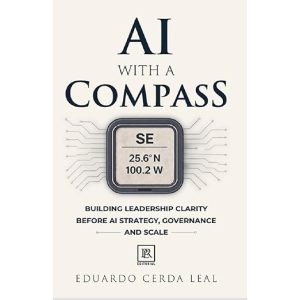
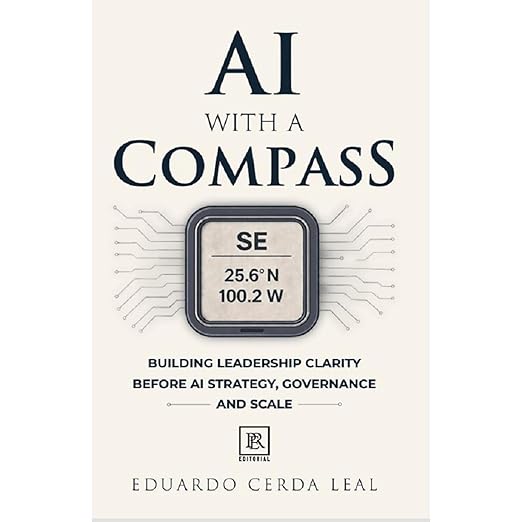
Why do so many organizations that invest heavily in AI pilots fail to scale them? Eduardo Cerda Leal opens this audiobook by naming the gap most technology vendors are invested in not naming: the limiting factor in enterprise AI adoption is rarely the algorithm and almost always the organization. AI with a Compass is addressed to executive leaders who understand that framing or who need to be persuaded of it, and its seven hours cover the organizational, methodological, and governance dimensions of enterprise AI in a way that most technical AI literature deliberately avoids.
The Virtual Voice narration handles business and technology content adequately. The conceptual vocabulary of enterprise leadership, agents, governance frameworks, change management, delivers clearly, and the structure of the argument comes through without significant loss. For content this conceptually oriented, where the listener is following a line of reasoning rather than inhabiting a story, AI narration is less limiting than in other genres.
AI Agents Outweigh Even ERP-Level Disruption
Cerda Leal's central argument is that the shift from AI projects to AI agents represents a change of organizational kind, not just degree. An AI project is bounded; it has a defined scope, a team, a budget, and an endpoint. An AI agent operates autonomously across the enterprise, adapting and acting without human approval at each step. The governance structures, cultural conditions, and leadership capacities required to operate responsibly at agent scale are fundamentally different from those that suffice for a pilot program, and most organizations that are scaling AI are discovering that gap through failure rather than design.
The comparison to ERP implementation is pointed and useful. Enterprise resource planning implementations are legendary in the technology industry for the organizational disruption they cause, the resistance they generate, and the frequency with which they fail to deliver promised value. Cerda Leal argues that moving to enterprise AI agents is a more profound organizational change than ERP, which implies a specific set of warnings about scope management, stakeholder alignment, and the danger of moving faster than the organization's change capacity allows. That comparison alone makes the argument concrete in ways that abstract governance frameworks often fail to achieve.
Autonomy Requires Trust Beyond the Technology Itself
The audiobook's most practically valuable sections concern the relationship between autonomy and trust. Cerda Leal argues that autonomous AI systems require a specific kind of organizational trust to function well: not the trust that the technology works, but the trust that the humans responsible for it have built sufficient guardrails, validated sufficient outputs, and earned sufficient stakeholder confidence to extend autonomy responsibly. Building that trust is a leadership task, not a technical one, and the book provides a framework for thinking about it that is more structured than most executive guidance on AI currently offers.
The discussion of isolated pilots versus enterprise-wide systems is similarly useful. Most organizations experimenting with AI are running disconnected pilots in different business units, each with its own data, its own metrics, and its own local definition of success. Cerda Leal identifies the transformation required to move from that fragmented state to a unified system of intelligence as the central challenge of enterprise AI at scale. The audiobook provides conceptual vocabulary for that challenge without pretending the vocabulary solves it, which is an honest and useful distinction.
Narration Flattens Key Governance Distinctions
Listeners expecting implementation blueprints, specific technology recommendations, or case studies with named organizations will find this audiobook operating at a higher level of abstraction than that. Cerda Leal is writing a leadership orientation, not a technical manual, and the level of specificity reflects that goal. The book is most useful for executive leaders who are developing their mental model of enterprise AI governance rather than practitioners looking for implementation guidance.
The Virtual Voice narration is adequate but occasionally flattens the emphasis on key distinctions that would benefit from a human narrator's ability to signal importance through vocal weight. Listeners taking notes will want to pay particular attention to the governance and guardrail sections, where the conceptual distinctions Cerda Leal draws are load-bearing for the larger argument. Returning to those sections after a first pass is worth the time, particularly for listeners using the audiobook to prepare for internal conversations about AI strategy.
The book's treatment of what Cerda Leal calls the 'clarity before acceleration' principle is worth extended attention. His argument is that most organizations accelerating into AI are doing so before they have clarity about what responsible AI behavior looks like in their specific organizational context. Building that clarity is slower work than launching pilots, and it requires executive involvement that many organizations have not yet committed to. The audiobook is most useful as a prompt for that internal conversation, providing language and framework rather than answers. That is the appropriate scope for a leadership orientation of this kind, and the seven hours are used accordingly.
C-Suite Executives Are the Intended Audience
This audiobook is specifically addressed to C-suite and senior executive audiences who are making strategic decisions about AI adoption and need a framework for thinking about organizational readiness, governance, and responsible autonomy. Technical practitioners looking for implementation guidance will find the abstraction level frustrating. Business leaders who have already developed detailed AI roadmaps will find some of the orientation material redundant. The book is most valuable for executives at the stage where they understand that AI matters and are trying to develop a leadership framework for navigating it responsibly. The Virtual Voice narration is a limitation but not a significant one for content this conceptually focused.
A Few Questions About AI with a Compass
Is this audiobook aimed at technical practitioners or business executives?
Explicitly at business executives and senior leaders. The book operates at a strategic and organizational level rather than a technical one, and its value is proportional to the listener's responsibility for enterprise AI direction rather than implementation.
Does the audiobook provide specific AI tool or vendor recommendations?
No. Cerda Leal deliberately operates at the level of organizational methodology and leadership framework rather than specific technology choices. Listeners looking for product recommendations or technical implementation guidance should look elsewhere.