Somebody filed a two-star verdict on this audiobook eighteen days before the release date printed on its own listing, and that response is still the only one there. February 23 sits ahead of March 13 by any calendar, so the single assessment available to a buyer was written about the text rather than the recording. It also happens to be the number the page displays, since one counted rating and one written opinion are the same event here. The whole public record is one dissatisfied reader.
Chat Assistant Stands in for Trade Alerts
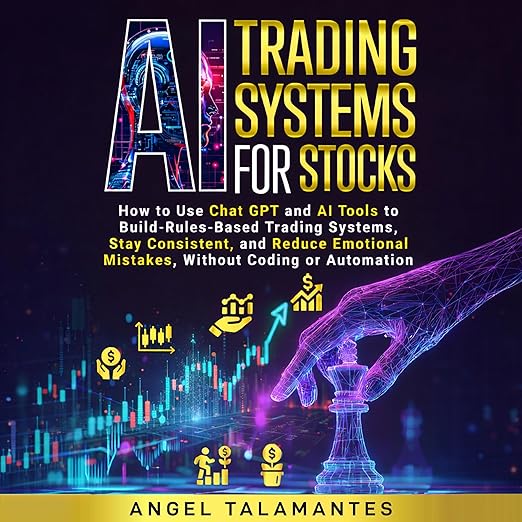
Rules instead of predictions is the promise, and the description is unusually blunt about what it will not do. No trade alerts, no forecasts, no automation, no black-box algorithms, no coding. What Angel Talamantes offers instead is a decision process: define entry, exit and position sizing in advance, manage risk before chasing return, and use a chat assistant as a structured second pair of eyes during planning and review rather than as the thing that decides.
Twelve Earlier Volumes Go Completely Unmentioned
Series data on this page deserves a look. The listing files the title as the thirteenth entry in a sequence called Stock Trading, while neither the title nor a word of the description acknowledges twelve earlier volumes or explains what they covered. Nothing in the recording is presented as continuing an argument. Buyers arriving at book thirteen of a program they have never heard of get no orientation whatsoever from the page they are buying from.
Publisher and author are the same name, which tells you the production was arranged rather than commissioned, and it explains the shape of the package: a short runtime, eight promised outcomes, a narrator brought in for the read. Nothing is wrong with that arrangement. It simply means the editorial filter a house imposes between a manuscript and a microphone was not applied here, and the one written response on the page happens to be about exactly that gap.
Steps Must Stay Audibly Numbered by Baird
Discipline, not artificial intelligence, is the durable half of this material. The passages on emotional error after a win or a loss, on overtrading, and on writing your exit before your entry describe failure modes that predate every tool named in the title, and they will still describe them when the current generation of assistants has been replaced twice over. A trader who takes only the risk-first sequencing has taken something real from the runtime.
Three hours and forty-six minutes is a sensible length for a checklist, and the structure follows the promised list closely enough to be navigable by ear. Each outcome in the description maps to a stretch of the recording: think in rules, plan with an assistant, define the three numbers, size the position, review, refine. Anyone who has sat through an eleven-hour trading book padded with market history will feel the restraint as a kindness.
Jacob Baird reads it, and the material poses a mechanical problem rather than an interpretive one. Instructional audio of this kind lives or dies on whether numbered steps stay audibly numbered, since a listener cannot glance back up the page to check which of three rules is being modified. Prompts written for a chat window are text by nature, so anything meant to be typed has to survive being said out loud first.
Sabbella's Complaint: No Tool Meets Its Job
Two stars, filed in February 2026 by Venkatarama Reddy Sabbella, carry the complaint a prospective buyer most needs to weigh: the title advertises AI tools, the content keeps asserting that AI tools can be used for this analysis or that one, and no specific tool is ever matched to a specific job. Anyone expecting to finish able to operate something will be disappointed. That criticism goes at the title, and the title invites it.
Prompts are where a book like this stands or falls, and the promised workflow is conversational: you are supposed to ask an assistant to pressure-test a plan, then read what comes back. Audio can describe that loop. Audio cannot hand you the wording. No companion document appears anywhere on the listing, so every rule, every template and every question you intend to reuse has to be transcribed by hand while listening.
One rating is not a sample, and buyers should read the displayed 2.0 accordingly. It is not a verdict from a market; it is one person's grade sitting alone on a page that has been live since March 2026. A second buyer with a different expectation could move that number by three full stars. Judge the title on what its description promises and what the complaint identifies, not on an average built from a single vote.
Traders Losing to Their Own Reflexes
Traders who already place orders and keep losing to their own reflexes are the intended audience, and the vocabulary confirms it. Position sizing and overtrading are not beginner concerns at all. Somebody who has never opened a brokerage account will find the risk material sensible and the context missing, while somebody three years in and still improvising entries will recognize the diagnosis immediately.
Curious non-traders looking for a plain account of how chat assistants get used in real financial work should calibrate expectations downward. The recording treats the assistant as a planning partner and stays at that altitude throughout, which is honest to its own stated scope and thin if the technology rather than the trading is what brought you here.
Look elsewhere if you want named tools, screenshots of a working setup, or backtested evidence that a rules framework beat the market. Look elsewhere too if you need a printable template, because the audio format and the missing companion file make this a listen-and-transcribe proposition. What remains is a short, calm argument for deciding in advance, which is worth something even from a page carrying one unhappy vote.
A Few Questions About AI Trading Systems for Stocks
Does the audiobook come with a companion PDF for the trading rules?
Nothing of the kind is listed on the product page. For a title built on writing your rules down before you place an order, that absence matters more than usual. Expect to keep a notebook open, because every framework the recording describes has to be reconstructed by hand if you want to use it at the screen.
Is this audiobook part of a series, and do earlier volumes matter?
The listing marks it as number thirteen in a sequence called Stock Trading, yet nothing in the copy points back at a previous volume and the material opens from scratch. Nothing suggests you are joining a serialized argument. Treat it as standalone and ignore the numbering, which appears to be a shelving decision rather than a reading order.
Does the audiobook suit beginners, or people who already trade?
The vocabulary settles the question. Overtrading, position sizing and post-loss behavior are problems you can only have after placing real orders, and the stated audience is people tired of emotional trading rather than people wondering how to start. Complete newcomers will follow the logic and miss the mechanics it assumes.