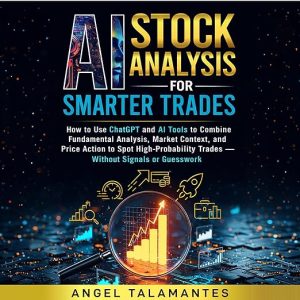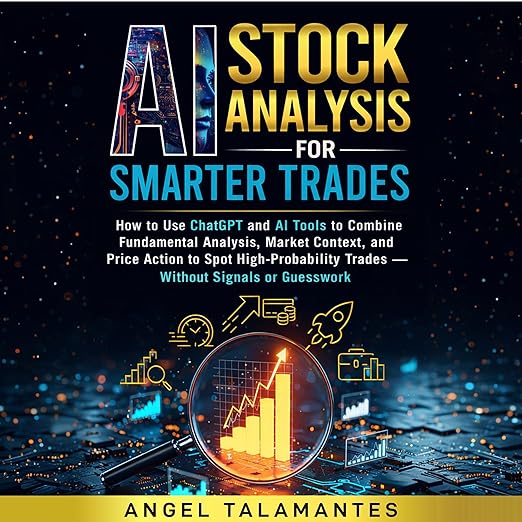
Angel Talamantes opens this audiobook with a provocation: most traders fail not because they lack tools, but because they lack a clear analysis process. It is a premise that cuts against the current grain of AI enthusiasm, where the fantasy is that better technology eliminates the need for better thinking. AI Stock Analysis for Smarter Trades, the eleventh volume in the Stock Trading series narrated by John Wilkinson, positions itself against that fantasy from the first chapter, insisting that ChatGPT and similar tools work best as thinking partners, not as oracles. That framing is the book's strongest asset, and it is more credible than much of what passes for AI-finance guidance in a market where every productivity claim competes for attention.
Much of the AI-in-finance conversation defaults to either hype or dismissal. Talamantes carves out a more useful middle ground: AI as assistant, human judgment as the thing the assistant serves. Whether the book delivers on that promise across four hours and forty-two minutes is a more complicated question, and one worth examining honestly given the single two-star review currently available. This audiobook entered a crowded field at a specific moment: the period when AI tools had become accessible to retail investors but before any clear consensus on best practices had emerged, which makes a structured methodology valuable precisely because the alternative is improvisation against volatile markets.
AI Traps Punish Overconfident Traders
The framework Talamantes proposes is genuinely coherent. He advocates combining fundamentals, market context, and price action into a unified decision-making process, with ChatGPT and similar tools handling the analytical lifting that traders typically drown in: parsing financial statements, understanding sector dynamics, filtering news sentiment without emotional contamination. The watchlist-building section, which uses AI assistance to create actionable tracking lists, is particularly practical and translates well to audio.
The book also covers what it calls AI traps, patterns of overconfidence that emerge when traders mistake fluent AI output for reliable analysis. This section is among the most useful, because it acknowledges the failure modes of the very tools being promoted. Knowing when not to trust the assistant is at least as important as knowing how to use it, and Talamantes treats this with appropriate seriousness. The single available review gives this audiobook two stars, which cannot be entirely ignored even at a thin sample size. Prospective listeners should factor that into their expectations and consider sampling before committing to the full runtime.
Wilkinson Won't Oversell What Charts Would Show
Narrator John Wilkinson delivers the content in a clear, measured register that fits instructional nonfiction. He does not oversell the material, which is the right instinct for a book that is itself skeptical of overselling. The four-hour-and-forty-two-minute runtime is appropriate for the scope: this is not attempting to be a comprehensive trading education, but rather a framework add-on for people who already have baseline market literacy and want a structured method for integrating AI assistance into their existing process.
The audio format works reasonably well for conceptual material like decision frameworks, psychology sections, and process descriptions. Where it is likely to fall short is in anything that requires visual reference: financial charts, tables of valuation metrics, or comparative data. Talamantes structures the content verbally, but listeners who want to work through the exercises as they listen may find themselves reaching for a notebook to reconstruct what a visual companion would have shown directly. This is a genuine limitation of the format choice, and listeners should enter with realistic expectations about how much hands-on application is possible in real time while listening.
Price Action Confirms Rather Than Predicts
The sections on managing risk before profits and thinking in probabilities rather than predictions are worth particular attention. These represent the philosophical core of the book's argument: that AI does not make the market less uncertain, it simply helps you process uncertainty more clearly. Listeners who absorb this distinction will get more from the specific techniques that follow, because the techniques only function properly when the underlying epistemology is in place and accepted.
Also worth close attention is the chapter on price action as confirmation rather than prediction, a framing that runs counter to much retail trading content, which treats technical analysis as a forecasting tool. Talamantes argues it is a verification tool, used after fundamental and contextual analysis have already narrowed the field. That is a meaningful methodological position with real implications for how the AI-assisted workflow is sequenced. The distinction may seem subtle in description but becomes significant when applied to actual decisions under uncertainty in real market conditions.
Built for Investors Upgrading an Existing Workflow
This audiobook is aimed at investors who already understand basic market concepts and want to integrate AI tools into an existing analytical practice. Complete beginners will likely need foundational material first; this is not a trading primer, it is a workflow upgrade for people who already know what P/E ratios and sector rotation mean, and who have some experience making real market decisions under uncertainty.
Those looking for a system that generates signals or removes decision-making uncertainty should look elsewhere. Talamantes is explicit that this is about thinking more clearly in an uncertain market, not about eliminating uncertainty. That is an honest and ultimately more useful promise, but it requires listeners who are comfortable with ambiguity as an irreducible feature of market participation. Given the single low rating in the available reviews, sampling before full purchase is a reasonable precaution for this audiobook before committing to the complete runtime.