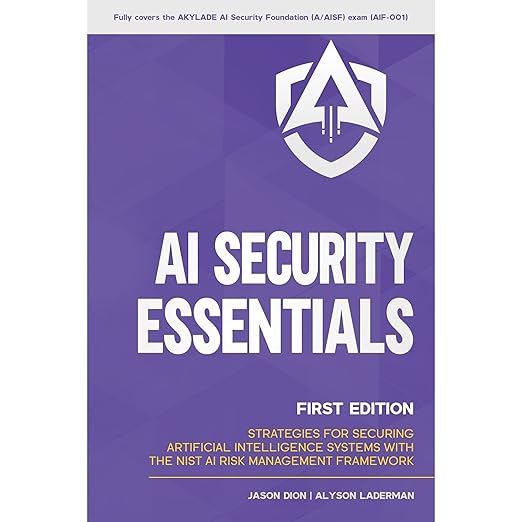
Cybersecurity certification content is not the most obvious candidate for the audiobook format, and Jason Dion's AI Security Essentials makes no pretense otherwise. The text states plainly that audio is designed to complement rather than replace hands-on study, and the Virtual Voice narration reinforces that positioning. What you get across eleven hours and twenty-five minutes is a structured walk through the NIST AI Risk Management Framework, covering the full stack from AI fundamentals to the four governance functions with enough specificity to serve as a legitimate exam preparation resource for the AKYLADE AI Security Foundation certification. For professionals already working in cybersecurity or AI governance who need a framework orientation, this audiobook delivers exactly what it promises.
Virtual Voice's Narration Handles Dense NIST Taxonomy
The scope of what Dion and co-author Alyson Laderman cover here is genuinely impressive: all four NIST AI RMF functions, all nineteen categories, all seventy-two subcategories, plus foundational coverage of machine learning, deep learning, natural language processing, and generative AI. That ambition is also the book's primary tension as an audiobook. Dense taxonomic content, the kind that maps neatly to a textbook's headers and numbered lists, loses some of its navigability when converted to linear audio. Listeners who would scan a printed page for the key distinction between two governance categories have to rely on memory and structure alone when listening.
The Virtual Voice narration handles the material competently. Technical terminology is pronounced correctly throughout, which matters considerably when you're absorbing unfamiliar acronyms and framework vocabulary. What's absent is the kind of human interpretive performance that would signal to a listener which concepts require slowing down, which examples are particularly illuminating, and where the mental model is genuinely shifting. For a book this content-heavy, that absence is felt.
Designed as a Commute Companion Between Study Sessions
The case for this audiobook rests on the supplemental use case the text itself describes: listening during commutes, walks, or routine tasks to keep concepts active between active study sessions. In that framing, it functions effectively. The chapter structure is organized around focused sections with content-specific headings, which means returning to a specific topic area is manageable even in audio form. The coverage of AI-specific threat actors, attack vectors, and vulnerability categories is particularly strong, grounded in real-world scenarios rather than theoretical abstraction, and organized around the kind of reasoning a security professional would apply in practice rather than the kind a student recites from flashcards.
One listener noted that this material is essential for anyone thinking about entering the AI cybersecurity job market, pointing to the way the field has been integrated into college curricula and absorbed by national security frameworks. That assessment holds for the audio version. The NIST AI RMF is a genuine knowledge anchor in a fast-moving field, and Dion's track record in cybersecurity education means the synthesis is reliable. The bonus practice materials accessible via the akylade.com membership site add an interactive layer that the audio cannot replicate but complements effectively for learners who want varied study modes.
Weigh the Print Edition Before You Commit Hours
The rating sample is small at four reviews, and one of those is written in Catalan, which suggests international appeal but limits the feedback base for English-language listeners. The book is an official textbook for a specific certification, which means its value is somewhat tied to the relevance of that certification in your particular professional context. Listeners who are not preparing for the AKYLADE exam may find the framework coverage useful as a general professional reference but should know the organizational structure follows exam objectives closely.
The end-of-chapter summaries and review materials that work well in print do not translate cleanly to audio, and the appendix with exam objectives and glossary is genuinely better accessed in written form. The free URL referenced for bonus materials and practice exams is specific to the akylade.com membership site. Treating this audiobook as a certification study supplement rather than a primary learning resource is the right orientation for getting the most out of the investment.
For listeners who are weighing this audiobook against reading the print edition as a study resource, the comparison is worth making explicit. The written text has the advantage of being searchable, scannable, and compatible with the kind of highlighting and margin-noting that many people use for certification prep. The audio works best for reinforcing concepts that are already partially anchored from written study, not for first-contact learning with entirely new material. Treating the two formats as genuinely complementary rather than interchangeable is the approach the book itself recommends, and it is sound advice for the content type.
The certification the book prepares for, the AKYLADE AI Security Foundation, is specific enough that listeners should verify the credential's recognition in their professional context before investing eleven-plus hours of study time. The NIST AI RMF coverage is valuable regardless of certification goals, but the exam-focused organization means some sections are shaped by assessment objectives rather than purely by what would be most useful to know in practice.
For listeners weighing this audiobook against the print edition as a study resource, the comparison is worth making explicit. The written text is searchable, scannable, and compatible with the kind of highlighting and margin-noting that many people use for certification prep. The audio works best for reinforcing concepts already partially anchored from written study, not for first-contact learning with entirely new material. Treating the two formats as genuinely complementary rather than interchangeable is the approach the book itself recommends, and it is sound advice for the content type involved here.
The certification the book prepares for, the AKYLADE AI Security Foundation, is specific enough that listeners should verify the credential's recognition in their professional context before investing eleven-plus hours in study. The NIST AI RMF coverage is valuable regardless of certification goals, but the exam-focused organization means some sections are shaped by assessment objectives rather than purely by what would be most useful to know in practice.
Best for Security Teams, Not Cybersecurity Newcomers
AI engineers, security analysts, DevSecOps professionals, and compliance teams working through the NIST AI RMF will get the most value here. The book also explicitly targets CTOs, CISOs, IT managers, and legal professionals navigating AI regulations, and the governance and ethics sections speak to those audiences specifically. Complete newcomers to cybersecurity will likely find the density challenging without supplemental reading. The audiobook format works best as a secondary study channel alongside the written text, practice exams, and hands-on lab work rather than as a standalone preparation tool for the certification exam.
Can you use this audiobook as your sole study tool for the AKYLADE AI Security Foundation exam?
The book explicitly says no. Audio is described as a reinforcement tool for keeping concepts active between study sessions, not a replacement for hands-on practice and written review materials. The best approach is to pair the audiobook with the written text, end-of-chapter summaries, and the practice exam materials at the akylade.com membership portal.
Is this audiobook appropriate for listeners without a cybersecurity background?
Dion writes for a broad professional audience including policy advisors and legal professionals, not only engineers. That said, the NIST AI RMF framework requires some baseline familiarity with risk management concepts. Complete beginners will likely need additional foundational resources alongside this text.
How does this AI Security Essentials audiobook cover the ethical dimensions of AI deployment?
The NIST AI RMF incorporates ethics, transparency, and trust as governance considerations, and the book covers those through the Govern function. Ethics are treated operationally, asking how you build trustworthy AI systems, rather than philosophically, which suits the professional audience the book targets.