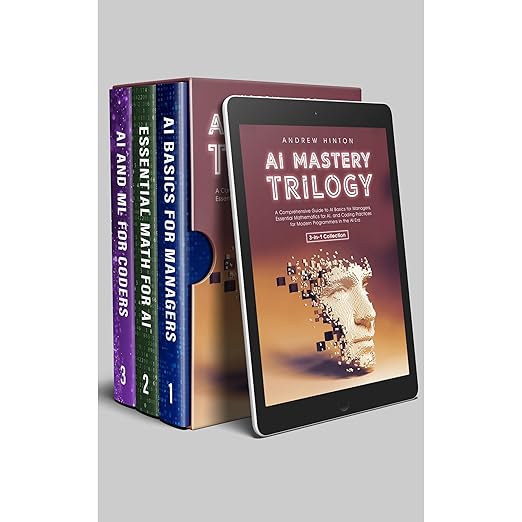
Can a single audiobook genuinely take a listener from zero AI knowledge to comfortable with the math and the code behind it? That is the specific promise of AI Mastery Trilogy, a three-in-one compendium bundling AI Basics for Managers, Essential Math for AI, and AI and ML for Coders into one twelve-hour listen. Andrew Hinton structures the trilogy to move in one direction, business context first, mathematical foundation second, hands-on coding application third, rather than treating the three books as interchangeable modules a listener can sample in any order. The narration here comes from Virtual Voice, an AI-generated voice track, a fitting, if slightly ironic, production choice for a book entirely about artificial intelligence.
Three Books Moving From Business to Code
The three-book structure is the whole design logic here, and it mostly works as advertised: Book One targets managers who need to understand AI's business implications without necessarily writing a line of code, Book Two backs up into the linear algebra, statistics, and game theory underpinning how AI models actually function, and Book Three moves forward again into practical coding guidance for building AI and machine learning applications directly. Reviewer Rahsean Holmes calls it 'a comprehensive and insightful guide' spanning managers, coders, and anyone interested in AI, a fair summary of the trilogy's actual ambition to serve three distinct reader profiles inside one purchase.
Reviewer Spirit Eagle singles out the mathematics section as 'particularly enlightening,' noting the trilogy 'smartly breaks down AI basics, essential mathematics, and modern coding practices' in a way that keeps complex topics accessible and engaging, a meaningful endorsement given how often AI math content either oversimplifies into uselessness or buries a general reader in notation. Reviewer Emmitta J. Lewis describes it as 'unparalleled' and expertly designed to take readers on a comprehensive journey, language that fits a twelve-hour trilogy better than it would a single standard-length technical book.
Bundling three related books into one compendium is a common structure in the self-published technical nonfiction space, letting a single purchase cover a wider arc than any one standalone title could, though it also means a listener less interested in one of the three components, say, a manager uninterested in writing code, still pays for and sits through material aimed at a different reader profile. That tradeoff is worth weighing against the convenience of a single twelve-hour purchase covering the full spectrum from strategy to mathematics to implementation.
Consistent Pacing Across Twelve Hours, No Fatigue
The honest case for the audio format here is narrower than for most nonfiction: technical material involving mathematical notation, code syntax, and formulas is inherently harder to absorb through audio alone than through a page you can pause and reread. Listeners tackling Essential Math for AI specifically, the trilogy's middle section, should expect to lean on pausing and rewinding far more than they would for the more conceptual, business-focused first book, since equations and derivations do not translate cleanly into spoken description no matter how clearly the narration handles them.
Virtual Voice's AI narration is worth naming plainly rather than treating as a footnote: automated narration tends to be clear and consistent in pacing, without the fatigue or inflection drift a human narrator can show across twelve hours, but it also cannot dramatize emphasis or slow down intuitively at a genuinely difficult concept the way an experienced technical narrator would. For a reference-style trilogy more likely to be consulted section by section than consumed start to finish, that consistency is arguably a reasonable tradeoff against the loss of interpretive nuance a human reader might offer.
Linear Algebra to Game Theory in One Section
AI moves fast, and any book bundling practical coding guidance alongside conceptual material risks specific tactics or tool references aging faster than the underlying math and business principles will. The synopsis does not specify a publication or update date, so listeners should treat the foundational and business-strategy sections as the most durable value here, and verify any specific coding library or tool references against current documentation before relying on them directly for real projects.
This is dense material delivered across twelve hours with no plot or narrative momentum to carry a distracted listener through; unlike a memoir or novel, losing focus during the math or coding sections means genuinely losing the thread of the argument, not just missing a bit of color. Treat this less as commute-friendly background listening and more as material that rewards a focused, note-taking kind of attention, ideally with a way to bookmark sections for the coding portions specifically.
Essential Math for AI specifically promises coverage from linear algebra to game theory, a genuinely wide span of mathematical territory for one section of a larger trilogy; linear algebra underpins how neural networks actually process data, while game theory shows up more in specialized areas like reinforcement learning and multi-agent systems. Listeners with zero prior math background should expect this section to move quickly across genuinely difficult material, and may want to treat it as a map of what to study further rather than a complete self-contained course covering every detail.
The series name attached to this listing, AI Fundamentals, suggests Hinton may have positioned this trilogy as an entry point into a larger planned catalog, though no additional volumes are referenced directly in the synopsis. A 4.7 average across 264 ratings suggests solid reception within the self-published AI-education space specifically, a competitive niche given how many creators are currently publishing AI-adjacent content across every format simultaneously.
One Purchase Covering Three Angles on AI
This suits working managers, developers, and technically curious generalists who want one purchase covering three angles on AI rather than buying three separate books piecemeal. Anyone building general AI literacy for a workplace context, needing enough of the business case, enough of the underlying math, and enough of the practical coding picture to hold their own in cross-functional conversations, will find the trilogy's breadth genuinely useful rather than superficial, based on the reviewer consensus praising its comprehensiveness.
Team leads assembling reading or listening lists for a department adopting AI tools will find this trilogy's breadth genuinely convenient, since it gives less technical colleagues and more technical ones a shared reference point covering both the business case and the underlying mechanics in one purchase, rather than assembling separate recommendations for each background.
Skip it if you need deep, exam-level mastery of any single one of the three areas; a book already comprehensive across three domains in twelve hours is, by definition, an overview of each rather than a deep specialization in one. Readers who already have strong data science math foundations may find Essential Math for AI's section moves slower than they need, and should consider a standalone, more advanced coding-focused resource instead if that is their primary interest.
The Short Version
- Narration: Virtual Voice's AI narration stays clear and consistent across twelve hours, though it cannot dramatize emphasis the way a human narrator would.
- Themes: AI fundamentals for managers, mathematics behind machine learning, practical AI coding
- Mood: Dense and technical, reference-style rather than narrative
- Verdict: A genuinely useful three-in-one AI primer for generalists, though technical listeners should expect to pause and rewind through the math sections.
Is this AI audiobook narrated by a human or an AI voice?
It uses Virtual Voice, an AI-generated narration track, an arguably fitting choice given the book's subject matter, though listeners should expect a more consistent than expressive delivery.
Is the math section of this audiobook accessible to non-technical listeners?
Reviewers specifically praise the mathematics chapters as accessible and enlightening, though audio alone makes equations and formulas harder to absorb than a page you can pause and study.