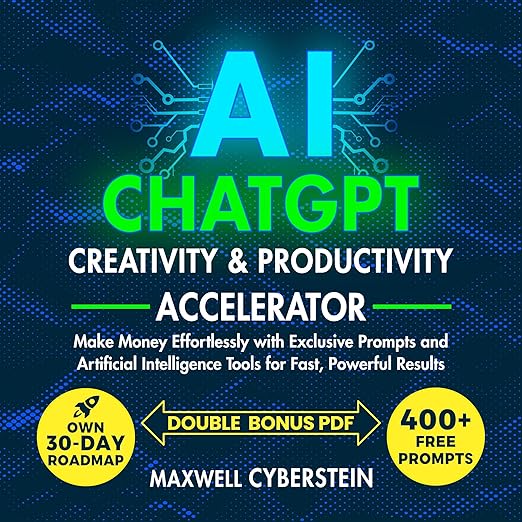
Four hundred prompts will not fit inside a recording of two and a half hours. That is the arithmetic sitting under this audiobook: the listing advertises over 400 curated prompts and a 30-day roadmap as bonuses, and reading the prompt library aloud with nothing else in the recording would leave roughly twenty-two seconds apiece. So the prompts live in the companion PDF, which the page confirms lands in your library alongside the audio, and the recording is the part that explains what to do with them. Knowing that before you buy changes what you are buying.
Co-Creating With Teams Is the Rare Chapter
Stripped of the bonuses, this is a short orientation to using a general-purpose chatbot for creative work. The described territory is content production: blog posts, social copy, sales pages, the daily output of a freelancer or a small marketing team. The pitch is speed without a collapse in quality, which is the honest version of the AI productivity argument, and it is at least aware that the collapse is a real risk. One promised chapter covers keeping depth and originality in a market that rewards volume.
Seven capability areas get named on the listing, and the sequence has a logic to it: get past the blank page, generate at volume, build the habit, automate the repetitive parts without losing your own register, then scale it and bring other people in. That last piece, co-creating with teams, clients and stakeholders, is the one most books in this category skip. Working out who edits the machine's output when three people are involved is a genuine problem and rarely written about.
The publisher credit reads Maxwell Cyberstein, the same name as the byline, which makes this a self-released title with no editorial layer between the writer and the buyer. That is neither good nor bad on its own, and in a category moving this fast it can be an advantage, since a house imprint would have added six months to the schedule. What it does mean is that nothing here has been checked by anybody else, and the confidence of the sales copy is doing all the reassuring.
Quintero Reads It as One Steady Voice
Brevity is the honest selling point. A recording you can finish across two dog walks is a reasonable way to decide whether a tool belongs in your working week, and the format suits an argument that is fundamentally about habit rather than about technique. Habits are absorbed through repetition rather than through reference, and a listener who replays the workflow chapter three times will have internalized more than a reader who skims a thick manual once. Millian Quintero is the credited reader, one voice for all of it.
Reasoning is what transfers well to audio. Why a vague instruction produces vague output, why a machine's first draft is a starting position rather than a result, why automating the repetitive part of a job is safer than automating the judgment part: none of that needs a screen. A listener comes away with a mental model, which is the durable purchase. Prompts age out within months. The reason a prompt works does not, and that split is worth holding on to while you decide which half of this package you actually want.
Pairing the recording with the document is how the thing is meant to be used, and the design is coherent once you see it. Listen for the model, open the file for the material, then run the thirty-day plan with the prompt library beside you. The weakness is that the page sells the bonuses first and the reasoning second, so a buyer skimming the listing will expect the recording to deliver 400 prompts and be surprised when it delivers an argument instead.
Two Ratings at the Top, No Words
Two ratings. That is the entire crowd verdict on this listing, both at the top of the scale, and neither voter wrote a word. A 5.0 built from two votes carries almost no information, and more than a year has now passed since release without a single written response appearing. A buyer therefore has no independent account of the recording, of the pacing, or of whether the promised document actually turns up in the library as described. On a self-released title, that absence is the main obstacle between you and the purchase.
Shelf life is the second concern. A guide to working with one specific chatbot is a guide to a moving target, and nothing on this listing says which version of the tool the workflows were built against. Techniques that depend on the interface, on file uploads, on how a conversation holds its context, all change without notice. The material on habit and judgment will outlive that. The material on exactly what to type will not, and the page draws no line between them.
Two smaller things a careful buyer notices. The copy signs off by telling you to download the audiobook now, an instruction written for the screen you are standing on rather than for the recording you end up holding. And the displayed title stacks two labels, AI and ChatGPT, in front of the phrase carrying the actual promise, which makes the thing awkward to search for and awkward to recommend out loud. Neither is fatal. Both are marks of copy built to be scanned rather than heard.
Freelancers Who Got Mush From a Chatbot
Freelancers and small-team marketers are the target, and the match is good, particularly for anyone producing a steady stream of short-form copy who has been avoiding these tools out of suspicion rather than principle. It works for people who want a working model before they want a technique library, and for anyone who tried a chatbot once, got mush back, and concluded the problem was the machine. The chapter on keeping your own register while automating the repetitive parts is the one to listen for.
Nor is this what you want if you already run these tools daily, since a short orientation aimed at beginners will tell you what you worked out in your first month. Give it a wide berth if the 400 prompts were the reason you clicked, because that is a document rather than a listen. Both of the people who scored this left the comment box empty, which is the entire crowd verdict on offer.