Ten stories, twenty years out, and after each one a technologist stops the fiction to explain which parts of it already exist. AI 2041 is built entirely on that alternation, and it is why the audiobook runs eighteen hours instead of nine. Penguin Audio handed the whole double act to Feodor Chin, one voice covering both a Mumbai teenager whose romance keeps colliding with an algorithm and, minutes later, a sober account of the machinery underneath her problem.
The Missing Co-Author Behind the Byline
Writing four days after release at the top grade, John Kim describes the architecture more clearly than the publisher's own copy manages: ten short stories, each one sandwiched between a non-fiction introduction and an epilogue, so that the likely trajectory of the technology and its effect on the social fabric arrive in the same chapter rather than in separate books. That is the entire design of the thing. Neither half stands up alone, and the book is honest enough to know it.
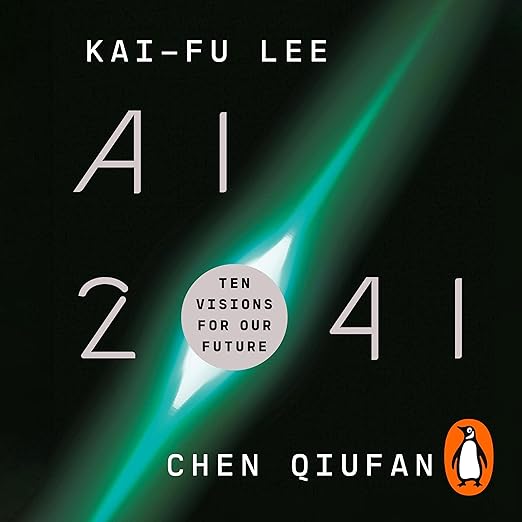
Credit comes up short on this page. The byline reads Kai-Fu Lee and stops there, while the description itself introduces Chen Qiufan as co-author and spells out the division of labor in plain terms, an AI expert and a celebrated novelist joining forces on one book. A listing that hides half the authorship of a work explicitly built by two people is not a clerical detail to shrug at. It decides whether anybody searching the novelist's name ever arrives at this recording.
Numbers on the page have come apart in their own way. The rating counter admits two votes while the display reads 4.3, and two whole-star votes cannot produce that figure: a pair of ratings lands on a whole number or on a half, never on a tenth. Underneath it sit five graded responses averaging 4.8 between them. The counter is not describing those responses, the average is not describing the counter, and both figures are safe to set aside.
Chin's Scene Work and Explanatory Prose
Posting from the United Kingdom four years after publication at the top grade, one buyer praises the global reach of the collection and quotes the book's recurring hinge back at it: every story is followed by its own Now for the science section. That structure is this book's best idea and by far its most useful feature for a listener, because you are never left deciding whether you are inside fiction or inside forecasting. The book tells you, chapter by chapter, precisely where the line falls.
Geography is doing genuine work in the design rather than decorating it. The settings named in the copy run from San Francisco to Tokyo, Mumbai, Seoul and Munich, and the differences between them are structural: job reallocation emerging as an industry for displaced workers reads nothing like virtual teachers offered to orphaned twins, and neither reads like a quantum scientist's revenge plot. Most English-language writing about this subject quietly assumes one country as the default. This book refuses to.
Feodor Chin's assignment is unusual enough to state plainly. Every chapter asks for two modes: scene work with characters, dialogue and atmosphere, then a shift into explanatory prose that has to sound authoritative without turning into a lecture. A handover per story, ten of them across the full running time, plus names and places drawn from five countries, makes this a technical job at least as much as a performing one. None of that work is glamorous and all of it is load-bearing.
Thin Stories a Listener Cannot Accelerate Through
Writing from Canada roughly two years after publication, a five-star response still lodges the sharpest complaint on the page: this is a long book for what it sets out to do, and the stories, while enjoyable and deep enough to deliver the vision, are not sophisticated fiction. That is an accurate description of the trade being made. Several of these stories exist to carry an idea from one end of a chapter to the other, and they are content to do exactly that and no more.
Eighteen hours and four minutes is where that complaint bites hardest in this format specifically. A reader who finds a story thin can accelerate through it and lose nothing; a listener cannot, and the commentary sections in particular ask for the kind of sustained attention that any recording of this length eventually wears down. The alternating structure helps, because a new story is always coming, but nobody should plan to take this in two long sittings.
Forecasting carries a shelf life, and this one was published in 2021. A book projecting twenty years forward from that point is now five years into its own window, which means a listener arriving today can check its near-term calls against what actually happened and watch some of them age well and others age strangely. That is a feature of coming to it late rather than a defect in the writing, but it does change the experience, and it is worth expecting.
A Futurist Approach to Technorealism
Anyone whose picture of this subject comes mostly from headlines is the clearest beneficiary, and a five-star posted ten days after release makes the case from an unexpected direction. It comes from somebody with a background in artificial intelligence research who does not usually read science fiction at all, who could not put the book down, and who was not certain the label even applied to what they had just finished. A futurist approach to technorealism was the phrase they reached for instead.
Nor is this the book you want if you came for either half on its own. Listeners after pure speculative fiction will find a commentary interrupting them every time a story finally lands, and listeners after a straight technology briefing will find themselves sitting through romance plots and revenge plots to reach it. The design is genuinely integrated, which is a polite way of saying that skipping half of it leaves you with something the authors did not write.
Come for whichever half you trust and stay for the one you did not expect to need. Eighteen hours is a real commitment, the credit line on this page is missing a name that should not be missing from it, and the star display is describing nobody in particular. What sits underneath all of that is still one of the more inventive structures anybody has built out of this subject.
A Few Questions About AI 2041
Is Chen Qiufan credited on the AI 2041 audiobook, or only Kai-Fu Lee?
Only Lee appears in the byline, though the description names Chen Qiufan as co-author. A four-star response from October 2021, which discloses knowing one of the authors personally, sets out the split directly: the paired short stories are Chen's and the commentaries are Lee's. The listing never reflects that.
Do the ten stories hold up as fiction on their own terms?
Unevenly, and deliberately so. Some are built to carry an idea rather than a character, and read like parables once you notice. Others, particularly the ones built around a teenager's romance or orphaned twins taught by virtual teachers, work as short fiction independently of the technology they dramatize. Expect a range rather than a consistent standard.
How long is the AI 2041 audiobook and how is it best paced?
Eighteen hours and four minutes, split into ten story-and-commentary pairs. The natural unit is one pair per sitting, a self-contained block that ends on a clean break. Attempting long stretches works against the structure, since each commentary asks for a different kind of attention than the story before it.
Does a forecast written in 2021 still hold up in the second half of its window?
That is part of the interest now. Half a decade into a twenty-year projection, some near-term calls can be checked against events and others cannot yet. The commentaries are careful to separate what already existed from what was speculative, which makes the aging visible rather than embarrassing.