- Performance: Dr. Mindy Pelz self-narrates with the same direct, YouTube-honed delivery her existing audience already knows and trusts.
- What it covers: Menopause reframed through the Grandmother Hypothesis, fasting and ketogenic strategy, post-menopausal self-discovery
- Feel: Empowering and personality-driven rather than clinically academic
- Our call: A genuinely audio-enhanced listen for women in or approaching menopause, built on personal connection more than peer-reviewed rigor.
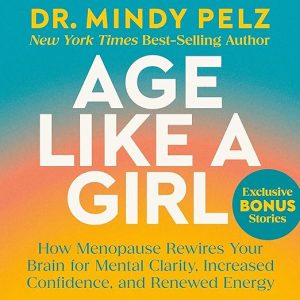
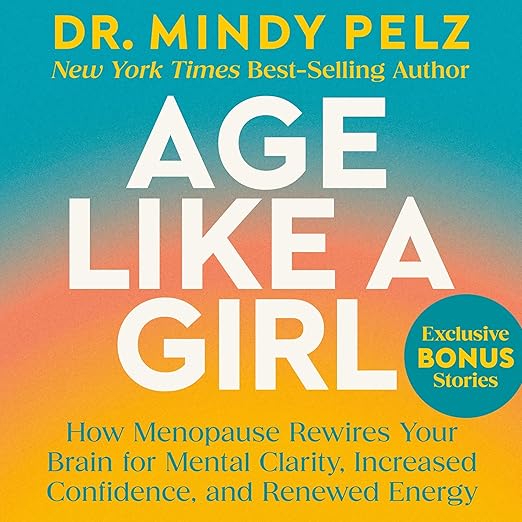
Why does menopause exist at all, biologically speaking, when evolution otherwise favors reproduction above almost everything else? Dr. Mindy Pelz opens this audiobook, Age Like a Girl, with exactly that question, and answers it through what evolutionary biologists call the Grandmother Hypothesis, the idea that women who survive well past their reproductive years improved their families' odds of survival by passing down wisdom and support to grandchildren, which may help explain why menopause evolved as a distinct life stage at all rather than simply fading into old age. Pelz, the self-narrating author already known for her bestsellers Fast Like a Girl and Eat Like a Girl, uses that framework to reposition menopause as what the synopsis calls a powerful biological upgrade rather than a decline.
The audiobook is organized into three parts across ten and a half hours: the biological purpose of menopause itself, drawing on neuroscience and examples from traditional cultures like Okinawan and hunter-gatherer societies that treat this life stage as one of strength and leadership; a practical toolbox covering fasting, ketones, nutrition, and exercise adapted specifically to postmenopausal hormones; and a more personal closing section where Pelz shares her own experience of self-discovery after menopause, framed through the image of emerging from a chrysalis.
Grandmother Hypothesis Explains Why Menopause Exists
Reviewer Ringo describes recognizing her own experience of perimenopause and brain changes in Pelz's account before she even had a name for what was happening to her, and credits the book with finally explaining it clearly enough to offer a real path forward. A second reviewer, writing in January 2026, describes discovering Pelz through YouTube while looking to start a fasting lifestyle, now three weeks into a strict intermittent fasting and ketogenic routine and crediting Pelz's books, including this one, with the motivation to start.
A third reviewer, Kimberlie Rens, titles her review 'Empowering, practical, and eye-opening' and specifically praises how Pelz 'explains complex topics like metabolism, blood sugar, and hormonal changes in a clear, relatable way.' Across all three reviews, the consistent theme is recognition, listeners who felt confused or dismissed by how little mainstream health guidance addresses menopause directly, finding language and a framework for what they were already experiencing.
The specific ketones-over-glucose claim at the center of the toolbox section is worth unpacking briefly, since it is the book's most concrete physiological argument: Pelz contends postmenopausal metabolism responds better to fat-derived ketones as a fuel source than to glucose, which underlies her broader fasting and ketogenic recommendations throughout Part Two. Listeners already familiar with her earlier books will recognize this as a throughline across her work rather than a new claim introduced here, applied specifically to the postmenopausal body this time.
Pelz Adds Audiobook-Only Moments and Reflections
This edition includes what the synopsis calls audiobook exclusives, spontaneous Dr. Mindy Moments and personal reflections woven directly into the listening experience that would not exist in the print edition at all. That is a genuine audio-specific reason to choose this format over the book version, not just a marketing bullet point, since it suggests Pelz treated the audiobook as its own distinct project rather than a straight read-through of the printed text.
Self-narration matters here in a way it does not for every wellness title. Pelz built a substantial YouTube following, referenced directly by the January 2026 reviewer above, on the strength of her own explanatory style, and hearing her walk through concepts like ketone metabolism or hormonal shifts in her own voice, with her own emphasis and pacing, closely replicates the video content her existing audience already knows and trusts. For listeners new to her work, that same directness should still land as accessible rather than clinical.
The book's three-part structure, biological framework, practical toolbox, then personal integration, mirrors a workshop or course progression more than a traditional chapter-by-chapter narrative, and that structure suits audio particularly well. A listener can return specifically to the toolbox section for fasting or exercise guidance without needing to re-listen to the evolutionary biology chapters, or revisit the closing personal section separately when they want the more reflective material rather than the practical strategy.
The Okinawan and hunter-gatherer cultural comparisons the synopsis references function as more than color; they are doing real argumentative work, positioning Western medicine's traditional framing of menopause as a deficiency to be treated as a comparatively recent and culturally specific viewpoint rather than a biological given. Pelz uses those societies' treatment of postmenopausal women as community leaders and knowledge-holders to support her larger claim that decline is not an inevitable feature of this life stage, and hearing that argument built out across real anthropological comparison, rather than asserted as a single motivational line, gives Part One more substance than a typical reframe-your-mindset chapter usually offers.
This audiobook also arrives from Hay House, a publisher with a long, well-established track record specifically in wellness, self-help, and integrative-medicine titles, which situates Age Like a Girl within a recognizable genre lineage for listeners already familiar with that catalog. That publishing pedigree suggests real production investment behind this specific edition rather than a straight, unadorned reading of the print manuscript, consistent with a house that treats its audio editions as their own distinct product.
Personality-Driven Wellness, Built Specifically for Women
Clinical rigor in the strict peer-reviewed-citation sense is not really what this book is selling, and listeners should know that going in. Pelz writes and narrates from a personality-driven wellness and functional-medicine perspective rather than a dry academic one, and while the synopsis describes the strategies as science-backed, none of the three reviews here engage with sourcing or citation practices specifically, focusing instead on how clearly and personally the material communicates.
This is also squarely a book for women approaching, inside, or past menopause specifically, built around a life stage roughly half the population never experiences and the other half experiences only once. Men, or listeners without any personal or caregiving connection to menopause, are simply not the audience the synopsis or the three attached reviews are describing, and should expect the entire ten and a half hours to assume that specific frame of reference throughout.
YouTube Fans and Reframe-Seekers Get the Most
Women in perimenopause or menopause looking for a reframing of this life stage away from decline-focused messaging, and anyone drawn to Pelz's existing fasting and metabolic-health work, are the clear audience here, backed by a strong 4.7 average across 215 ratings. Existing fans of her YouTube content in particular have a genuine reason to choose this format specifically, since it carries her own direct delivery rather than a studio-read alternative.
Clinical rigor in the peer-reviewed, footnoted sense should not be the expectation walking in, since this operates from Pelz's own functional-medicine and personal-experience perspective throughout. Listeners without any personal stake in menopause specifically, or those seeking a strictly academic treatment of the underlying hormonal science, will likely find the personality-driven framing here less suited to their needs.
Is this audiobook backed by clinical citations or more personal experience?
It leans toward Dr. Mindy Pelz's personality-driven, functional-medicine perspective rather than dense academic sourcing, though the synopsis frames the strategies as science-backed.
Who is the intended audience for this menopause audiobook?
Women in perimenopause, menopause, or beyond, along with anyone already following Pelz's fasting and metabolic-health work; it is not written with men or non-menopausal listeners in mind.
Does Dr. Mindy Pelz narrate this audiobook herself?
Yes, and her self-narration closely mirrors the direct, YouTube-style delivery that built her existing following.