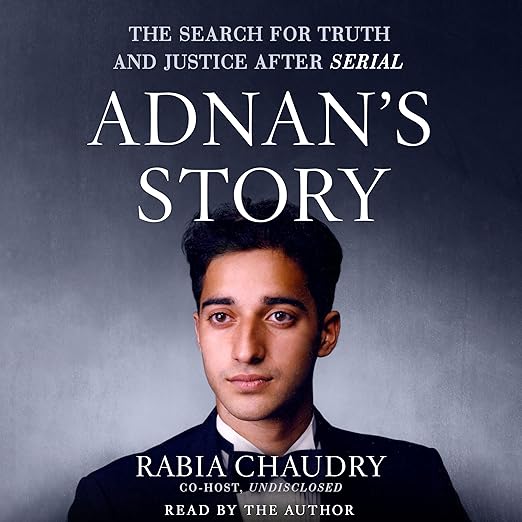
I listened to Serial in real time, the way most people did, episode by episode, letting Sarah Koenig's investigative voice become part of my commute. I remember the debates, the Reddit threads, the strange collective experience of a nation turning a murder case into an episodic drama. I thought I knew Adnan's story. Then I listened to Rabia Chaudry read her own book, and realized how much Serial had left out.
Rabia Chaudry is not a neutral party. She says so immediately and without apology. She is a family friend who has believed in Adnan Syed's innocence since his arrest, who contacted Sarah Koenig precisely because she wanted journalism to shine light on what she saw as a botched prosecution. Adnan's Story is her account, and she does not pretend otherwise. That honesty is the book's first and most important quality.
What the book accomplishes, and what Serial could not do within its episodic structure, is lay out the evidentiary case with methodical legal clarity. Chaudry's training as an attorney surfaces throughout. She walks through the cell tower data that the prosecution used as a cornerstone of its case and explains why, according to documentation the State allegedly withheld, those records carry a caveat that renders them unreliable for the type of analysis used at trial. She presents forensic evidence around Hae Min Lee's death, including questions about the timeline that she argues have never been adequately answered. Whether you find her arguments persuasive or not, they are assembled with discipline rather than emotion.
The Washington Post noted that her legal training serves her well, and so does the Pakistani heritage and Muslim faith she shares with Syed. She does not shy from the cultural dimensions of this case, including how Adnan's identity may have shaped jury perception, in ways that Serial touched but did not fully develop.
What Works
The self-narration is the single most important reason to choose the audio version over print. Chaudry's voice does something a professional narrator could not replicate. There are moments when her composure frays slightly, when the weight of more than twenty years of this case surfaces in the way she reads Adnan's letters or recounts his prison experience. Those moments are not performative. They are the sound of someone who has lived inside this story for decades.
She also incorporates Adnan's own voice through letters and personal reflections written from prison, and her reading of those passages adds a texture that print cannot match. You hear the distance and the refusal to abandon hope in his words. It is affecting in a way that purely journalistic prose rarely manages.
Before You Commit to Adnan's Story
Be clear-eyed about what this book is and is not. It is advocacy, not investigation. Chaudry is making a case for innocence, not conducting an objective inquiry. The book does not seriously engage with the strongest arguments for guilt, and a reader looking for genuine balance will need to supplement it with other sources. That is not a fatal flaw, but it is a limitation worth naming.
There is also the question of timing. Adnan Syed's conviction was overturned after this book was published. Depending on which edition you access, the listener may have more or less context for how the legal situation ultimately resolved. The core arguments Chaudry makes, however, remain relevant to the broader questions about how the case was handled.
Who It's For
Anyone who listened to Serial and felt the story was incomplete will find this essential. Listeners interested in wrongful conviction cases, prosecutorial misconduct, or the mechanics of advocacy journalism will also have much to engage with. The book is accessible to listeners with no legal background, and Chaudry is a skilled explainer. Skip it if you are looking for an objective account of what actually happened, or if you have a firm view of Adnan's guilt and are not interested in a sustained counter-argument. This book will not meet you in the middle on that question.
- Narrator: Rabia Chaudry self-narrates, and the intimacy of that choice is one of the audiobook's greatest strengths. Her voice carries both legal precision and personal grief.
- Subjects: Criminal justice failures, advocacy and friendship, the gap between media narrative and full truth
- Tone: Urgent and emotionally layered, with flashes of genuine outrage
- Bottom line: Essential listening for anyone who followed Serial, and a sobering account of how advocacy, journalism, and the legal system intersect and sometimes collide.
Common Questions
How does Rabia Chaudry's self-narration compare to professional narrators in similar true crime audiobooks?
The lack of professional polish is offset by the intimacy and credibility she brings. Her legal background makes the technical explanations clear, and her emotional connection to the case comes through in ways a hired narrator cannot replicate. It is a different kind of listening experience, closer to a long documentary interview than a conventional audiobook.
Is this book accessible if I have not listened to the Serial podcast?
Yes, though it helps to have at least a passing familiarity with the case. Chaudry provides enough context to orient new readers, and the Los Angeles Times noted the book can change how you think about the case even without prior knowledge. Serial fans will simply have more background to build from.