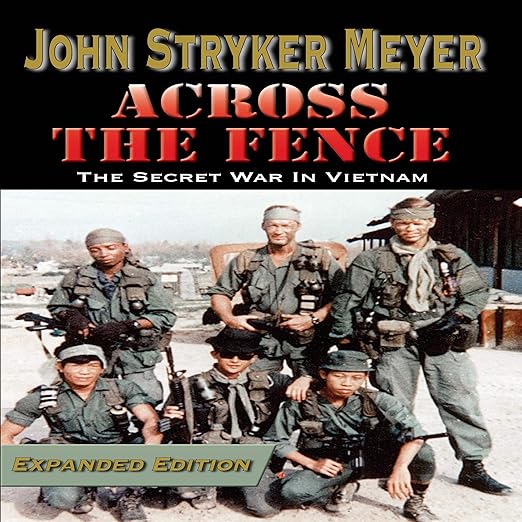
Expanded Edition, says the title. Expanded from what, this audiobook never explains. No earlier version is named, no note lists what was added, and no first publication date sits in the fields to measure an expansion against. Then the review column complicates it further, because the oldest response carries a January 2017 dateline, almost three years ahead of the December 2019 release date attached to this recording. Whatever that entry is praising, the expanded material cannot be part of it.
Meyer's Own Voice Makes the Whole Argument
Meyer narrates the account himself, which for a book of this kind is not a production convenience but the whole argument. The material is first-hand, in Lucas Crawford's phrase, covering eight years of a war fought across Laos and Cambodia that officially was not happening. When the voice saying a sentence about a boot touched in the dark belongs to somebody who was in that dark, a recording can do something no hired reader manages. Not a respondent among them mentions it, the gap this listing keeps returning to.
GoldFalconSix was in Special Forces from 74 to 77 at Fort Bragg, a couple of years after the 5th SFG came home from Vietnam and SOG stood down, and writes about rubbing elbows with SOG veterans, one a college roommate who later rose to major general. That entry calls the book the real deal, asks how any of these men survived, and answers its own question: many did not. It is the most authoritative thing available here, and it dates from 2017.
Count the written responses and you reach five. Look at the vote counter above them and it reads three. One of those two counts is wrong, with no indication here of which one. Meanwhile the 4.6 badge sitting on a three-vote tally cannot be checked by hand, because it survives only under particular rounding conventions, which means no honest claim about the individual grades can be built from it at all. Read what the five of them actually wrote and leave the number where it lies. It is the least dependable thing on display.
Five Warriors Stack the Dead as Cover
Eight years of it, out beyond the battlefields most people picture and out beyond anything a correspondent was permitted to file. SOG operated under Military Assistance Command Vietnam as a studies and observations group, the sort of name reserved for work never meant to be acknowledged afterward, and its operations ran into Laos and Cambodia. The description offers four scenes as a sample, and they were plainly chosen to tell you what kind of book you are buying.
Go deep into the jungle with five SOG warriors surrounded by 10,000 enemy troops as they stack the dead into a human buttress for cover. Witness a man shot in the back four times and left behind, who survives to finish his missions against impossible odds. Shudder as an enemy soldier touches a Green Beret's boot in the dark of night. Cringe as a sergeant on Spike Team Louisiana calls an air strike onto his own team, and a Green Beret, out of his body, watches his leg get blown off.
Lucas Crawford reads all of it as a portrait of a young man dropped almost immediately into one of the most dangerous roles the American military had at that moment, part of an elite unit facing overwhelming odds nearly every time it left the wire. That framing matters. Without it, the set pieces could pass for an anthology of survival stunts, and what actually gives them weight is the running tally of who went out on a mission and who came back from one.
SOG Publishing Writes Its Own Imperative Copy
Mustang6 filed the only grade under five and gave one reason for it: the narrative ends at Vietnam. A retired post-Vietnam infantryman, that reviewer wanted to know how Meyer got home and what he made of civilian life, and was disappointed to find none of it. Fair complaint, too, against a memoir carrying Expanded Edition on its cover, since the most obvious material to expand into, the part nobody has written down, is everything that came after the wire. A title promising more, on a book several readers wish were longer at exactly one end, is an awkward place for a page to go quiet.
SOG Publishing appears in the publisher field, meaning the book comes out under the initials of the unit it describes. Nothing improper in that, and it does account for the register of the description, four imperative sentences instructing you to go, witness, shudder and cringe. Copy like that gets written by people standing close to the material. It also suggests nobody from outside stood between the story and the jacket, which cuts both ways for a first-hand account.
Two of the five responses arrive from outside the United States, one filed in Brazil and written in Portuguese, one from Australia. The Australian entry praises Meyer as a writer and as a man of moral value and strong character, then closes on a sentence an autocorrect has mangled into nonsense. Small stuff on its own. Together it underlines how thin the sample is: five entries, one not in English, one older than the edition being sold, none of them about the audio.
A Different Book Nobody Has Written
Veterans and the families of veterans are the core audience, and two of these five respondents identify themselves as service members. GoldFalconSix served in Special Forces and Mustang6 came home a post-Vietnam infantryman, and the agreement between them is the closest thing to corroboration this page offers. Anyone who reads military history at the operational level, how five men plan a mission and survive contact with ten thousand, will find this unusually specific about method. Listeners drawn to the parts of the Vietnam war conducted outside Vietnam get their account from somebody who was standing in it, rarer on the shelf than the shelf suggests, and rarer still in a recording where the same person supplies the voice.
Newcomers should know the book assumes you can carry acronyms unaided; the description drops SOG and Spike Team Louisiana early and spells out only the first. Anyone who wants a settled rating should note that the counter and the comment column disagree about how many people have voted. And anyone hoping for the homecoming will not find it. What happened to these men after Vietnam is a different book, and nobody has written it here.
Common Questions
What is missing from the Expanded Edition of this audiobook?
Nothing here identifies what the expansion added, and no earlier version or first publication date is recorded for comparison. A four-star response supplies a different absence, noting that the narrative stops at Vietnam and never covers the return home. If you already own a previous edition, this page will not help you tell the two apart.
How graphic is the combat in this audiobook?
Very. The description previews a stack of bodies used as cover, a soldier shot four times and left behind, and a sergeant calling an air strike down onto his own team. A Green Beret experiences his own maiming from somewhere outside himself. Anyone sensitive to detailed injury and death should treat those four sentences as an accurate sample.