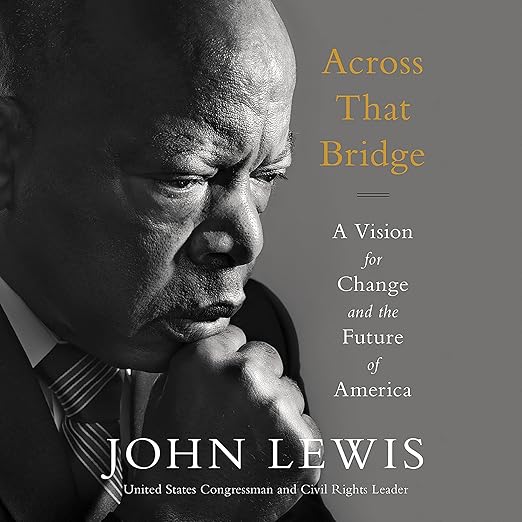
Forty arrests, dozens of beatings, and John Lewis never abandoned nonviolence, so how did he keep faith in it? Across That Bridge, the final book Congressman Lewis published before his death, answers that question across five hours and twenty seven minutes of audiobook narration from Keith David, distilling six decades of Civil Rights Movement leadership into direct, hard won principles for anyone confronting injustice today. This is not a chronological memoir, it is Lewis at the end of his life, handing over what he actually learned.
Lewis writes from a position few living authors could claim: a confidant of Martin Luther King Jr., a leader arrested more than forty times, and a survivor of serious physical attacks during the movement's most dangerous years. Rather than retelling that history in narrative form, Across That Bridge organizes his experience into thematic reflections on nonviolence, patience, and what he calls the responsibility each generation carries to continue the work, treating the Civil Rights Movement not as settled history but as an ongoing demand.
The book's updated introduction, written to address the political climate Lewis saw developing, gives the material a pointed contemporary edge rather than letting it settle into pure historical reflection. Reviewer 1speeder describes turning to this book specifically for guidance and evidence that, in her words, good and courageous people still exist, which is precisely the use Lewis seems to have intended for it: not a museum piece, but a working guide for hard times.
Across That Bridge won the NAACP Image Award for Outstanding Literary Work in the Biography category, a recognition that speaks to how the book was received as more than a simple collection of reflections. Lewis organizes the material around specific virtues, faith, patience, study, truth, among others, using each as a lens for a related memory or lesson, which gives the book an almost devotional structure closer to a series of short sermons than a traditional linear memoir.
The Strengths
Keith David's deep, authoritative delivery is well suited to material built on moral gravity rather than plot momentum. This is a voice with a long career narrating documentary and historical nonfiction, and that register, serious without being funereal, gives Lewis's principles the weight they need without tipping into melodrama the source material never asked for.
At just under five and a half hours, the audiobook moves efficiently through Lewis's core arguments rather than diluting them across a much longer runtime, which suits the essay like structure of the book. Reviewer Ricardo Mio's description of Lewis as a man of 'undeniable integrity and inner strength' who was beaten and jailed more than forty times captures exactly the moral authority listeners are hearing behind every chapter of this recording.
Lewis's closeness to Martin Luther King Jr. gives the book a specific historical intimacy that secondhand civil rights histories cannot replicate. He is not reconstructing King's thinking from documents and interviews; he is recalling direct conversations and shared strategy sessions from inside the movement's inner circle, and that firsthand vantage point runs through every principle he lays out here, whether he names King explicitly or not.
What to Watch For in Across That Bridge
This is reflection and principle rather than a full chronological account of Lewis's life or the Civil Rights Movement broadly. Listeners wanting a comprehensive historical narrative, march by march, arrest by arrest, should know this book assumes a working familiarity with that history already and builds forward from it into lessons rather than backward into a full retelling of events.
The short runtime, five hours and twenty seven minutes, means the book covers real ground efficiently, but it is not going to satisfy listeners looking for the kind of exhaustive detail found in a much longer biography or autobiography. Lewis's earlier and considerably longer memoir, Walking with the Wind, is the better choice for readers wanting the full chronological account. This book works best as a companion to that history rather than a replacement for it.
Readers building a broader civil rights library alongside historians like Taylor Branch will find this book operates on a different register entirely, personal principle rather than comprehensive historical narrative. It complements that kind of scholarship rather than replacing it, working best for listeners who already have the historical scaffolding in place and want Lewis's own distilled, personal philosophy layered on top of it.
Lewis wrote the book's core material before his death in 2020, and listeners should understand the introduction addressing contemporary politics reflects his perspective at the specific moment he revised it, not a running commentary on events since. The core principles he lays out, drawn from decades of movement work, are the more durable part of the book, while the topical framing serves as a reminder of how he wanted that wisdom applied in his own final years.
Who Will Get the Most From It
Readers already familiar with Civil Rights history looking for Lewis's own distilled wisdom, anyone drawn to nonviolence as an active philosophy rather than passive endurance, and listeners wanting a short, weighty listen will get exactly what this book promises them.
Skip it if you are looking for your first, comprehensive introduction to the Civil Rights Movement or to Lewis's full biography specifically, start with Walking with the Wind instead. For listeners who already know the history and want Lewis's final, direct word on what it demands going forward, this is essential listening.
Listeners who appreciate short nonfiction built for rereading or relistening, principle driven books meant to be revisited rather than consumed once, will find this format particularly suited to that kind of repeated engagement. Each chapter functions almost independently enough to return to on its own, a deliberate structural choice for a book meant to function as ongoing guidance rather than a single narrative arc to finish and set aside.
- Narration: Keith David's authoritative delivery suits Lewis's moral weight without tipping into melodrama.
- Themes: nonviolence, generational responsibility, civil rights leadership
- Mood: Reflective and urgent at once
- Verdict: A short, weighty listen best suited to readers who already know Lewis's history and want his final word.
Questions Listeners Ask
How long is the Across That Bridge audiobook?
Five hours and twenty seven minutes, narrated by Keith David.
Is Across That Bridge a full biography of John Lewis?
No, it is a thematic reflection on principles and lessons from his life rather than a chronological account. His earlier book Walking with the Wind covers the fuller life story.
Does this audiobook address recent political events?
Yes, it includes an introduction Lewis updated to address the political climate he saw developing, giving the material a pointed contemporary angle.
Is this a good starting point for learning about the Civil Rights Movement?
It works better as a companion for listeners with some existing background. Those wanting a full introduction should start with a broader history or Lewis's own longer memoir first.