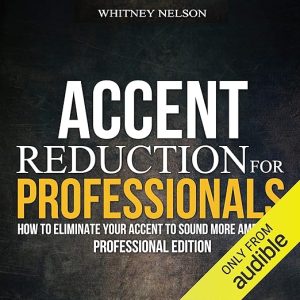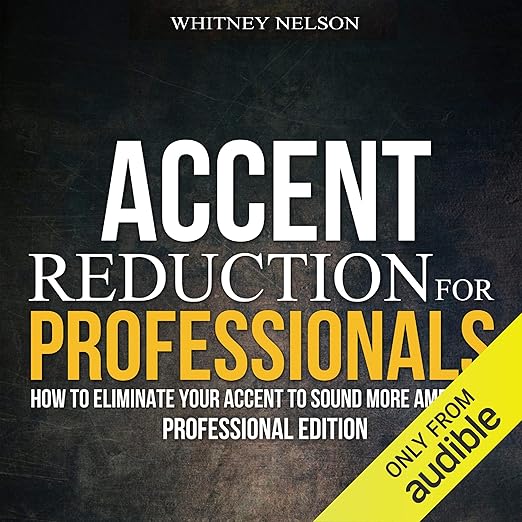
Accent Reduction for Professionals by Whitney Nelson is an audiobook that addresses one of the more uncomfortable professional realities many immigrants and non-native speakers face: the gap between fluency in a language and the way that fluency is received by native-speaking colleagues and employers. Nelson does not treat this as a shameful problem to be hidden. She treats it as a professional variable to be managed, and the directness of that framing is one of the book's strongest qualities. At two hours and eleven minutes, this is a concise listen that covers its territory quickly, which suits its target audience: people with professional obligations who need actionable guidance, not a semester-long linguistics course.
SGarcia Highlights Presentations, Contracts, and Client Calls
Nelson's premise is that the attention a foreign accent draws in professional settings is often not a reflection of a speaker's intelligence, expertise, or communication ability, but it does affect how those qualities are perceived by native-speaking audiences. The book's aim is practical: help listeners develop habits and techniques that allow them to be understood on their own terms rather than constantly managing the friction of miscommunication. Reviewer SGarcia, who describes exactly this experience, noted that the author explains which aspects of American accent production matter most for intelligibility and how those skills apply practically in workplace contexts like presentations, contract discussions, and client calls. That applied focus is the through-line of the book rather than a phonetics lecture or a general ESL course. Nelson also addresses the psychological dimension of accent in professional settings, including the confidence deficit that many non-native speakers carry into high-stakes conversations, and that attention to the emotional side of the problem gives the book more texture than a purely technical approach would achieve. The emphasis on practical application over linguistic theory keeps the material accessible throughout and means listeners can start implementing something immediately rather than waiting to finish a full theoretical foundation first.
Marienchild's Diction Models Clear American English
Eva R. Marienchild's narration is an asset here in a way that becomes clear quickly. An audiobook about accent and spoken communication needs a narrator with precise, patient diction, and Marienchild provides exactly that. The clarity of her delivery is not just pleasant listening. It functions as a reference point throughout the material. When Nelson discusses specific sounds or patterns, the narration models what clear American English actually sounds like in practice. Reviewer Jolly noted the importance of understanding the American accent for professional communication across global contexts, and having a narrator who embodies careful articulation rather than casual spoken delivery is a genuine production advantage for this particular title. The audiobook format, which can be a limitation for visual or exercise-heavy content, is actually well suited here because the medium itself is about listening to spoken language.
Braden Wilson Says It Reads Like a Compilation
The book's brevity is its main limitation. Two hours and eleven minutes gives Nelson enough room to introduce accent reduction principles and provide actionable techniques, but not enough to deliver the kind of repetitive, spaced practice that accent modification actually requires. Reviewer Braden Wilson described the book as very informative but also noted it reads like a compilation, which points to a real structural tension: Nelson covers a lot of ground in a short time, which means each technique gets introduced rather than trained. This is a starting framework, not a complete program. Listeners who approach it expecting a systematic course with exercises drilled over time will need to supplement it with additional practice resources, ideally with audio models or recorded feedback. The book is also specifically angled toward American English, so listeners working in British or other English-speaking professional contexts will need to translate some of the advice to their target accent variety. Consider it the beginning of a process rather than the end of one.
Accent Friction Is a Skills Gap to Close
This audiobook is most relevant for non-native English speakers in professional environments who feel that accent-related miscommunication is costing them opportunities, confidence, or effectiveness in workplace settings. The framing is explicitly career-focused: presentations, proposals, client interactions. It is also worth considering for people preparing for interviews or transitions into English-dominant roles for the first time. Those already fluent and comfortable in professional English will find little here that is relevant to them. And listeners who want deep phonetics instruction or the kind of systematic drilling that comes with a formal accent coach will need more than this book alone. For the specific audience Nelson is addressing, the directness and practicality of the approach make it a useful and honest starting point, and the format itself reinforces the message in a way that print instruction cannot replicate. For listeners who are serious about making lasting changes to how they communicate in English professional settings, this audiobook is best understood as the first step in a longer process rather than a standalone solution, and treating it that way will produce far better outcomes than expecting the two hours alone to close the gap. The audiobook also implicitly makes the case that the discomfort many non-native speakers feel in professional spoken contexts is not a character flaw or an intelligence deficit but a skills gap that can be worked on deliberately. That reframe alone is worth the listen for many people who have internalized negative self-talk around their spoken English. Nelson's book is a starting point for a longer process, not a complete solution in itself.
- Voice: Eva R. Marienchild brings clarity and patience to the material, a fitting choice for a book about spoken communication.
- Big ideas: Accent reduction, professional communication, English fluency for non-native speakers
- Atmosphere: Practical and encouraging, pitched at listeners with a specific professional goal
- Worth it?: A concise, accessible entry point for non-native English speakers navigating workplace communication challenges, though its brevity limits depth on any single technique.