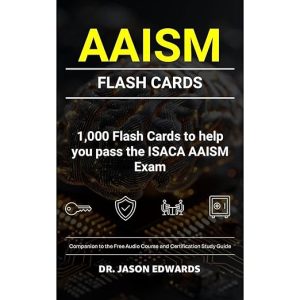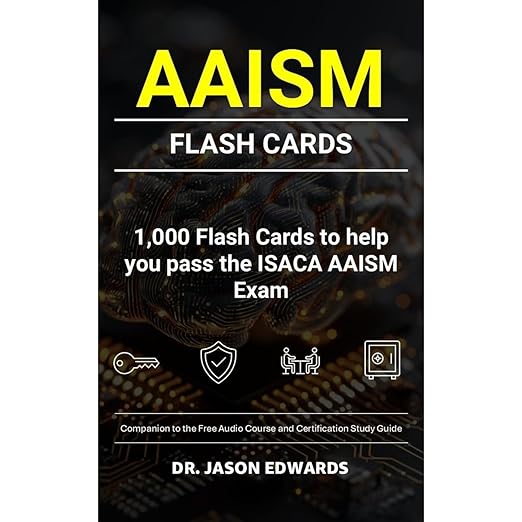
AAISM Flashcards for People With Jobs delivers exactly what its title promises, and that directness is why the audiobook format works for it. Jason Edwards, author of the Bare Metal Cyber Study Guides series, has built a companion tool to his main AAISM text: 1,000 flashcards spread across 31 hours and 13 minutes of Virtual Voice narration, designed to be broken into manageable daily sessions rather than consumed in one sitting. For security professionals studying for the AAISM exam around demanding work schedules, the format is not a compromise, it is the point. The card content covers both direct recall of terminology and model components alongside the judgment scenarios that security certification exams typically weight most heavily.
The AAISM Flash Cards audiobook operates on a clear pedagogical principle: the gap between understanding a concept and being able to retrieve it quickly under pressure is where exam candidates lose points, and that gap closes through repetition rather than rereading. Edwards designs the cards to serve two distinct functions. Direct recall cards test terminology, model components, and factual knowledge. Judgment cards test decision-making: how to handle conflicting information, which approach fits a given scenario, and what distinguishes a best answer from an almost-right answer. The audiobook delivers both in a format that accumulates over time into genuine exam readiness.
Virtual Voice narration carries this material without friction. The AI delivery is even and clear throughout the 31-hour runtime, which is what you need from a study tool rather than from a story. Listeners should not expect warmth or dramatic inflection; the value is in the consistency, which keeps the listening experience neutral enough that your attention stays on the card content rather than the narrator's performance. For flashcard audio, that is the right tradeoff. The AAISM certification's focus on application security and implementation methodology means that several of the judgment cards are testing scenario interpretation rather than pure recall, and the even pacing of Virtual Voice gives those cards the same neutral weighting as simpler definitional cards, which requires the listener to supply their own attention calibration.
Tracking AAISM Misses Builds a Revision Plan
Edwards frames the book around a calendar-habit model: set a daily target, complete it even on difficult days, and track which topic categories keep generating misses. Over a sustained study period, your miss pile becomes a personalized revision plan that is far more efficient than rereading chapters uniformly. That insight is not new to anyone familiar with spaced repetition research, but Edwards builds it directly into the book's usage instructions, which makes the methodology explicit rather than leaving it to the listener to figure out. The 31-hour runtime supports a multi-week program without running out of fresh material before the exam, and listeners who cycle through sections then replay their weak areas are implementing spaced repetition through audio replay without needing dedicated software.
The three-part study loop Edwards recommends, reading a chapter from the main AAISM for People With Jobs book to build understanding, listening to the mapped audio course to keep reasoning active during off-screen time, and using these flashcards to test recall and surface gaps, is a sound and repeatable system. Each component serves a distinct cognitive function. The flashcard audiobook is the retrieval-practice leg, and it works best in that role. Portability is a genuine advantage: commutes, travel, and the dead time between meetings become meaningful study windows rather than wasted hours, which is specifically valuable for professionals who cannot schedule consistent long blocks of uninterrupted study time.
Passive Listening Will Not Build AAISM Retention
As with all flashcard audiobooks, the format requires active engagement to be effective. Passive listening while doing something else will not produce the retrieval-practice benefit. The listener needs to attempt an answer before the card delivers one, which means pausing the audio mentally or physically before each response. Listeners who treat this as background audio rather than active drill will find the 31 hours of content sliding past without producing meaningful retention. That is a real risk with this format and worth naming plainly.
The Virtual Voice narration does not differentiate between high-priority and lower-priority cards. Every flashcard receives the same even delivery, which means listeners must supply their own judgment about where to focus additional repetitions. This is manageable if you track misses deliberately, as Edwards recommends, but it is worth noting for anyone who relies on a narrator's vocal emphasis to guide attention. AAISM Flashcards for People With Jobs is also transparent about what it cannot do: it does not replace learning the concepts. Listeners who approach the flashcards before building a solid foundation in the main material will find the cards more disorienting than useful.
Reliable Daily Drilling for Busy AAISM Candidates
Security professionals actively preparing for the AAISM exam who have completed or are progressing through the main AAISM for People With Jobs study material will find this audiobook a reliable daily drill tool. Busy professionals who study in short windows, commuters who want portable exam preparation, and candidates entering the final review phase before their test date are the ideal audience. Anyone who prefers a structured, calendar-driven approach to exam preparation rather than open-ended rereading will appreciate the way Edwards frames the usage methodology. Listeners who have not yet worked through the conceptual foundations should build those first; the retrieval loop only produces the intended result when there is something already in memory to retrieve, and the 31-hour runtime is most productive when it is reinforcing an established knowledge base rather than introducing concepts for the first time.
- Read by: Virtual Voice is even and consistent, an appropriate choice for flashcard content where neutral delivery keeps focus on the material.
- At its heart: AAISM exam preparation, spaced repetition, cybersecurity recall
- Vibe: Methodical and purposeful
- Short version: A reliable retrieval-practice tool for AAISM candidates who study in short daily windows and need portable exam preparation.