Tess Campbell's Prose Voice Is Her Speaking Voice
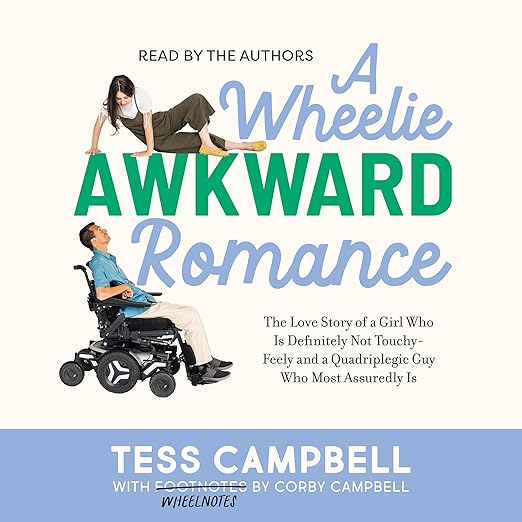
Tess Campbell narrates her own love story in this audiobook, and that choice alone tells you everything about the kind of memoir this is: unguarded, specific, and refreshingly unpolished in all the right ways. Reading about Corby's 'correctly punctuated dating profile' catching Tess's eye is one thing; hearing Tess herself deliver that line, with all the wry self-awareness it implies, is something else entirely. She wrote the book and she reads it, which means every joke lands exactly as she intended and every quiet moment of doubt feels genuinely unperformed. The decision to self-narrate is not always wise for authors who lack a performance background, but Campbell makes it work because her prose voice and her speaking voice are clearly the same person.
Memoir narrated by the author can go either way. Sometimes the voice is flat, the pacing uneven, the intimacy of the page lost in translation to audio. A Wheelie Awkward Romance avoids most of those traps. Tess's delivery matches her written persona: precise, a little guarded at first, then unexpectedly warm. The story of how one online message turned into twenty, then into a relationship that neither of them quite planned for, becomes especially vivid when the person telling it is also the person who lived it. That quality of being genuinely inside the story, not performing it from outside, is what distinguishes good self-narrated memoir from bad.
Corby's Wheelnote Footnotes Create a Call-and-Response
The book's structural hook, Corby's 'wheelnote' footnotes woven through Tess's narrative, is one of the more inventive formal choices in recent disability-adjacent memoir. It gives Corby a persistent voice without turning the book into a co-authored text, and it creates moments of genuine comic timing as his dry asides punctuate her more anxious reflections. This works especially well in audio because the tonal contrast between Tess's narration and the interpolated footnotes gives the listening experience a kind of call-and-response rhythm. You come to anticipate them and miss them when they're absent.
What distinguishes A Wheelie Awkward Romance from the more predictable disability-romance shelf is its refusal to be inspirational on demand. Tess is, by her own account, intensely logical, prone to anxiety, and deeply resistant to sentimentality. She doesn't fall in love with Corby because he teaches her something. She falls in love with him because he's funny and specific and writes with correct punctuation, and because the accumulation of small genuine moments eventually outweighs her considerable internal resistance. That's a more honest account of how attraction works than most books in this genre manage. It refuses the tidy arc.
Reviewer Michelle McClellan notes that the book gets 'hard to read because it was sad over and over,' which is accurate and worth flagging. This is not a light listen from start to finish. The challenges Corby faces as a quadriplegic, the practical logistics of care, the social friction of being a visibly disabled person in a world not designed for him, these dimensions surface with enough honesty to occasionally sting. Tess doesn't soften them for palatability. She also doesn't dwell on them for effect. The book's emotional range is its strength, and Campbell's narration holds that range with the naturalness of someone who has lived it rather than someone performing it.
Reviewer Amanda's five-star assessment lists exactly what the book delivers: real laughter, a challenging love story, an honest portrait of disability, and something that doesn't feel manufactured. That specificity of endorsement is worth more than a more general positive response, because it confirms the book is doing the precise thing it sets out to do. The detail about evening wheelchair rides and Tess's scarf-knitting habit, small concrete particulars that could feel trivial in a lesser book, accumulate into a genuine relationship portrait. The specificity is the point.
Generous Self-Deprecating Humor, Aimed at Herself
One reviewer notes that the book is 'mostly about her figuring out who she is and what she wants,' and that framing is worth taking seriously before you start. If you're expecting a sustained portrait of Corby's life and perspective, you'll find it in fragments rather than as a full through-line. Tess is the primary lens here, and her internal landscape, her anxiety, her logic-first approach to emotion, her gradual softening, occupies considerably more page time than Corby's daily reality. Some readers will find that centering entirely satisfying. Others may wish for a more equal distribution of interiority.
The title's pun is a signal: this book has a sense of humor about itself. The humor is never at Corby's expense. It's more frequently at Tess's expense, which is a generous and smart authorial choice. Self-deprecating narrators who genuinely mean it, rather than performing self-deprecation for the audience's comfort, are relatively rare in memoir. Tess Campbell is the real thing. Her ability to find herself slightly absurd, particularly in the early phases of the relationship, is what makes the warmer later sections feel earned rather than inevitable.
Skip It If You Need a Warm Arc
This audiobook rewards listeners who appreciate memoir that resists easy uplift. If you've been moved by books like Crying in H Mart or What My Mother and I Don't Talk About, the emotional register here, honest about difficulty without being defeated by it, will feel familiar. Listeners curious about disability and relationships, not as a medical narrative but as a fully human and often comic one, will find this among the more thoughtful treatments available in audio form. Self-narrated memoir fans will particularly appreciate the intimacy of hearing Tess Campbell read her own work.
Skip it if you need your romance arcs to be predominantly warm and forward-moving. The book has real friction and sustained uncertainty, and some sections hit harder than the lighter framing of the title might suggest. At just under seven hours, it's a contained commitment, but it earns every minute of that runtime through specificity rather than sentiment.
Quick Take
- Narration: Tess Campbell narrates her own memoir with precision and earned warmth; her dry delivery and the contrast with Corby's footnote voice give the audio a call-and-response rhythm.
- Themes: Disability and partnership, anxiety and openness, love built from specificity rather than sentiment
- Mood: Wry and honest, occasionally hard-going, ultimately warm
- Verdict: A self-narrated memoir about an improbable online connection that works because Campbell trusts her readers with the full, uncomfortable version of the story rather than the tidy one.
Before You Listen
Does Tess Campbell narrating her own audiobook affect the listening experience?
Significantly and positively. Her voice matches the book's written persona, precise and dry before becoming genuinely warm, and the self-narration means the comedic timing of lines like the 'correctly punctuated dating profile' lands exactly as written. The contrast with Corby's wheelnote footnotes creates a real call-and-response dynamic.
What are Corby's 'wheelnote' footnotes and how do they function in the audiobook?
They're Corby's own commentary interpolated throughout Tess's narrative, giving him a persistent dry voice without making the book a formal co-authorship. In audio, the tonal contrast between his footnotes and her narration creates an effective rhythm that you come to anticipate as the audiobook progresses.