At a Glance
- Read by: Jost self-narrating is essential; fifteen years of live television delivery means his comedic timing in the audiobook is calibrated at the professional level of his actual career.
- At its heart: Self-deprecation as craft, privilege and discomfort, Staten Island vs. elite Manhattan, family loss, the making of a professional comedian.
- Vibe: Controlled and funny with genuine tonal range; the September 11 chapter and the WrestleMania story exist in the same voice without contradiction, which is the point.
- Short version: A well-crafted comedy memoir audiobook that earns both its laughs and its serious moments; essential for SNL fans, rewarding for anyone who appreciates self-deprecation done at a professional level.
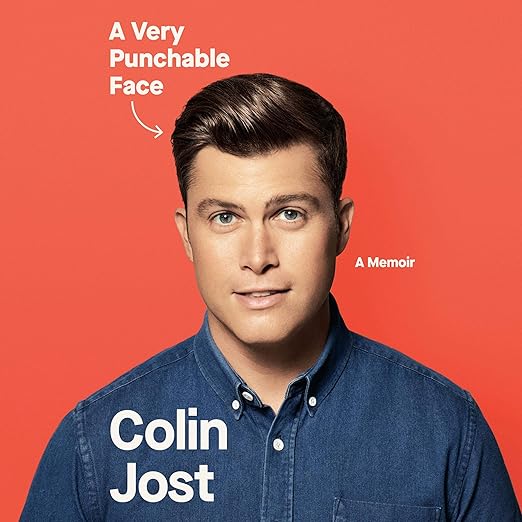
The craft of 'A Very Punchable Face' is not subtle, and Colin Jost is not trying to make it subtle. His essay collection, structured as a memoir of learning to take a punch, 'metaphorically and, occasionally, physically', works because Jost's fifteen years of writing for live television have given him a specific, professionally calibrated skill: he knows exactly when to land a line, when to hold back, and when to let something genuinely serious sit without reaching for a joke. The audiobook benefits enormously from his self-narration, which delivers these calibrations with the same confidence you would expect from the co-anchor of Weekend Update, because that is exactly the training ground they come from.
His Mother's 9/11 Chapter, Told With Restraint
Jost grew up in a Staten Island family of firefighters, commuted three hours a day to attend an elite Manhattan prep school, arrived at Harvard the year Facebook was being built in the adjacent dormitory, and ended up at Saturday Night Live as a writer before eventually becoming co-anchor of the program's most iconic recurring segment. The memoir's surface material is the self-deprecating autobiographical comedy that his public persona has always drawn on, Czech teenagers attacking him with potato salad, Jimmy Buffett saving his life, competing in a WrestleMania match against twenty-four other participants and 'almost winning.'
The deeper material is where the book distinguishes itself from the category of celebrity essay collections it could have settled for being. The chapter about his mother's experience as a physician at the scene of the Twin Towers collapse on September 11 is written and performed with a restraint that makes it the audiobook's most affecting passage. Jost does not play it for emotion or use it to pivot tonally. He reports it. The same voice that delivered the WrestleMania story delivers this chapter, and the consistency of register is the point. This is how he actually processes experience, through the same instrument, at the same controlled delivery, and that consistency is what makes him a specific kind of writer rather than a collection of comedic premises.
Larry David's blurb, 'I always wanted to punch his face before I read this book. Now I just want to kick him in the balls', is on the cover because it correctly frames what reading this book is like. Self-deprecation raised to the level of a genuine professional discipline. Sarah M.'s review is similarly accurate: 'adorable and funny, yet punchable face', which is Jost's entire brand, executed with competence that the audiobook makes legible in a way the print edition cannot quite achieve.
The Harvard chapter, the SNL early years, and the touring years performing stand-up for small audiences in institutional spaces all contain honest material about failure and confusion that celebrity memoirs often elide. Jost does not skip this period or compress it into a montage. He spends time in it, which makes the later success feel earned rather than inevitable.
A Narrator Who Never Underlines Punchlines
Jost's SNL experience is a literal professional credential for what the audiobook's narration is doing. Weekend Update is written for the ears of a live studio audience and broadcast to millions of viewers who are watching and listening simultaneously. Jost has been calibrating comedy delivery for audio-visual reception for over fifteen years. The result in this audiobook is narration that never over-explains a joke, never underlines its own punchlines, and never misses a pause. Duane Schneider's description, 'often laugh out loud funny', reflects what those calibrations produce in a listening experience. These are not accidental moments of humor landing. They are professional comic timing working exactly as intended in a new format.
The confessional honesty that Sharon f. leff identifies is also real and distinct from what comedy memoirs usually deliver. The honesty is not about making himself look bad, Jost is not performing vulnerability. It is about specificity. He names specific amounts, recalls specific incidents with the precision of someone who has processed them so many times they have become reliable material. The memoir's emotional texture comes from that specificity rather than from any manufactured openness.
Some Chapters Are Just Dinner Party Stories
The essay format means the book does not have a traditional narrative arc. Chapters are self-contained, loosely chronological but not rigorously so, and the book does not build toward a conclusive statement about who Jost is or what his life definitively means. Listeners who want memoir with strong forward momentum, a clear journey with a declared destination, may find the structure somewhat associative and oblique.
Some chapters are lighter than others. A few of the anecdote essays function as very good dinner party stories rather than genuinely revealing memoir. Sharon f. leff notes that 'legitimate substantive content was occasionally replaced with bits for jokes', which is a fair structural observation. The bits are excellent bits. But they are still bits in the way that some of the more personal chapters are something more than that.
Behind-the-Scenes Value for Weekend Update Fans
SNL followers and Weekend Update fans will find the behind-the-scenes content essential. Jost's account of how the segment is written and performed, what the SNL writers' room culture actually looks like from the inside, and what it costs to be the person sitting at that desk delivering political comedy in real time, all of this is valuable documentary content that exists nowhere else. Sharon f. leff notes that 'Jost's memoir could become a sitcom like Jerry Seinfeld's classic', which is both a compliment and an accurate description of its sensibility.
Listeners who want a comedy memoir audiobook that earns its humor through professional craft rather than shock or self-pity will find this book consistently satisfying. Jost is a writer who has spent fifteen years making other people's material funnier. When he applies that skill to his own life in audio, the result is a memoir that functions exactly as promised. Larry David was right. You will want to punch his face. You will also find it genuinely, technically impossible.
Common Questions
Do I need to follow Saturday Night Live to appreciate this audiobook?
No, though SNL familiarity considerably enriches the backstage sections. The memoir's other material, childhood on Staten Island, Harvard, the early comedy touring years, works independently of any knowledge of SNL or Weekend Update.
Is the audiobook format significantly better than the print edition for this book?
Yes. Jost's delivery has been shaped by fifteen years of writing for live audiences, and his timing is what makes the comedy function properly. Print communicates the jokes; the audiobook performs them with the precision of a professional comedian who has been rehearsing this particular skill for his entire career.
What is the audiobook's structure?
Essay collection with loose chronology. Chapters are largely self-contained and the book does not build toward a traditional narrative conclusion. Listeners who want a strongly linear memoir should know the format is more associative than sequential, though the overall arc from Staten Island to SNL is present.