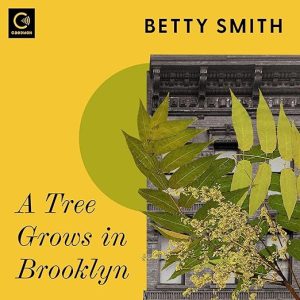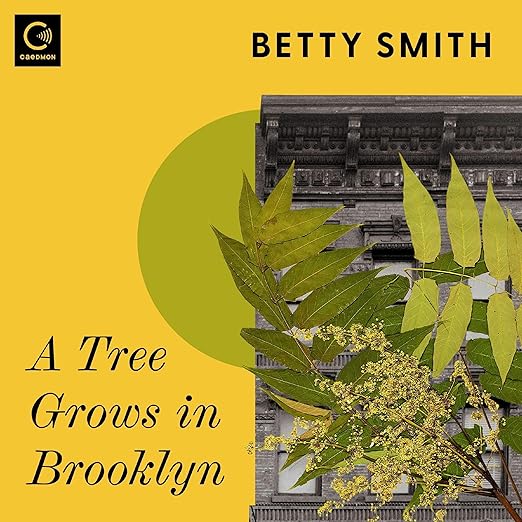
Williamsburg's tenement slums shaped Francie Nolan into someone stubborn enough to survive an unstable, often heartbreaking childhood, but could that same environment have produced anyone gentler? Betty Smith's 1943 novel has spent more than eighty years answering that question by refusing to simplify it: Francie's father Johnny is loving and hopelessly unreliable, her Aunt Sissy marries and remarries without bothering with divorce, and the family's poverty is constant without ever fully defining who any of them are as people. This audiobook, read by Kate Burton across just under fifteen hours, gives that turn-of-the-century Brooklyn its full due, the weekly junk-day economy of traded scraps, the fierce, protective love inside a genuinely chaotic household, the small triumphs that matter enormously because so little else is reliable.
Smith Refuses to Flatten the Nolans' Poverty
Smith's real achievement is refusing to let poverty flatten the Nolans into either tragedy or inspiration porn; the family's 'erratic and eccentric behavior,' as the synopsis itself puts it, gets treated with the same clear-eyed tenderness whether the moment is a drunken humiliation or a stolen afternoon of real joy. Mary E. Trimble's review, from a reader revisiting the novel decades after a first read, notes absorbing far more of 'the rich, sensitive writing' on this second pass than she remembered from the first, a common reaction to a book that rewards adult rereading precisely because so much of its emotional complexity is easy to miss as a younger reader. First published in 1943, the novel has outlasted most of its contemporaries specifically because it never moralizes about the Nolans' choices, it simply shows them clearly and lets a listener draw their own conclusions.
The novel's real subject is less plot than atmosphere and accumulation, the specific rhythms of a place and time, junk day, tenement stairwells, the small rituals that make hardship survivable, rendered with enough precision that the 1900s Brooklyn setting becomes as fully realized as any character. The New York Times blurb quoted in the synopsis calls it a book that 'cuts right to the heart of life,' and that assessment holds up: this is not a plot-driven page-turner so much as a slow, accumulating portrait of a girl becoming herself despite, and partly because of, everything stacked against her.
Francie's Library Habit Becomes Her Real Education
Francie's relationship with books and libraries, established early and returned to throughout, gives the novel a specific throughline that resonates differently depending on a listener's own relationship with reading: her insistence on working through the library alphabetically, one book at a time, becomes a quiet metaphor for the kind of self-directed education poverty could not otherwise provide her. That detail alone has made the novel a perennial favorite among librarians and educators for eight decades running.
Burton Keeps the Theatrics Restrained and Domestic
Kate Burton's narration keeps a theatrical instinct properly restrained for a novel built on domestic scale rather than grand incident, and that restraint is the right call throughout. Immigrant vernacular and period-specific Brooklyn speech patterns come through as naturally spoken rather than performed for effect, which matters enormously in a book where dialogue carries so much of the family's emotional texture. Burton also handles the novel's gradual shift from a child's perspective to something closer to an adult's understanding with real subtlety, a gradation rather than a sudden switch, tracking Francie's own growing awareness of her family's failures alongside her love for them.
Fifteen hours is a real commitment, but the episodic, almost novelistic-vignette structure of the book makes it easy to absorb in discrete sessions without losing the thread; you can leave and return to the Nolans' Brooklyn the way you might revisit a familiar neighborhood. For listeners who already love Betty Smith's prose on the page, or who have never read the novel and only know its reputation as an American classic and PBS Great American Read pick, the audio format adds real value specifically because so much of the book's power sits in voice, Francie's, Johnny's, the whole cacophonous, loving, exhausting family unit talking over each other.
Burton's pacing also handles the novel's structural looseness well, since Smith moves between tightly scened chapters and broader, essayistic passages about neighborhood ritual without much formal transition. A less disciplined narrator might make those shifts feel like whiplash; Burton treats both modes as part of one continuous voice, so the novel's meandering, memoir-like quality reads as intentional rather than unfocused.
Most Reviews Here Are About Other Editions
Pacing is deliberately unhurried, closer to a family chronicle than a tightly plotted novel, and listeners expecting propulsive incident every chapter should recalibrate; the book's tension comes from accumulated hardship and small moments of grace rather than dramatic reversals. Alcoholism, poverty, and the quiet damage both inflict on a family are handled with real honesty rather than melodrama, which means some passages sit with discomfort longer than a plot-driven novel typically would, and that patience is the point rather than a flaw to route around. The genre tag attached to this listing leans toward the educational, which undersells what is actually a work of literary fiction; approach it as a novel first, not a lesson, and the fifteen hours land very differently.
Most of the print reviews attached to this listing turn out to be about other editions entirely rather than the audio production itself, one flags a musty used paperback, another gripes about garbled text on a Kindle edition, leaving little direct listener commentary specifically about Kate Burton's reading. That gap is worth naming honestly rather than papering over with borrowed enthusiasm; judging the narration specifically means leaning on Burton's own established track record with period pieces and close character work more than on this particular listing's thin review count of twenty-four ratings. None of that reflects poorly on the audio edition itself, it simply means a prospective listener has less crowd-sourced narration feedback to weigh than a more heavily reviewed title would offer.
Readers of Literary Classics Will Feel at Home
Readers of American literary classics, anyone assembling a personal syllabus around the Great American Read list, or listeners who love slow, character-driven coming-of-age fiction in the vein of Willa Cather or Harper Lee will find exactly what the reputation promises. It also works well as an introduction for someone who has always meant to read this specific classic but never gotten around to the print edition; Kate Burton's steady, unshowy narration removes any intimidation factor a dense, decades-old novel might otherwise carry.
A fast-plot mystery or thriller this is not, and anyone craving momentum over atmosphere would be better served elsewhere in the catalog. Listeners sensitive to depictions of alcoholism and its effect on a family, portrayed here without any sentimental softening, should also go in with that expectation set. For anyone genuinely open to a slower, richly observed portrait of one girl's Brooklyn childhood, though, fifteen hours is a small price for a genuine American classic done justice.
- Performance: Kate Burton keeps her theatrical instincts restrained, letting immigrant vernacular and period detail feel naturally spoken rather than performed.
- What it covers: poverty and resilience, family dysfunction and love, coming of age in turn-of-the-century Brooklyn
- Feel: Heartbreaking and uplifting in equal measure
- Our call: A rich, unhurried classic best suited to listeners who value atmosphere and character over plot momentum.