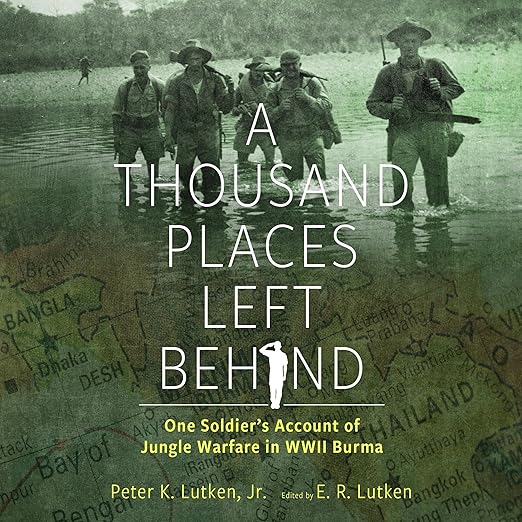
Peter K. Lutken Jr. was a young man from the Mississippi backwoods who ended up commanding an entire battalion of Kachin fighters behind Japanese lines in northern Burma during World War II. That premise sounds like the setup for a Hollywood screenplay. In this audiobook, what makes A Thousand Places Left Behind something more than that is how Lutken himself described it decades later: without heroic posturing, with genuine respect for the Kachin people who fought alongside him, and with the specific kind of honesty that comes from a man who has had fifty years to think about what he did and what it meant.
David Lutken narrates this audiobook, and the fact that the narrator shares the subject's family name is not incidental. This is the story of Peter Lutken told by his son David, and that relationship gives the narration a dimension no hired professional could replicate. I came to this audiobook knowing almost nothing about OSS Detachment 101 or the Burma theater of World War II, which is precisely why the book is so valuable: this is a corner of the war that the popular history has largely ignored, and Lutken's story opens that corner with extraordinary specificity.
A Little-Known Unit Even Extensive Readers Miss
The book is built from hundreds of pages of transcripts from recordings Lutken made late in his life, and that origin shapes both its strengths and its structure. The voice is conversational, direct, and disinclined to dramatize events that were already sufficiently dramatic on their own terms. Lutken describes rafting uncharted rivers, engaging in guerrilla warfare against Japanese forces, learning the Kachin language and customs, and surviving the kind of experiences that would occupy most memoirs for their entire length, but he does so in the matter-of-fact register of a man who did what was in front of him and expected others to do the same.
The historical dimension is equally strong. OSS Detachment 101, the American intelligence unit in which Lutken served after being transferred from the British V Force, is little-known even among readers with extensive World War II knowledge. The Burma theater, involving American and British forces alongside local populations against a Japanese occupation, has received a fraction of the attention given to the European or Pacific theaters. Lutken's account fills specific gaps in the record with firsthand testimony that is otherwise unavailable.
The Kachin people themselves emerge as fully realized participants in the history rather than background figures. Lutken's genuine admiration for them, the respect he developed for their language, customs, and fighting ability, comes through on every page, and the postscript about 'Project Old Soldier,' the crop exchange program he and other veterans of the unit initiated in the 1990s that lasted until after his death in 2014, demonstrates that his relationship with Burma and its people was not confined to the war years.
A Reading That Suggests Someone Who Knew the Man
David Lutken's narration of his father's memoir is one of the genuine privileges of the audiobook format when it is used this way. His reading carries an intimacy and careful attention that suggests someone who knew the man behind the stories, not just the transcripts. The Mississippi cadence in the prose is handled with natural ease, and the emotional weight of certain passages, particularly those dealing with casualties and the difficulty of returning home, lands with appropriate gravity without performance.
A reviewer who described the book as filled with 'moments and participants no one else knows about' captures something essential about why this audiobook matters. The combination of a story that has not been told elsewhere and a narrator who has personal stakes in telling it faithfully makes for an audio experience that justifies the ten-hour-and-forty-five-minute investment with considerable force.
The maps, which are described in the production materials as based on Lutken's personal travels, are noted as available in a companion format. For an audiobook about jungle navigation and guerrilla warfare across specific terrain, those visual aids may be useful for listeners who want to follow Lutken's movements geographically, though the audio experience conveys the essential story without them.
Chuck in NC on Lutken Unwilling to Categorize
The book is based on oral history transcripts rather than written memoir, and that origin produces a narrative voice that is more episodic than continuously structured. Events are presented with the organizational logic of memory rather than literary chronology, which works as an approach to the material but means some listeners may find the pace uneven across the ten-hour runtime. This is the honest shape of a man talking about his life over a very long time, and Lutken's editor and family have done careful work to shape those transcripts into something coherent, but listeners who prefer tightly structured narrative may notice the episodic nature.
One reviewer, Chuck in NC, raised a pointed observation: that Lutken seemed unwilling to categorize the Japanese forces with the severity he felt was appropriate. This reflects a genuine tension in the book between Lutken's personal moral accounting of the war and the reviewer's expectations for that accounting. Lutken is consistently honest about the violence and difficulty of the conflict without adopting the language of dehumanization that characterized much American wartime rhetoric about Japanese forces. Listeners will form their own views on that choice.
The postwar section and the 'Project Old Soldier' program deserve particular attention. The fact that Lutken and other OSS veterans maintained meaningful connections to Burma and the Kachin people for fifty years after the war ended is not a coda to the story but a demonstration of what the war actually meant to the people who fought it. The book handles this dimension with real emotional intelligence.
Irreplaceable in the Precise Meaning of the Word
Listeners with an interest in World War II history, particularly the lesser-known theaters and units, will find this audiobook fills genuine gaps in their knowledge. Anyone interested in the history of American intelligence operations, the OSS, or the precursors to the CIA will find the Detachment 101 material substantive and specific. Military history readers who want a firsthand account rather than third-person narrative will find the oral-history format rewarding.
Listeners who want tightly structured military narrative or comprehensive coverage of the Burma theater from a strategic perspective should supplement this book with broader histories. But as a firsthand account of what it was like to move through northern Burma in the 1940s alongside Kachin fighters, to learn their language and earn their trust, and to live with the consequences of that experience for the rest of a long life, A Thousand Places Left Behind is irreplaceable in the precise meaning of that word.
Before You Listen
Why does David Lutken narrate his father's audiobook, and how does the family relationship affect the performance?
David Lutken, the author's son, narrates the memoir because the book is built from oral history recordings his father made late in life, and the family undertook the project of shaping those transcripts into this volume. His narration carries an intimacy and careful attention to his father's voice that suggests someone with deep personal stakes in the material. The emotional weight in the memoir's more difficult passages lands differently when delivered by someone with that direct connection.
What was Project Old Soldier mentioned in the audiobook, and why does it matter to the story?
Project Old Soldier was a crop exchange program that Lutken and other veterans of OSS Detachment 101 initiated in the 1990s, decades after the war, to support the Kachin people in Burma. It lasted until after Lutken's death in 2014 at age 93. The program demonstrates that his connection to Burma was not bounded by the war years but remained a genuine commitment for the rest of his life, which gives the earlier sections of the memoir additional weight.