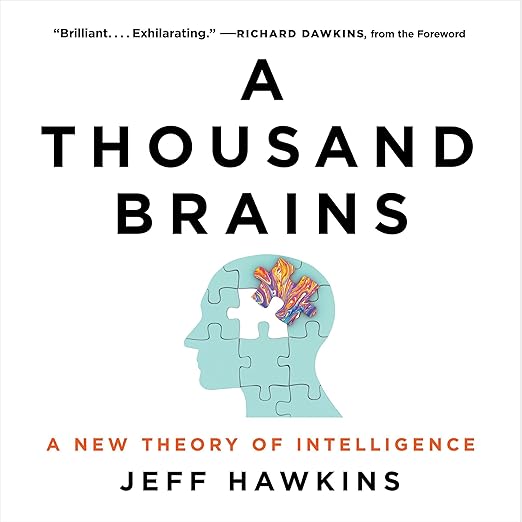
Jeff Hawkins spent years after founding Palm Computing working on a single problem: how does the neocortex actually produce intelligence? Not what the brain does in a functional sense, but the specific mechanism by which biological tissue gives rise to understanding. A Thousand Brains is his attempt to bring that research to a general audience, and this audiobook, narrated by Jamie Renell, gave me about four hours of what I would describe as one of the clearest explanations of consciousness and intelligence I had encountered in years, followed by a second section that made me want to argue back.
That pattern turns out to be a feature, not a flaw. Hawkins knows his theory is not yet settled science, and he presents it with enough intellectual honesty that the places where he reaches beyond his evidence are visible rather than hidden. The audiobook format suits the material in a particular way: Hawkins is building an argument that depends on layering, each concept setting up the next, and Renell's narration keeps that architecture legible without making it feel schematic.
The Verdict, Briefly
The theory at the heart of the book is that the brain does not build a single model of the world, but hundreds of thousands of models in parallel, each one held in a column of neocortical cells. Every part of the neocortex is doing the same basic computation, with each column using maplike reference frames to build its model of whatever it is processing, whether that is visual input, a physical object, or an abstract concept. The thousand brains of the title are not metaphorical; they refer to this distributed system of modeling that Hawkins argues is the basis of everything we understand as intelligence.
The first section of the audiobook, which covers the biological evidence and the theory's explanatory power, is genuinely exceptional. One reviewer compared it to On the Origin of Species in terms of its potential impact on how we understand intelligence, and while that comparison is ambitious, it reflects something real: Hawkins provides a more concrete mechanism for intelligence than most popular neuroscience manages. He can explain why humans have a sense of self, why we perceive a unified world despite receiving fragmented sensory input, and why certain kinds of knowledge resist verbal description, all from within the same theoretical framework.
The Best Parts of A Thousand Brains
The audiobook rewards listening over reading for one specific reason: Hawkins builds his argument in real time, and Renell's pacing gives the listener space to absorb each step before the next arrives. The neocortical column structure and the concept of reference frames are not intuitive ideas, but Hawkins works from analogy and concrete example in a way that audio delivers more effectively than text, because the format removes the option to slow down, underline, or flip back. You are carried through the argument at the author's intended pace, and that turns out to be an asset for material this dense.
At eight hours and forty minutes, the audiobook covers three substantially different territories: the biological theory, the implications for artificial intelligence, and a speculative final section on the long-term future of machine intelligence and human civilization. The transitions between these sections are not equally smooth, and a reviewer who listened with a technical background noted that the AI section, which argues that machine intelligence built on current deep learning approaches cannot achieve human-like general intelligence, moves from empirical argument to polemical assertion in ways that are worth noticing. That shift does not undermine the first section, but it does mean the audiobook is not uniformly reliable as a guide to the current state of AI research.
Points to Consider
Hawkins is a theorist with a specific commitment to his framework, and the audiobook's second and third sections reflect that commitment in ways that sometimes outrun the evidence. His argument that AI can only achieve genuine intelligence if it replicates the neocortical column structure is intellectually coherent but contested; listeners with backgrounds in machine learning or cognitive science will notice places where he is making a philosophical claim about the nature of intelligence rather than reporting an empirical consensus.
That is not a reason to dismiss the book. It is a reason to listen actively and hold the first and second halves somewhat separately. The theory of how the neocortex works is supported by converging evidence from multiple research programs; the claims about what AI can and cannot achieve are more speculative. Renell's narration does not differentiate between these registers, which puts some responsibility on the listener to do that work.
Who Should Pick Up A Thousand Brains
Listeners with a general interest in how the brain works, or in the philosophical questions surrounding artificial intelligence, will find this audiobook substantive and accessible. Hawkins does not require a neuroscience background; he builds everything from first principles using clear analogies.
Those who want a rigorous, peer-reviewed survey of current neuroscience or AI research should look elsewhere. A Thousand Brains is the work of an inventor with a theory, not a textbook survey. Listeners who appreciate that distinction and are willing to engage with a big, contested idea on its own terms will find the first half of this audiobook among the more intellectually satisfying in the popular science space. The second half requires more critical distance, but that tension makes for a more interesting listen than a book that stays safely within its lane.
Do you need a background in neuroscience to follow this audiobook?
No. Hawkins builds his argument from first principles using concrete analogies, and Jamie Renell's narration maintains a pace that gives listeners time to absorb each concept before moving on. Some scientific literacy helps, but the book is written for a general intelligent audience.
How does the audiobook handle the transition between the neuroscience and the AI sections?
The transition is notable rather than seamless. The book moves from empirical biological theory to more speculative claims about AI and the future of intelligence, and some reviewers have flagged that the second and third sections are less evenly supported than the first. The audiobook presents all three sections in the same register, which puts interpretive responsibility on the listener.