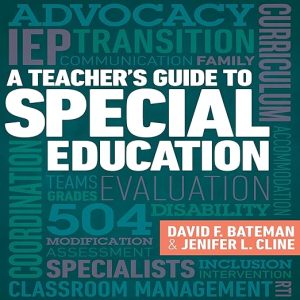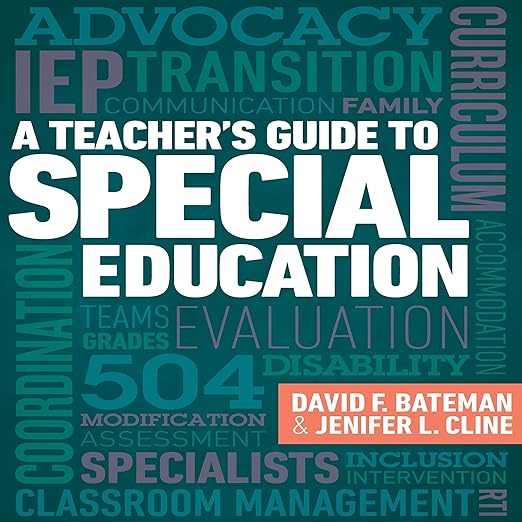
IEP meetings, Section 504 accommodations, and transition plans running from preschool through postschool life: David F. Bateman organizes this audiobook to move from legal framework straight into classroom practice, a structural choice that separates it from denser special-education law texts built for administrators rather than teachers standing in front of a class. A Teacher's Guide to Special Education runs six hours and forty-seven minutes, narrated by Kim Handysides, and it's worth noting upfront that the synopsis itself credits a second author, special education administrator Jenifer L. Cline, even though the byline lists Bateman alone. Bateman is also the author of the related A Principal's Guide to Special Education, and this teacher-facing companion covers the pre-referral, referral, and evaluation processes, individualized education programs and the parties involved in them, and accommodations for students who don't qualify for special education but fall under Section 504.
IDEA Is Federal Law for Every Classroom Teacher
The scope here is genuinely comprehensive for a working reference: classroom management and student behavior strategies, educational frameworks and service delivery options, and the assessment, grading, and diploma questions that come up constantly in inclusive classrooms but rarely get direct training. The book is published by Echo Point Books and Media, an independent bookseller based in Brattleboro, Vermont, with audio engineering credited to Blake Rook, and purchasing it also unlocks an accompanying PDF alongside the audio, which matters given how much of the material, appendixes of key terms and definitions especially, functions as reference content rather than a linear narrative.
IDEA itself, the Individuals with Disabilities Education Act, is federal law, which means the processes Bateman and Cline walk through here, pre-referral, evaluation, individualized education programs, aren't optional best practices a school might choose to follow; they're legal requirements every public school district in the country has to meet. That's precisely why a book aimed at general education teachers rather than special education specialists matters so much: the legal obligation doesn't fall only on the specialists down the hall, it falls on any teacher with a student who has, or might need, an IEP or a 504 plan in their classroom, which describes an enormous share of working teachers whether they received formal training on it or not.
Handysides Keeps IEP and 504 Distinctions Clear
Kim Handysides is exactly the right narrator for legal-procedural content this dense. She navigates acronym-heavy passages, IDEA, IEP, Section 504, without letting distinct legal concepts blur into each other, a real risk in material this technical when read by someone less careful. Her pacing also shifts appropriately between the legal-framework sections, which demand slower, more precise delivery, and the classroom-strategy sections, which move more naturally at a conversational clip. That calibration reflects a narrator choosing reliability and clarity over performative expressiveness, exactly the right call for professional reference material where a listener needs to trust every acronym and every distinction between IEP and 504 eligibility.
Reviewer Molli Davies captures a real, ongoing use case directly: she describes returning to the book when filling out paperwork, treating it less like a one-time listen and more like a resource she keeps coming back to throughout the school year. Reviewer Stephanie anderton, a first-year special education and fourth-grade teacher, confirms the book delivers real, usable information for someone newly navigating this exact territory, precisely the audience Bateman and Cline appear to be writing for: teachers who need practical grounding, not academic theory.
Listen Over Summer, Before IEP Season Starts
The tension worth naming directly: this is a reference book that many teachers, per Molli Davies's review, will want to return to for one specific answer mid-year, not necessarily relisten to from the beginning. Audio doesn't support that kind of quick lookup as naturally as a searchable PDF or print index does, which is exactly why the included PDF matters so much here. Plan to use the audiobook for your first full pass through the material, building genuine understanding of how these processes connect, and lean on the PDF later when you need to find one specific answer, a Section 504 eligibility distinction or a transition-planning deadline, quickly during an actual school year.
Reviewer M. M. calls the book comprehensive with easy-to-follow chapters, which matches the overall structure, though comprehensive here means genuinely broad, covering everything from pre-referral processes through diplomas, rather than narrowly focused on one specific area like behavior management alone. Listeners hoping for deep specialization in a single topic, autism-specific strategies or reading intervention specifically, for instance, will find this book's breadth is intentional but means less depth on any single specialization than a topic-specific title would offer.
Timing matters more than usual for a book like this. Listening through the full six hours and forty-seven minutes during summer break, before a new school year and its first round of IEP meetings actually begins, will serve most teachers better than trying to absorb the material reactively once a specific student's paperwork is already due. The legal and procedural content especially benefits from that lead time, since terms like pre-referral and transition planning are easier to internalize before you need them under real deadline pressure than while you're scrambling to apply them correctly for the first time in an actual meeting.
General Education Teachers Need This Legal Grounding
This is squarely built for general education teachers with students with disabilities in their classrooms, which describes most classrooms given how common inclusive placement now is, and it's especially valuable for first-year teachers navigating this territory for the first time, exactly Stephanie anderton's situation. School administrators wanting a shared reference point with their teaching staff, and anyone studying for a special education certification requirement, will also find the comprehensive legal grounding genuinely useful rather than superficial.
Parents of students receiving special education services may also find real value here, since understanding how their child's general education teacher is expected to navigate this exact legal and procedural landscape can make IEP meetings feel less opaque from the other side of the table.
Skip this if you're looking for a narrative teaching memoir with anecdotes and inspiration rather than legal-procedural reference material; this book is built for practical utility, not storytelling. It's also worth pairing with the included PDF rather than relying on audio alone if you already know you'll need to search back to a specific section repeatedly during the school year, since that kind of quick lookup is where a purely linear listen shows its limits.
Before You Listen
Does the audiobook cover IEP meetings and Section 504 accommodations?
Yes, in real depth. It covers individualized education programs and the parties involved, plus accommodations for students who don't qualify for special education but fall under Section 504, alongside the broader referral and evaluation process.
Is Jenifer L. Cline credited as a co-author of this audiobook despite the single byline?
The synopsis explicitly names special education administrator Jenifer L. Cline as a contributing author alongside David F. Bateman, even though the listing's byline credits Bateman alone.