Before You Press Play
- Narration: George Saunders is credited with reading his own seminar, which is as close to the material's native form as audio gets, though nobody on this listing has assessed the recording.
- Themes: Close reading as craft training, four Russian masters of the short form, what fiction asks of the person reading it.
- Mood: Patient, companionable, unmistakably a classroom.
- Verdict: The most serious writing course you can buy in this format, provided you accept that it expects you to reread.
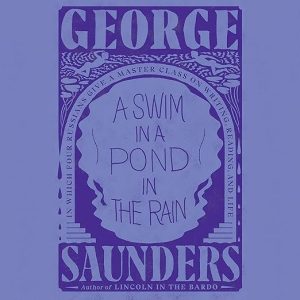
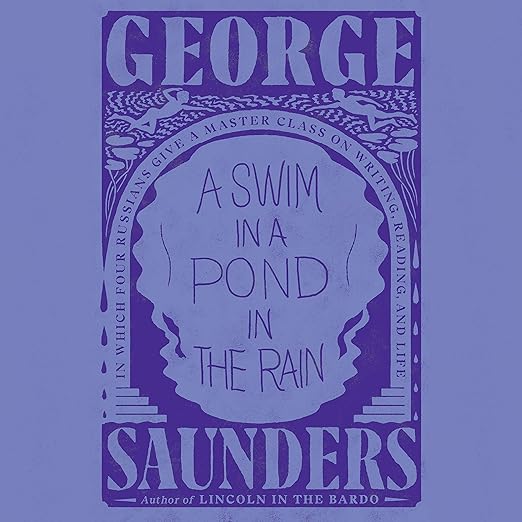
Fourteen hours and forty-four minutes is an unusual length for a book of seven essays, and that number is the first thing worth understanding about this audiobook. George Saunders has spent two decades walking MFA students at Syracuse University through the nineteenth-century Russian short story, and what the publisher offers is a version of that class. The essays come paired with the stories themselves, by Chekhov, Turgenev, Tolstoy and Gogol, and that pairing is where the hours go. Nobody sells a craft manual at this length. You are buying a syllabus.
I have worked through a fair number of books about writing, and most are advice books: rules, checklists, encouragement. Saunders is doing something else. He reads a story alongside you, stops when it ends, and asks what happened to you while you were reading it. His own introduction, quoted in the description, calls the seven stories "fastidiously constructed scale models of the world," which tells you what kind of attention the book expects in return.
Five Reviews, and None Describe the Listening
Seven essays, four writers, one classroom method. Saunders approaches the stories, in the publisher's phrasing, "technically yet accessibly", and the technical half is real: he wants to know why one sentence keeps you reading and why the next one loses you. Brian Shevory, who chose the book for a reading group, describes Saunders "deconstructing and analyzing these texts from different stylistic methods just like he would in his writing seminars". K Green, writing from Australia, sets the difficulty in course-catalog terms, calling it "a Writing 102 course" and warning that "you won't get the fundamentals".
What none of these five reviews does is describe the listening. Every one of them talks about reading. Brian Shevory notes that Saunders "also provides these stories in the text, so we can read along"; Joy Llewellyn tells you to "make a cup of tea or coffee and settle in for an amazing reading experience." That is evidence about which edition this enthusiasm attaches to, and it matters here more than on most books, because the method being taught is close reading.
Saunders Turns a Skeptic Into a Watcher
Saunders is credited with reading the book himself, and on material like this the self-narration is not a marketing convenience. The essays began as a seminar. They were spoken in a room, to students, for twenty years before any of it became a manuscript, and the prose still carries that shape: the aside, the doubling back, the question left hanging. Nobody on this page has said a word about how the finished recording sounds, so I will not pretend to know. What I can say is that the material was built for a voice rather than adapted to one.
Structure helps too. The design hands you stopping points: a story, then Saunders on the story, seven times over. Joy Llewellyn came to this writer late and says so, "I only recently learned of this writer, much to my chagrin," then credits the book with teaching "so much about writing in his Master Class notes after each story". Read that as a description of pacing and it becomes useful: the book is meant to be interrupted.
Steve Krizman's review is the most useful one here for deciding whether this is for you. It describes being walked "through seven short stories written by the famous Russian writers of the 19th century" and then admits, "I'm not a fan of short stories." The next sentence begins "After reading" and the text breaks off at exactly that point, so where the admission finally landed is never said. What survives is the mechanism: Saunders got a self-declared skeptic of the form to watch their own reactions in real time.
Too Much School Textbook, One Reviewer Says
The obvious tension is between the method and the medium. Saunders is training you to slow down, reread a paragraph, notice the exact line where your attention slipped. Audio moves at one fixed speed and will not let you glance back without effort. Treat the recording as the lecture and keep the stories to hand in some form you can mark up, because rereading is not an optional extra in this argument but the argument itself.
The description also flags a PDF companion holding the book's tables, outlines, figures and appendices. Download it the day you start rather than three essays in. Anything an author sets out as a figure sits there because a sentence could not carry it.
The only review here below five stars deserves reading before you buy. A two-star notice from Italy, written in Italian, grants that Saunders writes well and then objects that the book is "troppo testo scolastico," too much of a school textbook, built on analysis this reviewer does not enjoy. It goes further and doubts the original authors were thinking along the lines Saunders proposes. I read that as a fair description of what the book is rather than a claim that it fails. If close analysis already irritates you on the page, fourteen hours of it will not convert you.
A last note on the numbers. The displayed average rests on a very small pool of ratings, so read the score as decoration and the reviews as the evidence. That enthusiasm comes from people who write or want to: a reading group pick, a self-identified writer, a reader of dozens of how-to-write books. It is a narrower group than the description implies when it addresses "anyone interested in how fiction works".
Skip This if Russian Fiction Sounds Like Homework
Writers who have already absorbed the standard advice books are the natural audience. If you have never been told to show rather than tell, start somewhere else and come back. If you have been told it a hundred times and still want to know what is actually happening inside a paragraph that works, this is the level up.
Readers who arrived through Lincoln in the Bardo or Tenth of December, both named in the description, will find the machinery under his own fiction explained by the person who assembled it. Reading groups are served too, though a group would want everyone holding the stories in a form they can annotate.
Pass on it if you need a fast guide to finishing a draft, if nineteenth-century Russian fiction sounds like homework you already escaped, or if line-by-line analysis bores you. Pass too if the length itself is the obstacle. What I would do before buying is play a few minutes of the sample and ask one question: does this sound like a teacher you would happily sit with for the equivalent of two working days? That is the commitment, and for the right listener it is time well spent.
A Few Questions About A Swim in a Pond in the Rain
Does the audiobook include the Russian short stories themselves or only Saunders's essays?
The description says the seven essays are paired with the stories, and Brian Shevory's review confirms the stories are supplied so a reader can follow along. Nothing on this page states how the audio handles them, but a runtime approaching fifteen hours is far longer than seven essays alone would need.
How important is the PDF that comes with this audiobook?
Important enough to open on day one. The description lists tables, outlines, figures and appendices, which is material an author moves out of the prose precisely because prose could not hold it. Skip it and you keep the commentary while losing the scaffolding built to support it.
Do I need to have read Chekhov, Turgenev, Tolstoy or Gogol first?
No. Brian Shevory allows that prior familiarity probably helps, then points out that the stories come with the book. Arriving cold has a genuine advantage, since Saunders keeps asking what your reactions were as they happened, and a story you already hold opinions about is harder to read that way.
Is this a beginner's guide to writing fiction?
Not by the estimate of the reviewer who put it best. K Green places it well above the introductory tier and says plainly that the fundamentals are not in it. Come with a draft or two behind you and it works as a step up; come with nothing and you will be missing the vocabulary it assumes throughout.