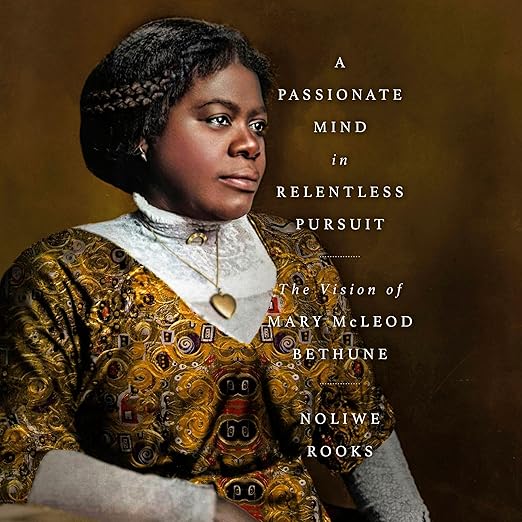
Mary McLeod Bethune is one of the most consequential educators in American history, and yet the average American today can barely place her name. That gap between significance and recognition is exactly what Noliwe Rooks sets out to close in A Passionate Mind in Relentless Pursuit, and this audiobook does it with an intimacy that biographical scholarship rarely achieves. Danielle Lee James narrates across just under four hours, a short runtime that suits the book's essayistic ambition: Rooks is not trying to write a comprehensive biography but a corrective, an argument about why Bethune belongs at the center of any serious account of Black American achievement in the twentieth century.
Bethune is the only Black American whose statue stands in Statuary Hall of the US Capitol, a fact Rooks mentions early and deliberately. The detail is meant to jolt the reader: how can someone significant enough to occupy that space be so thoroughly absent from popular historical consciousness? Rooks answers the question through specificity rather than abstraction. Bethune was the fifteenth of seventeen children, the first in her family born into freedom after emancipation, and she survived conditions that would have ended most ambitions entirely. By twenty-nine, she had founded a school in Daytona, Florida, for five girls that would eventually become Bethune-Cookman University. She enlisted Eleanor Roosevelt, Harry Truman, and Franklin D. Roosevelt as allies in her cause, not as supplicants but as a strategist who understood that progress required access to the powerful. Rooks gives us a woman who was operating at multiple scales simultaneously, building institutions, shaping policy, and modeling for the civil rights generation what visionary leadership from within a system of oppression could look like.
A Narrator Steady Through Rooks's Own Family Thread
Danielle Lee James's narration is precise and dignified without becoming formal to the point of distance. She handles Rooks's shifts between historical narrative and present-day reflection with clear transitions, which matters because the book moves back and forth in time and Rooks is transparent about her own family's connection to Bethune's legacy: her grandmother trained to be a teacher at Bethune-Cookman University, and her family vacationed at the all-Black beach Bethune helped found. That personal thread gives the audiobook an additional layer of intimacy, a scholar returning to a figure who shaped the landscape of her own childhood without her knowing it. James gives that autobiographical material a slightly warmer register, which prevents the book from feeling purely academic. Reviewer Shanice OBrien noted that the book 'doesn't simply recount history, but creatively prompts the reader to reflect on both the past and present,' and James's narration sustains that reflective quality throughout.
Bethune and Roosevelt as Equal Strategists
At just under four hours, this is a short audiobook by any measure, and that brevity is both a strength and a limitation. The book reads more like an extended essay or a long-form argument than a conventional biography, and listeners expecting a comprehensive account of Bethune's life will find it incomplete. The structure is thematic rather than strictly chronological, which allows Rooks to draw connections across decades but occasionally obscures the timeline of Bethune's actual career. For listeners who want depth on specific chapters of Bethune's life, including her time advising the Roosevelt administration or the details of how Bethune-Cookman University developed, the audiobook's brevity will feel insufficient and send them to longer secondary sources. But as an introduction and a case for why Bethune matters right now, it is near-ideal.
Rooks's account of Bethune's relationship with Eleanor Roosevelt is one of the more illuminating passages in the audiobook, partly because it refuses to cast the relationship as one-directional. Bethune needed Roosevelt's access and platform; Roosevelt needed Bethune's credibility with the Black community and her strategic clarity about what civil rights required. Rooks presents this as a genuine political partnership rather than a story of a powerful white woman helping a deserving Black one, which is the more comfortable narrative but also the less accurate one. That refusal to simplify the power dynamics of Bethune's alliances runs throughout the audiobook and is what makes it feel contemporary rather than hagiographic. Danielle Lee James reads these passages with the precision they require, neither elevating Bethune into sainthood nor reducing her to a symbol, which keeps the account grounded in the actual, complicated work of building institutions under conditions of systematic oppression.
A Gateway for Teachers Assigning Black History
This audiobook is an excellent fit for listeners who already have an interest in Black American history, education reform, or early twentieth-century social movements and want an entry point into Bethune's specific legacy. It works well as a gateway: short enough to finish in a single long listening session but substantive enough to send listeners toward deeper reading. Teachers looking for a compelling biographical introduction to assign at the high school or undergraduate level, readers who enjoy biography at the essayistic scale of a book like Isabel Wilkerson's work, and anyone who wants to understand the educational philosophies that shaped the civil rights generation will find genuine value here. The audiobook is less suited to listeners who want the full arc of a life in granular detail. But for those who want to understand why Bethune's statue stands where it does and what it took to put it there, Rooks and James have made a compelling case.
Is this audiobook a full biography of Mary McLeod Bethune?
No. At under four hours, it is closer to an extended essay or argument than a comprehensive biography. Rooks focuses on Bethune's significance and the reasons she has been underrecognized rather than providing a cradle-to-grave account of her life.
What background knowledge does a listener need before starting this audiobook?
Some familiarity with early twentieth-century Black American history and the civil rights context will enrich the experience, but the audiobook does sufficient explanatory work that listeners new to Bethune's story can follow and benefit.
Does Noliwe Rooks bring a personal perspective to this audiobook's subject?
Yes, deliberately. Rooks grew up in Florida, near Bethune's legacy, and her grandmother trained at Bethune-Cookman University. That personal thread is woven through the book and gives it an intimacy that purely scholarly biography sometimes lacks.
How does the audiobook handle the political dimensions of Bethune's work?
Rooks is direct about Bethune's strategic approach to political power. The audiobook discusses her relationships with Eleanor Roosevelt, Harry Truman, and FDR not as inspirational anecdotes but as evidence of Bethune's sophisticated understanding of how change gets made.