Key Details
- Voice: Kathleen Godwin delivers a steady, trustworthy read suited to dense practical guidance rather than dramatic performance.
- Big ideas: high-functioning autism and Asperger's diagnosis, practical family support, DSM-5 updated clinical guidance
- Atmosphere: Reassuring, clear, and practically grounded rather than academic
- Worth it?: An essential, clearly organized reference for parents newly facing a high-functioning ASD diagnosis, best used alongside its companion PDF.
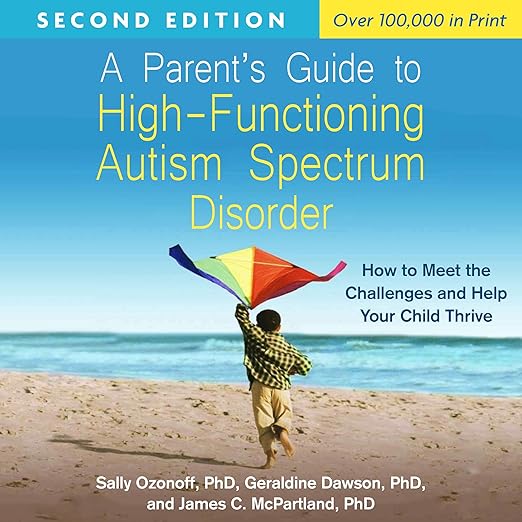
The evaluation report that recommends this exact book to parents is not a hypothetical, one reviewer describes that precise scenario after her six-year-old's diagnosis, and it captures why this audiobook has built a loyal following among parents navigating high-functioning autism spectrum disorder for the first time. Sally Ozonoff's guide, now in its second edition and updated for the DSM-5 diagnostic changes, runs nearly ten hours and covers diagnosis, treatment, and the day-to-day realities of raising a child whose challenges are not always visible to people outside the family.
Misread as Behavior Problems by Teachers and Pediatricians
What distinguishes this guide from the wider shelf of autism-parenting books is its narrow, deliberate focus on high-functioning ASD and Asperger's specifically, conditions where a child's real struggles can be misread by teachers, extended family, or even pediatricians as simple behavioral issues, because the child does not present the more visible markers people associate with autism generally. Ozonoff and her co-authors write from clinical expertise, and reviewers consistently praise a clear, concise style that delivers information without making a tired parent dig for it, a genuinely rare quality in a category that can easily tip into either oversimplified reassurance or dense academic prose.
The two-part structure, one reviewer notes the book divides into a section on understanding the diagnosis and a second on practical support, gives this audiobook real utility as a reference rather than a single linear read-through. That structure matters more in audio than it might in print: a parent revisiting a specific chapter on school accommodations months after first listening needs to be able to navigate back to it, and the clarity of that two-part organization should make relocating specific guidance easier than a less deliberately structured book would allow.
Worth noting directly: this audiobook comes from Echo Point Books & Media, an independent publisher based in Brattleboro, Vermont, rather than one of the larger mainstream audiobook houses. Independent presses specializing in backlist and practical nonfiction often bring genuine editorial care to niche health and parenting categories precisely because they are not chasing bestseller-scale numbers, and the inclusion of a full companion PDF alongside the audio here is consistent with that kind of specialist, reader-first publishing approach rather than a rushed or minimal production.
Godwin's Steady Register Over Dramatic Range
Kathleen Godwin narrates, and nonfiction health guidance like this depends on a steady, trustworthy vocal register more than dramatic range, information this practical needs to land clearly the first time, since an exhausted parent listening during a commute or a rare quiet moment does not have the bandwidth to decode an overly stylized performance. Based on the genre and the book's clinical grounding, a measured, warm-but-plain delivery serves the content better than a more theatrical read would.
The audio format suits a book explicitly built around vivid stories and real-world examples well. Case-study-style illustrations of how other families have navigated diagnosis, school challenges, and peer relationships read naturally aloud, closer to hearing a knowledgeable friend walk through relevant scenarios than parsing a textbook. For parents already stretched thin, being able to absorb this guidance hands-free while managing a household is a real practical advantage over sitting down with a physical book.
The synopsis credits leading experts in the plural, and while only Sally Ozonoff appears in the byline data here, that framing signals a genuinely collaborative clinical text rather than a single practitioner's individual perspective. For a topic where treatment approaches and educational strategies can vary significantly by clinician, a guide synthesizing multiple expert viewpoints into one coherent narrative carries real value, provided, as reviewers confirm, the writing stays this clear and well organized throughout.
Companion PDF Covers What DSM-5 Updated
This audiobook includes an accompanying PDF, delivered alongside the audio in your library, which almost certainly contains reference material, checklists, or resources that behave better as visual references than as narrated audio. Anyone relying on this book as a working reference rather than a one-time listen should plan to actually open that PDF rather than treating the audio alone as the complete package.
As a second edition updated for DSM-5 changes, this text reflects diagnostic language that has shifted meaningfully from how autism and Asperger's syndrome were categorized in earlier editions or older books parents may have already encountered. If you or your child's care team are working from older terminology, this update is genuinely useful, but worth knowing going in that some vocabulary here may differ from what an earlier diagnosis or an older support book used.
Tens of Thousands of Parents, Real Depth
At nine hours and forty-two minutes, this is a substantial listen for a nonfiction guide, longer than many comparable single-sitting parenting books. That length reflects real depth rather than padding, based on reviewer descriptions of comprehensive diagnostic and treatment coverage, but parents in the earliest, most overwhelmed days after a diagnosis may want to sample specific chapters rather than attempting the full runtime linearly right away.
The synopsis notes that many tens of thousands of parents have already relied on this guide, a detail that signals this is an established, trusted resource reaching a second edition rather than a first-time entry into a crowded category. Autism parenting guides proliferate quickly and vary enormously in quality; a book that has already built that kind of track record before this update, one substantial enough to warrant revising for DSM-5 changes specifically, carries a different kind of credibility than a brand-new, unproven title would.
One reviewer specifically praises the book for helping identify appropriate-behavior guidance and peer-relationship strategies without reducing a child to a checklist of deficits, a tonal balance that is genuinely difficult to strike in clinical parenting literature. Worth flagging as a real strength distinguishing this guide from drier diagnostic manuals that read more like reference textbooks than a resource written with an actual family's daily life in mind.
Grandparents and Siblings Count as an Audience Too
Parents and caregivers newly navigating a high-functioning ASD or Asperger's diagnosis are the clear core audience, and the reviewer consensus, several describing it as essential, one wishing she had found this book years earlier, suggests it delivers real, practical value rather than generic reassurance. Educators and extended family members seeking to understand a child's experience without projecting neurotypical expectations onto it would also benefit.
Grandparents, siblings, and other family members adjusting to a new diagnosis in the family are a worthwhile secondary audience too, even though the synopsis frames the book around parents specifically. The clear, jargon-light style reviewers praise translates well to anyone in a child's life trying to understand what high-functioning ASD actually looks like day to day, not just the primary caregivers managing appointments and school meetings.
Skip it if you are looking for a memoir-style emotional narrative rather than an expert-authored practical guide, this is reference material first, personal storytelling second, or if your child's needs fall outside the specifically high-functioning end of the spectrum this edition is scoped around, in which case a broader-spectrum resource may serve you better.