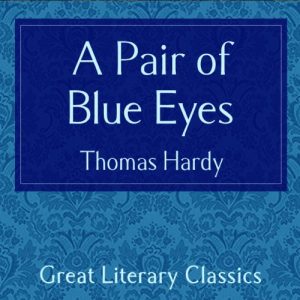
Elfride Swancourt cannot decide between two very different suitors, and that indecision carries the entire audiobook of Thomas Hardy's A Pair of Blue Eyes across more than fifteen hours. This was Hardy's third published novel, written in 1873, well before he hardened into the tragedian who wrote Tess of the d'Urbervilles and Jude the Obscure, and the seams of that earlier, gentler Hardy show throughout. The heroine is drawn closely from his first wife, Emma Gifford, whom he met while restoring a Cornish church much like the one at the center of this story, and that autobiographical root gives the romantic triangle a specificity most Victorian marriage-plot fiction never bothers to earn.
This Cliffside Scene Coined the Word Cliffhanger
Elfride's two suitors come from opposite ends of the social ladder, and Hardy uses that gap to stage a genuine conflict between heart, mind, and the expectations pressed on her by her parents and by a rigid Victorian class structure. Literary trivia often credits this novel with an unusual legacy: a suspenseful cliffside scene involving one of Elfride's suitors is frequently cited as an early source for the word cliffhanger in English fiction, a small piece of history worth knowing before you start. The plotting is looser than Hardy's mature work, and the coincidences pile up in ways his later novels would smooth over, but the prose already carries his gift for landscape, for making the Cornish coast feel like a character with its own moods and pressures.
Reviewer fra7299, on a fourth trip through Hardy's catalog, points out that this novel already contains 'many of Hardy's repeated themes: human emotions and conflicts, the nature of love and relationships, an examination of social class structure,' along with picturesque depictions of rural life, all present here in an earlier, less polished form. The title itself rewards a close listen: Elfride's blue eyes are mentioned repeatedly by both suitors as the physical detail that first draws them in, and Hardy leans on that recurring image as shorthand for how each man's affection stays partly surface-level, drawn to a striking feature rather than to Elfride's actual interior life. It's a subtle piece of authorial commentary on the novel's own courtship plot, easy to miss without paying attention to the pattern. HardyBoy64 calls it 'a slightly lesser novel than many of Hardy's other masterpieces' while still awarding it five stars, which is roughly the consensus this book earns: not the place to discover why Hardy matters, but a rewarding stop once you already know. Both reviewers arrive at that same verdict from different directions, which says something about how consistently this novel rewards existing fans specifically.
Wickham's Calm Suits a Vintage Recording
Peter Wickham narrates with an unhurried, period-appropriate calm that suits Hardy's long descriptive sentences and his characters' slow-building internal debates. Wickham makes no attempt to modernize the pacing or punch up the drama; he lets the novel's own rhythms carry the listener through its more digressive stretches, which is the correct instinct for this kind of material. Worth flagging directly, because the listing itself does: this is described as a vintage recording, and the audio quality may not match a freshly produced modern audiobook. For a text over 150 years old, narrated in a recording that is itself dated, treat this as a heritage listen rather than a polished new production, closer in spirit to a well-preserved archival recording than a studio release built with today's engineering standards. Public-domain classics like this one often reach listeners through smaller, independent productions rather than major studio releases, and that context is worth having going in: a vintage recording of a lesser-known Hardy novel was never going to receive the same production budget as a freshly recorded bestseller. Judge Wickham's narration on its own terms, unhurried and clear, rather than against the polish of a big-budget contemporary release, and the fifteen hours become considerably easier to settle into.
The fifteen-hour runtime is a real commitment for a novel that isn't Hardy's most celebrated, and it rewards listeners willing to sit with a slower unfolding than contemporary fiction typically offers. What you get in exchange is Hardy working out, for the first time in fiction, the exact tensions between passion and propriety that would define his greater novels. Hearing that development in real time, rather than jumping straight to Hardy at the height of his powers, has its own quiet value for anyone building a real relationship with his body of work over multiple titles.
Small Print Complaints Don't Apply to Audio
The genre tag attached to this listing, education-learning under 'Words, Language & Grammar,' has nothing to do with the actual book. A Pair of Blue Eyes is a 19th-century narrative novel, not a language course, and listeners browsing by that category will find themselves in the wrong aisle entirely. This kind of tagging error shows up periodically across classic-literature audiobooks in ways that have nothing to do with the work itself, so don't let the category discourage you if romantic Victorian fiction is what you're actually after. One attached review complains about small print type, but that concern belongs to a print edition of this same book. The audiobook format sidesteps that particular problem completely, since font size, the print edition's complaint, simply doesn't apply to a spoken performance.
At just over fifteen hours, this is not a casual single-weekend listen, and Hardy's plotting occasionally leans on coincidence in ways a more disciplined novelist would have trimmed. Readers expecting the tight, inevitable tragedy of Hardy's later work should recalibrate; this is an earlier, warmer, more forgiving version of his instincts, closer to comedy of manners than to fate-driven tragedy for most of its length, with genuine tragedy only fully arriving in its final stretch. Hardy's Cornish setting does real work throughout, with cliffside walks and church restoration scenes giving the courtship a physical backdrop that keeps the psychological drama grounded in specific, changeable weather and terrain rather than an abstract drawing-room setting. That grounding is arguably the clearest throughline connecting this earlier novel to the landscape-driven fiction Hardy would become famous for.
Newcomers Should Start With Tess Instead
Existing Hardy readers curious about his early development, fans of Victorian marriage-plot fiction, and listeners who enjoy long, patient character studies will find plenty to like here. It also rewards anyone interested in how a novelist's real life, in this case Hardy's courtship of Emma Gifford, filters into fiction almost unchanged, down to specific settings and professions.
Skip this one if you're brand new to Hardy and want his best foot forward; start instead with Far from the Madding Crowd or Tess of the d'Urbervilles, then circle back here once you're invested in his development as a novelist. Listeners sensitive to older, lower-fidelity recordings should also know what they're getting into given the vintage-recording note attached to this specific production, since it may not sound like a freshly engineered modern audiobook from the opening minutes.
Does the vintage recording affect how enjoyable this audiobook is?
It can. The listing itself notes this is a vintage recording and that audio quality may not match modern production standards, so listeners used to freshly engineered audiobooks should adjust expectations before starting.
Why is this audiobook categorized under language and grammar learning?
That genre tag appears to be a metadata error. This is a 19th-century narrative novel, not a language course, and the tag has no real connection to the book's content.