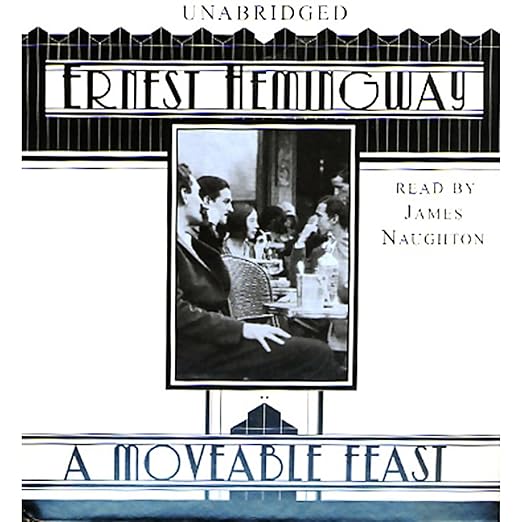
Hemingway said that if you were lucky enough to have lived in Paris as a young man, it stays with you for the rest of your life. A Moveable Feast, narrated by James Naughton and available here in the restored edition, is the account of that luck and what it cost him: his first marriage, his early certainties, and eventually the clear-eyed version of himself that the Paris years briefly made possible. This audiobook runs four hours and twenty-two minutes, short by the standards of the memoir form but exactly the right length for material this compressed. Hemingway was writing at the end of his life about the beginning of his writing life, and the temporal distance gives every sentence a precision that feels like reckoning.
Never Go on a Trip With Anyone You Don't Love
The restored edition, which forms the basis of this audiobook, is an important distinction from earlier printings. Published posthumously in 1964 and based on manuscript versions that had been edited before publication, the restored text, prepared by Hemingway's grandson Seán Hemingway from the original manuscripts, presents the memoir closer to how the author left it. The book includes a personal foreword from Patrick Hemingway and an introduction from Seán Hemingway, as well as previously unpublished Paris sketches involving Hemingway's son Jack and his first wife Hadley. For listeners who have encountered earlier editions, these additions are substantive: the sketches with Jack reveal a domestic tenderness that the public Hemingway persona often obscured, and the Hadley passages carry the weight of a marriage he would later destroy by falling in love with Pauline Pfeiffer.
The literary portraits are what most readers come to this memoir for, and they are as sharp as the book's reputation suggests. Scott Fitzgerald appears as a man of extraordinary talent held hostage by anxiety and a destructive marriage, and Hemingway's account of their shared road trip to Lyon, summarized in a line a reviewer quoted directly, Never go on a trip with anyone you do not love, is simultaneously a travel observation and a precise diagnosis of Fitzgerald's particular wretchedness. Ford Madox Ford is treated less charitably. Gertrude Stein and Alice B. Toklas appear in a complicated light that the restored edition, which includes material Stein's partisans found unflattering, clarifies rather than softens.
Naughton Refuses to Compete With the Prose
James Naughton's narration suits the material in the most important sense: he does not compete with Hemingway's prose. The danger with audio performances of canonical literary texts is that narrators can impose a reverence that calcifies the writing, making it feel like a monument rather than a living text. Naughton keeps the sentences moving with the rhythm Hemingway built into them, short declarative bursts followed by longer sentences that accumulate weight, without emphasizing the style at the expense of the content. The memoir's famous passage about learning to write true sentences, simple and direct and honest, is more effective in this reading because Naughton delivers it as a statement of practice rather than a manifesto.
The audio format serves this particular memoir well because Hemingway's Paris is insistently sensory: the smell of the brasseries, the physical cold of the apartment on rue Cardinal Lemoine, the specific quality of light on the Seine on certain mornings. These are the details that carry the memoir's emotional argument, that place and youth and poverty and creative intensity form a combination that cannot be replicated but can be remembered with absolute precision. Naughton renders these passages with the right kind of quietness, allowing the sensory details to do their work without underlining them.
The Feast Line as a Spoken Declaration
The memoir's structure is more fragmented than its reputation sometimes suggests. These are sketches rather than chapters in the conventional sense, each one a discrete scene or encounter, and the cumulative effect builds through accumulation rather than narrative development. Listeners expecting a sequential autobiographical account of Hemingway's Paris years will need to recalibrate toward something more impressionistic. Each sketch is complete in itself, and the four-hour runtime reflects that structure: this is a memoir you can enter at any point, though the full arc, from the early poverty of the Hemingway-Hadley years through the literary community scenes to the final devastating passages about the end of the marriage, carries its greatest force heard in sequence.
One reviewer described the time spent with this book as time that would be savored, and that quality of savoring is exactly what the audio format, at its best, can amplify. There is nothing rushed in Naughton's performance, and the memoir's own relationship to time, writing from old age about youth, memory against the passage of time, the Paris that stays with you when everything else changes, is better served by unhurried listening than by rapid reading. The book's most celebrated line, the moveable feast passage itself, lands differently in audio than on the page, as a spoken declaration rather than a printed epigraph.
Pleasures That Are Meditative, Never Propulsive
Readers with an existing relationship to Hemingway's fiction will find the memoir an essential companion text. Those coming to Hemingway for the first time should perhaps begin with the shorter fiction, The Sun Also Rises or the Nick Adams stories, before arriving here; the memoir's emotional resonances deepen with knowledge of what the Paris years produced. Literary listeners interested in the 1920s expatriate community, the relationship between biography and craft, or the experience of young writers learning their trade in conditions of near-poverty will find much here to think about. Those looking for conventional narrative momentum should be aware that the book's pleasures are meditative rather than propulsive.
At a Glance
- Performance: James Naughton brings a seasoned authority to Hemingway's prose, capturing the clipped declarative style without turning the memoir's intimacy into performance; his reading suits both the sharp literary portraits and the quieter personal passages.
- What it covers: The writer's Paris and the craft of prose, literary friendship and rivalry, youth and the memory of lost time
- Feel: Elegiac and precise, with bursts of dry humor and the particular ache of things irrevocably past
- Our call: Hemingway at his most personal and his most literary, and James Naughton's narration gives the restored edition's original manuscript the careful listening it deserves.
Frequently Asked Questions
What is different about the restored edition of this audiobook compared to earlier versions of A Moveable Feast?
The restored edition presents the manuscript as Hemingway himself prepared it, before posthumous editorial changes were made before the 1964 publication. It includes previously unpublished Paris sketches featuring Hemingway's son Jack and his first wife Hadley, and a foreword by Patrick Hemingway and introduction by editor Seán Hemingway.
Does prior knowledge of Hemingway's biography help when listening to this audiobook?
It deepens the experience considerably. The portraits of Fitzgerald, Stein, Ford Madox Ford, and others carry more resonance if you know their subsequent histories, and the passages about Hadley hit harder knowing that the marriage did not survive the Paris years.
How does James Naughton's narration handle Hemingway's famously spare prose style?
He delivers it with the rhythm it was written to carry. Naughton does not over-perform the style or treat it as a monument. The sentences are allowed to move at their own pace, which suits both the declarative passages and the more expansive landscape and memory sections.
Is A Moveable Feast a good audiobook for someone who has never read Hemingway?
It works as an introduction but may reward later listeners more than first-timers. The memoir's emotional weight depends partly on knowing what the Paris years produced in fiction, and some of the literary portraits assume familiarity with the figures Hemingway is describing. Starting with The Sun Also Rises and returning to the memoir afterward would be the stronger sequence.