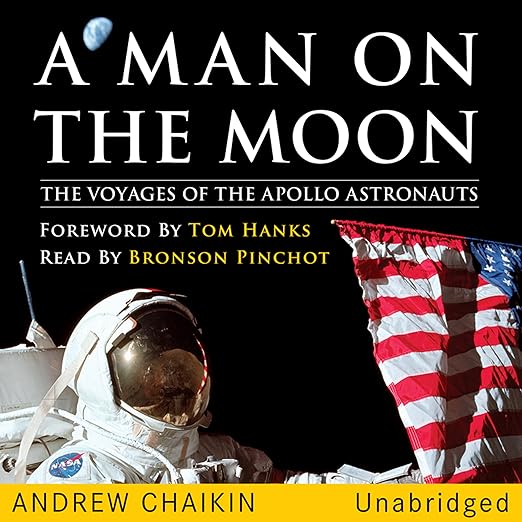
Quick Take
- Read by: Bronson Pinchot carries twenty-three hours in which two dozen astronauts must stay distinguishable and the technical passages must not flatten.
- At its heart: The Apollo program from inside the helmets, first-person recollection, engineering under deadline, the 1969 landing.
- Vibe: Absorbing, methodical, quietly awed.
- Short version: A strong single-volume Apollo history in audio, provided you accept that everything visual stays in print.
Apollo is the rare historical subject whose primary sources were all still alive and willing to talk, and Andrew Chaikin reached twenty-three of the twenty-four men who flew to the moon before that window closed. Reporting on that scale is why this audiobook runs twenty-three hours, and why the description can make the claim it makes: that the astronauts themselves have called this the definitive account of their own missions. Bronson Pinchot reads, and the copy notes an Audie in history and biography for 2016.
Our Take on A Man on the Moon: The Voyages of the Apollo Astronauts
Access is the book, and it is worth being precise about what it bought. Chaikin did not interview a representative sample. He worked through nearly everybody who has ever traveled to the moon, and then went after the ones who never left the ground: the engineers, planners and administrators who fought to get the program moving. A February 2014 entry describes years spent tracking those conversations down, and that is the difference between this and a history assembled from transcripts and press kits.
What Chaikin did with the material is the second decision, and the more literary one. The chronology could have been organized around spacecraft, budgets or politics. Instead the moon is approached repeatedly, mission by mission, from inside the helmets, so that the night of July 20, 1969 arrives as the culmination of an accumulating human experience rather than as an isolated triumph. Armstrong and Aldrin get the moment everyone remembers, and the flights on either side of it stop being footnotes, which is the quiet achievement of the whole structure.
Why Listen to A Man on the Moon: The Voyages of the Apollo Astronauts
Somebody who has read widely across Mercury, Gemini and Apollo put the recommendation more usefully than a blurb could, in a July 2012 entry: asked which single volume a general, non-technical reader should take, this is the one, precisely because the author chose to tell the material as a story told from the viewpoint of the people flying. That is also why it survives the move to audio. Narrative history built on first-person recollection is far easier to follow without a page than a systems-led account would be.
Twenty-three hours of hardware, procedure and mission chronology is a serious ask of a reader, though, and the specific job here is keeping two registers apart: the technical passages, where precision matters and momentum can die, and the recollections, where two dozen different men have to remain distinguishable inside one voice. Spend three minutes on a stretch of flight-detail material and then on one of the personal passages. If both arrive at the same pitch, the long middle of this will blur, and if they do not, twenty-three hours will feel considerably shorter than it looks.
The emotional case is separate and real. One December 2022 entry recalls being woken by a parent at eleven years old to watch the first landing on a black-and-white television and never quite clearing it from memory. Books about Apollo are often bought by people who were there for it, and the ones who were not now outnumber them. This account is the closest thing to a transferable version of that night, because it was assembled while the witnesses could still be asked what it actually felt like.
What to Watch For in A Man on the Moon: The Voyages of the Apollo Astronauts
No rounding rule turns one vote into 4.8. A lone rating can only produce a whole number, since the single voter picks a whole number and the average of one value is that value, so the displayed figure and the rating count on this page cannot both be describing the same thing. Five written responses sit below it, every one of them enthusiastic, which makes the badge unnecessary as well as broken: the writing on the page argues the case better than a decimal ever could.
Genre filing is a separate problem with practical consequences. This record is shelved under computers and technology, which is not where a reader of narrative history browses, and more importantly it is what any recommendation engine will use to decide what to offer somebody who finishes it. A listener who loves this will be pointed toward programming manuals rather than toward the space history and reportage that actually sits next to it.
Treat the written responses as verdicts on a printed history that has been in long circulation. One of the five is not written in English at all, and its single reservation concerns the paper the photograph section was printed on and a cover finish that did not wear well. That is a considered complaint about an object you cannot buy here. Anything visual in this history stays in print, and no accompanying image file is declared on the listing.
Who Should Listen to A Man on the Moon: The Voyages of the Apollo Astronauts
If you want one Apollo history and no more, this is a defensible choice, and it is an especially good one for listeners who care about what the people involved understood at the time rather than what hindsight has arranged for them. It also suits listeners who know the outline of the program and want the detail underneath it, delivered at a length that lets every mission keep its own character.
Engineering-minded listeners hunting for systems detail, propulsion mathematics or program economics should be warned that this is the wrong book for that, since people and their own memories carry the structure from beginning to end. Anything you want to look at while listening, you will be sourcing for yourself. Twenty-three hours is also a genuine commitment, and this history rewards being taken mission by mission rather than in the background of something else.
Before You Listen
Does the audiobook cover every Apollo mission or only the landings?
The scope is the program, not just the landings. The description is built on interviews with twenty-three of the twenty-four moon voyagers plus the people who struggled to get the program moving. Expect the landing missions to dominate, with earlier flights and the ground effort carrying the setup rather than being skipped.
How technical does it get for someone with no engineering background?
The material is organized around people rather than systems, which is exactly what makes it work aloud. Hardware and procedure appear because the astronauts lived inside them, not as tutorials. A few stretches of mission detail will pass faster than a page would allow, and the narrative carries you through them.
Is 23 hours of audiobook the complete text or an abridgement?
Nothing on the listing indicates cuts, and twenty-three hours is consistent with a large work of narrative history read in full. At an hour a day it runs past three weeks, which suits a chronological account where the later missions only pay off if you sat through the early ones.
What separates this from other histories of the moon program?
The interview base. The description claims in-depth conversations with twenty-three of the twenty-four men who made the trip, plus the people who got the program off the ground, and reports that the astronauts have called the result the definitive account of their missions. That access cannot be repeated now.