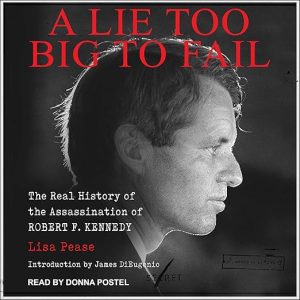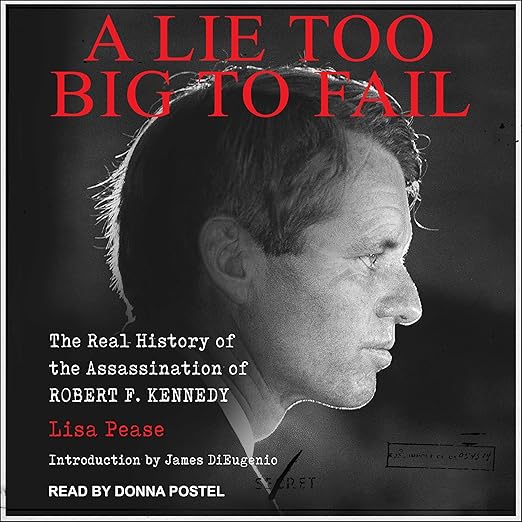
- Narrator: Donna Postel holds a long, dense, controversial narrative with the even clarity this kind of material actually needs.
- Subjects: assassination conspiracy investigation, institutional cover-up, Kennedy-era political violence
- Tone: Methodical, dense, quietly urgent
- Bottom line: A serious commitment for readers already invested in Kennedy-assassination research, not a casual true-crime entry point.
Lisa Pease spent lunch hours, nights, and weekends hunched over library microfilm, working through Los Angeles Police Department files on Robert Kennedy's assassination that most researchers never knew were sitting in public reach. That research marathon is the backbone of this nearly twenty-six-hour audiobook, and it shows in ways that separate serious archival work from the conspiracy genre it will inevitably get filed under. Pease built her reputation over decades as co-editor of Probe Magazine and chief archivist of the Real History Archives before writing this book, and A Lie Too Big to Fail reads like the product of someone who has spent years arguing with primary documents rather than with strangers online, even though internet debate is literally where her research habit started.
The core argument is specific and evidence-driven rather than speculative: witnesses who had evidence of a broader conspiracy were silenced, physical evidence was altered or destroyed, and Pease contends the resulting trial functioned less like a genuine search for truth than a managed proceeding designed to avoid where the evidence actually led. Notably, the book doesn't dictate a single answer about Sirhan Sirhan's own culpability or state of mind; the synopsis is explicit that Pease lays out evidence and lets listeners form their own conclusions, which is a meaningfully different posture than a book arguing toward one predetermined verdict.
Pease's credentials matter here more than in most books in this genre. She co-edited The Assassinations, a 2003 anthology examining the deaths of John Kennedy, Martin Luther King, Robert Kennedy, and Malcolm X together, and her role as chief archivist of the Real History Archives means she has spent a career organizing primary documents for other researchers, not just building a personal theory in isolation.
One structural strength worth noting: the book places the RFK case inside its broader era, drawing out what the synopsis calls shocking overlaps with other high-profile murders and attempted murders of the period. That comparative framing gives the book more analytical weight than a single-incident conspiracy narrative typically carries.
Kennedy-assassination research has produced a substantial body of work over the decades, and Pease's book distinguishes itself within that crowded field through its narrow, disciplined focus. Rather than attempting a sweeping unified theory covering multiple assassinations at once the way some researchers in this space do, she stays close to the RFK case specifically and the LAPD's documented handling of it, which gives the book an evidentiary tightness broader conspiracy surveys often lack, even when those broader surveys cover more ground.
Central to Pease's case is a specific claim about the trial itself: that the prosecution had access to physical and testimonial evidence suggesting a broader conspiracy and chose not to pursue it, effectively building a case designed to secure a conviction rather than to establish the full truth of what happened. Whether or not a listener ultimately agrees with her conclusions, the book lays out that specific institutional-failure argument, evidence available but not pursued, methodically rather than as a passing accusation.
Postel's Delivery Lets the Documented Evidence Lead
Donna Postel doesn't have any narration credits I was able to track down beforehand, so I'm assessing the performance on what nearly twenty-six hours of dense, contested, emotionally loaded investigative material actually requires: sustained clarity that lets the documented evidence carry the argument's weight rather than an editorializing tone pushing the listener toward outrage.
Reader reaction is strong and specific. One reviewer purchased the book around the anniversary of Kennedy's assassination and called it 'an incredibly researched, brilliant piece of intrepid reporting.' Another described it as an essential addition to any Kennedy assassination library after decades of following the case. A third reviewer who had long suspected a cover-up said the book presented information about RFK's murder they'd genuinely never encountered before, even after years of reading in the space.
For listeners already steeped in Kennedy-assassination literature, the sheer density of primary-source detail here, drawn directly from the police files Pease spent years working through, offers material that's genuinely hard to find summarized elsewhere.
The book draws on named witnesses and specific documented police procedures rather than anonymous sourcing or open speculation, which is exactly the kind of granular, source-by-source case-building that rewards being heard in long, uninterrupted stretches; listeners who give it real sustained attention will notice how carefully each claim gets built on a specific, named, checkable piece of evidence rather than an inherited assumption.
Filed as Writing Craft, Really Political History
This listing is tagged under education and writing and publishing, which is a real mismatch worth flagging. This is a history and political investigation book, closer to true crime and archival journalism than to anything about the craft of writing, and a listener browsing by that category tag would have no obvious reason to find it.
At nearly twenty-six hours, this is one of the longest audiobooks in recent memory for this kind of subject matter, and it demands real patience with granular procedural detail rather than a dramatized true-crime pace. Go in expecting a methodical archival deep dive, not a fast-moving narrative thriller.
It's worth stating plainly that assassination-conspiracy literature is inherently contested territory. Pease's conclusions represent one deeply experienced researcher's reading of suppressed and destroyed evidence, and listeners should approach the book as rigorous advocacy journalism rather than settled consensus history, without either dismissing the research or treating it as beyond question.
Twenty-six hours of sustained, emotionally serious material about a real political assassination and its documented cover-up is a genuinely heavy listen, not just a long one. Pacing yourself across several sessions rather than attempting long unbroken stretches will likely serve both the material and your own attention span better than treating it as a single marathon listen.
Twenty-Six Hours Aimed at Committed True-Crime Readers
This is built for readers already invested in Kennedy-assassination research, true-crime listeners drawn to institutional cover-up narratives, and anyone who has read the Warren Commission-era literature and wants a dissenting, deeply sourced counter-argument.
This is worth a content note for younger or more casual true-crime listeners specifically: this isn't an easy entry point into the genre. It assumes real patience with archival procedure and offers none of the pacing tricks dramatized true-crime podcasts typically use to keep a casual audience engaged.
Listeners specifically interested in press and media criticism will also find real substance here, since Pease devotes considerable attention to how contemporary journalism covered, and in her account failed to adequately scrutinize, the official narrative as it developed in real time.
Skip this one if twenty-six hours of dense, contested political history isn't a commitment you're ready to make, or if you're looking for a settled, consensus account rather than an advocacy-driven investigation built to challenge the official record.
Does this audiobook cover the JFK assassination too, or is it entirely focused on Robert Kennedy?
It's focused specifically on the RFK case, though Pease situates it within the broader era and draws comparisons to other high-profile assassinations and attempted assassinations of the period.
Does this audiobook present its argument about Sirhan Sirhan as settled fact, or does it leave room for interpretation?
Pease lays out the evidence she gathered and explicitly leaves listeners to form their own conclusions about Sirhan's role, rather than dictating a single definitive answer.