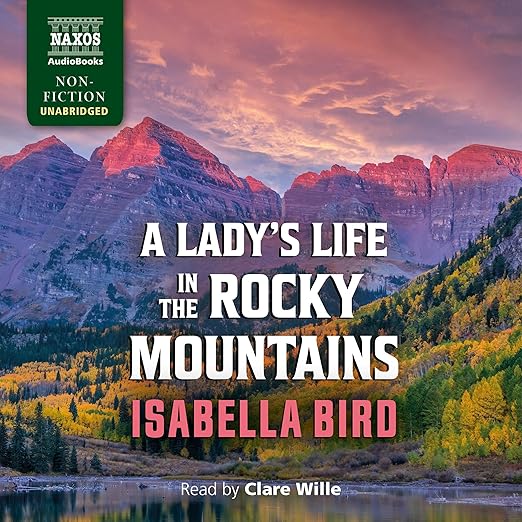
Isabella Bird's prose has a quality that stops you cold, and this audiobook captures it. The sentences are precise but unguarded, the observations sharp without cruelty, and the courage embedded in every paragraph is not the bold, chest-thumping kind but the quieter, stranger courage of a woman in chronic pain who simply decided to keep going. I came to this recording after reading Walter De la Mare's essays on travel writing, and Bird's letters kept resurfacing in my thoughts as an unplanned counterpoint to nearly everything romantic or exaggerated about the Victorian explorer tradition, a comparison I had not expected to make going in. Hearing Clare Wille read them aloud confirmed that instinct. These are not dispatches dressed up for posterity. They are living correspondence.
The audiobook adaptation of A Lady's Life in the Rocky Mountains rests on letters Bird wrote to her sister Henrietta between September and December 1873, eventually published as a collection in 1879. Bird covered some 800 miles through Colorado on horseback after back surgery had left her doctors recommending outdoor life as her only real treatment. The incongruity never stops being striking: a 4'11" Victorian woman with debilitating pain, alone, sleeping in snow, crossing mountain passes, wrangling cattle, and documenting all of it with a journalist's eye and a novelist's ear.
What separates this from the colonial adventure genre Bird is sometimes lumped into is her self-awareness. She does not pretend to be conquering anything. She notices her own reactions with the same clear-eyed attention she turns on the landscape, including her ambivalence about "Mountain Jim" Nugent, the violent, one-eyed outlaw with a taste for poetry who becomes one of the book's most compelling presences. Her description of him is neither romantically naive nor morally dismissive. She sees him whole, which is a harder literary achievement than it looks. One reviewer called her account of their friendship a story of "wit and amazing insight," and that reads as accurate. Bird is never simply dazzled by the West. She reports it.
Clare Wille's narration suits this material well. Her pace is measured without being plodding, and she finds the humor in Bird's understated asides without overplaying it. Victorian irony collapses quickly if a narrator leans too hard on it. Wille does not. She lets the sentences do the work, which is the right call for a writer as precise as Bird. The audio quality is clean across the 7 hours and 44 minutes, and the letters format means each section has a natural rhythm that makes the listening experience feel episodic in a satisfying way.
Wrote to Be Heard as a Voice to One Person
The case for the audio format here is stronger than it might initially seem. Bird wrote these letters to be read aloud, or at the very least to be heard in the mind as a voice speaking directly to one person. The epistolary form creates intimacy that a more formal travelogue rarely achieves, and Wille's narration restores that quality. You feel addressed. The landscape descriptions land differently when spoken: the frozen rivers, the pine forests at altitude, the cattle drives, the makeshift settlements. A reader of the period noted that Bird makes you feel you have "strolled with her" through places she loved, and audio is the closest contemporary equivalent to that effect.
Historically, the book is valuable for reasons beyond its literary quality. Bird arrived in Colorado at a moment of tremendous flux, roughly a decade after the Civil War and during the period of rapid western settlement. Her observations about the ranchers, miners, and homesteaders she encounters carry sociological weight, even when she is not consciously making sociological arguments. Her encounters with the landscape's Indigenous history are less developed by modern standards, but her account of the region's material culture and the daily lives of its settlers is detailed enough to be genuinely documentary. The accompanying PDF noted in the synopsis provides additional context worth consulting alongside the audio.
She Ascends Long's Peak Without False Heroism
Two things stand out as points of active attention rather than passive listening. First, watch how Bird handles fear. She describes physical danger with remarkable calm, not because she is suppressing it but because her relationship with her own body is already so complicated by illness that external peril seems almost beside the point. The section where she ascends Long's Peak is worth revisiting. The physical discomfort she describes is vivid, and her determination is not accompanied by false heroism. Second, pay attention to her treatment of gender expectation. She does not write manifestos, but she is acutely aware throughout of how she is perceived and how that perception shapes what she is allowed to do. The tension between her freedom in the wilderness and the constraints she would face returning to civilization is never stated outright but runs under nearly every passage.
A small caveat worth noting: listeners who know the Estes Park region well, as one reviewer does, may find some of the route descriptions hard to pin down geographically. Bird's landmarks are often identified by informal local names of the 1870s that do not map cleanly onto modern place names. This does not diminish the literary experience, but if you are hoping for a precision trail guide, this is not that.
Good Company for Fans of Kingsley and Stark
This audiobook rewards listeners who enjoy primary source travel writing and have some appetite for Victorian prose style, which is more expansive and digressive than contemporary nonfiction. Fans of Mary Kingsley or Freya Stark will find Bird to be excellent company. History readers interested in the American West of the 1870s will find material here that complements more conventional historical accounts. The audio format makes it particularly good for people who find 19th-century prose heavy going on the page but respond well to a skilled narrator unlocking the rhythm of older sentences.
Listeners who need a strong narrative drive or a conventional memoir arc may find the letters format episodic in ways that feel fragmentary. Bird circles back to certain locations, mentions Jim Nugent across multiple letters with varying degrees of affection and unease, and her chronology is not always linear. That is part of the charm for the right reader, but it can feel diffuse for someone wanting a single clean story with clear rising action and resolution.
Frequently Asked Questions
Is the audiobook narration well matched to Bird's Victorian epistolary style?
Clare Wille's measured, clear delivery suits Bird's prose well. She keeps the irony present without overemphasis and handles the longer descriptive passages without losing momentum, which matters a great deal for a text written in 1870s English.
Does the audiobook include the PDF companion mentioned in the synopsis?
The PDF is listed as available in your Audible Library alongside the audio file upon purchase. It provides supplementary material to accompany the letters, though the core listening experience stands fully on its own.
How much does knowledge of Colorado geography help when listening to this audiobook?
Some familiarity with the Estes Park and Long's Peak area adds texture, but it is not necessary. Bird's descriptions are vivid enough to create a clear sense of place even for listeners with no prior knowledge of the region.