Before You Press Play
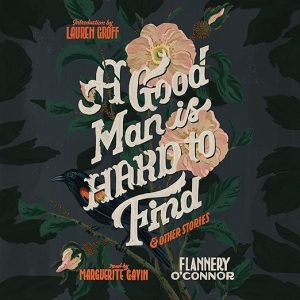
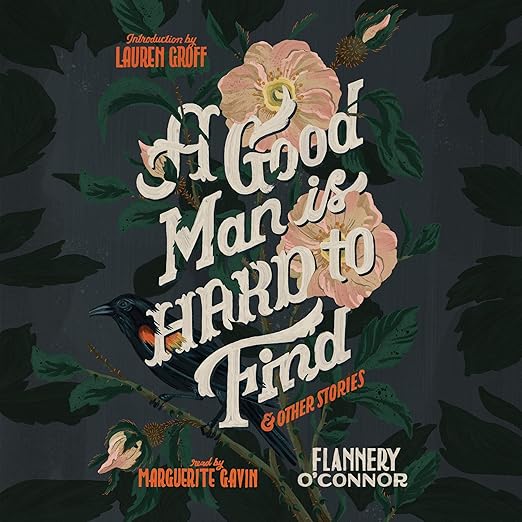
- Narration: Marguerite Gavin carries every story alone, and nothing on the page tells you whether Lauren Groff's new introduction is in the file with her.
- Themes: Grace arriving through violence, Southern Gothic comedy, salvation and its cost
- Mood: Funny and appalling in the same sentence
- Verdict: A canonical collection worth hearing straight through, wrapped in a listing that gets almost every detail about itself wrong.
How does a Flannery O'Connor collection end up filed under education and learning, with its only tag reading Words, Language & Grammar? I have no idea, and nothing else on this page offers one. The absurdity is small, but it sets the tone for a listing that is unusually bad at describing the audiobook it is selling.
What is on offer is the 1955 collection that, in the description's own account, established O'Connor's reputation. The publisher's copy calls it a critical edition and advertises a new introduction by Lauren Groff, then runs the sentence about Groff straight into the following one without a period, which is a neat miniature of the care taken here. Three stories are named as samples: The Life You Save May Be Your Own, Good Country People, and The Displaced Person. The whole set runs seven hours and fifty-one minutes.
This Five-Star Notice Reviews a Parcel
Count the responses before weighing them, because one of them is not about the book at all. A five-star notice posted in France in September 2020 reads, in its entirety, "J'étais satisfaite sur tous les plans!", under a headline praising the condition of the volume and a delivery "plus rapide que prévu initialement". That is a review of a parcel. It leaves four responses actually concerned with O'Connor, and they happen to be unusually good ones.
Mark opens with the plainest verdict available, "I officially have a new favorite writer.", and then argues that "she's highly regarded but still highly underrated, less well known than she should be". The route in is the interesting part: Mark describes a habit of listening to "a lot of American literary professors on audio" and hearing several of them reach for O'Connor to illustrate a point. Curiosity assembled out of other people's teaching, then finally satisfied at the source.
Comedy and Horror Share the Same Clause
O'Connor suits listening for a reason people rarely name. The stories are short and self-contained, which helps, but the real argument is tonal. Her sentences run comedy and horror through the same clause, and a voice has to decide moment by moment which of the two is in front. Casper, in a notice posted in the Netherlands, describes the outcome as a "stark and unsettling landscape" where the stories are "deeply disturbing at times" and simultaneously "a testament to O'Connor's mastery of the short story form".
S. Michael Wilson supplies the most useful map on the page. That review identifies the Southern Gothic label, the strain of Christian allegory underneath it, and a governing pattern in which redemption and grace arrive through hardship and violence rather than in spite of them. Carrying that into the first story changes how it lands, because you stop waiting for a rescue that was never the design.
Listening to the Stories With No Professor
The publisher's own characterization is sharper than most jacket copy manages. These stories, it says, are infused with religious symbolism, haunted by apocalyptic possibility, sustained by the tragic comedy of human behavior, and confronted by the necessity of salvation. Four participial clauses, four separate pressures, all running at once. Whoever wrote that sentence had read the book, which cannot be said of every description attached to a classic.
The other case for audio is one Mark makes by accident. Plenty of readers meet O'Connor first through somebody else explaining her, in a classroom or a recorded lecture course, and reach the stories already holding an interpretation. Hearing them read straight through, with no professor in the room, is the cleanest way to discover what you actually think of them.
Numbers That Don't Match on This Listing
The star display cannot be taken seriously. The counter reads one rating while five written responses sit underneath it, and 4.3 is not a figure a single grader can produce, because one grade lands on a whole star. Those two numbers are not counting the same population. One is a sample of one. The other is five people who took the trouble to write something.
Dates matter less than usual here, but they matter. The earliest notice went up in August 2016 and the next in January 2018, both before this recording appeared in January 2020, the second of them exactly two years to the day before it. Neither can be discussing an edition that existed when it was written. For a collection published in 1955 that is nearly irrelevant, and I raise it only because the page presents all five as though they addressed one object.
Then the genuine caution, which is the introduction. This is sold as a critical edition with a new piece by Lauren Groff at the front, and nothing on the listing states whether that piece was recorded. No running order is published either. If the introduction is why you are choosing this edition over another, the description gives you no way to check, and it is a question worth settling before you spend the money rather than afterward.
One further point concerns the material itself. Casper's warning is fair and bears repeating: the content is "dark and often violent" and it never softens. Josh Mauthe, an English teacher who arrived at O'Connor after more than forty years of meaning to and cataloguing the reasons for the delay in a run of four separate despites, files the most honest headline on the page: "Great stories that I respected much more than I loved". That is not a complaint about the reading, and it may well be the correct reaction.
Confirm Groff's Introduction Is Actually Included
Readers who have never got to O'Connor and keep meaning to should start here, on the publisher's own claim that this is the collection which made her name. People who read her at school and remember only the shock will find the comedy they were not shown, which is the half that never survives a classroom summary. Anyone who already listens to lectures about American fiction has the shortest distance to travel of all.
Two warnings before you buy. Anyone wanting a gentle evening should choose almost anything else, since the violence is structural rather than incidental and the design depends on it. Anyone wanting Groff's introduction should confirm it is in the file. As for the collection, seven decades on these stories still make a reader laugh in the wrong place and then sit very still, which is not an effect any shelving error can spoil.
Questions Listeners Ask
Does the audiobook include Lauren Groff's new introduction?
The description advertises a critical edition with a new introduction by Lauren Groff, and nothing on the listing states whether that introduction was recorded. No running order is published to settle the question either. If the introduction is the reason you are choosing this edition, get confirmation before buying rather than after.
Why is a Flannery O'Connor collection tagged Words, Language & Grammar?
Nothing on the listing explains it. The genre line reads education and learning, which would suit a textbook rather than a 1955 collection of Southern Gothic fiction. The practical cost is discoverability: readers browsing literary fiction will never meet this edition, while readers hunting for grammar guides will trip over it.
Is this audiobook a good entry point to Flannery O'Connor?
By the publisher's own account, yes, since the description credits this collection with establishing her reputation. One reviewer, an English teacher who reached her after more than forty years of meaning to, reports respecting the stories more than loving them, which is a fair warning about the temperature rather than the quality.
How long is the collection, and how should it be paced?
Seven hours and fifty-one minutes covers the whole set. Short stories reward stopping, and reviewers describe this material as disturbing and violent enough that stacking several into one sitting blunts the effect. One story per session is how I would take it, which a continuous file makes harder than a book of pages does.