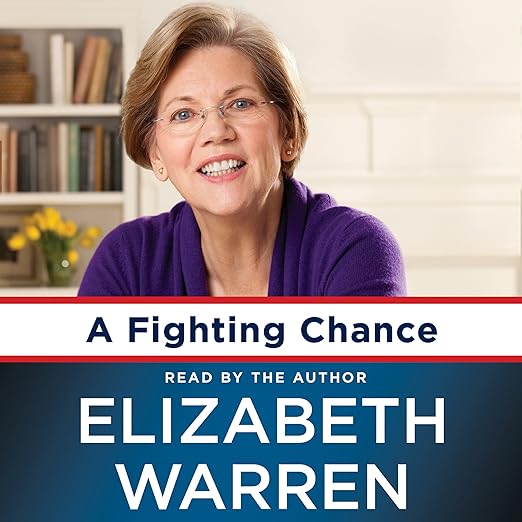
One of the five reviews on this page carries the date April 22, 2014, which is also the day the recording was published. Eleven hours and seventeen minutes went on sale, and somebody filed a considered five-star assessment of it the same afternoon. That reviewer, signing as LAM, is clearly discussing a text and not a performance, and the detail is a useful warning about what this column can and cannot tell you. What makes the omission sting is that the audiobook is read by its author, the one production fact this page should have led with.
What Elizabeth Warren Delivers
Warren's account starts in small-town Oklahoma with a girl who "yearned to go to college and then become an elementary school teacher," an ambition the copy calls ambitious given "her family's modest means." Early marriage and motherhood close that door. Fifteen years later it opens onto something larger: a law professorship and, specifically, "a deep understanding of why people go bankrupt." Then a phone call about advising Congress on the bankruptcy laws, and the rest of the life follows from a technical question almost nobody finds interesting.
Losing is what structures the middle, and the description is unusually willing to say so. Ten years fighting for better bankruptcy laws, lost. An attempt to hold the federal government to account during the financial crisis that made her "a target of the big banks." An agency she conceived to protect consumers from predatory bankers, and then was "denied the opportunity to run it." Three defeats in a row, laid out in three consecutive sentences, before the pivot at 62 to running for office. Political memoirs almost never build themselves this way, and the shape is the reason this one holds together.
Trace's five-star, written from Australia, catches the register better than any line of the marketing manages. What lands is not the policy but "the setting the kitchen on fire and finding a way to balance work with family," a domestic detail sitting next to Senate races. The review also records enjoying "the writing and the stories" and being reminded of a mother. Read the description and you expect an argument. Read the reviews and you find people reporting a life, a different and better book.
What Elizabeth Warren Gets Right
Eleven hours and seventeen minutes is the runtime, and Elizabeth Warren reads all of it. For a memoir this is the strongest possible configuration: the person telling you about the phone call is the person who took it, and the anger in the bank-lobbying chapters arrives first-hand instead of through an interpreter. The publisher description even acknowledges the format, calling it "this passionate, funny, rabble-rousing audiobook," more than most 2014 memoir listings bothered to do. A hired reader would have to act the outrage in the bank chapters; the author simply reports it. The risk runs the other way too, of course, since professional writers are not automatically professional readers, and nothing here lets you preview how Warren handles eleven hours of her own sentences.
Macmillan Audio put it out in April 2014, and what the reviewers consistently praise is the prose voice, which is exactly what an author-read edition transmits. LAM calls Warren "a clear, honest and deeply entertaining writer." Even the four-star dissent concedes "a good book with lots of details about her life and ambition" and a subject who "does seem to have the credentials to be writing this." Whatever you make of the politics, no reviewer here disputes that the sentences work.
Disclosure is where the column gets genuinely interesting. The reviewer signing as 3party opens with a declaration most reviewers would bury: "I have known Elizabeth for thirty-three years, consider her a friend, and admire her tremendously." What follows is not the puff you would expect. The expectation going in was "an agglomeration of speeches she has given," the purchase was made "mostly out of loyalty," and the verdict is a capitalized "BOY WAS I WRONG!" A friend who expected boredom and got a book is better evidence than a stranger who expected nothing.
Where Elizabeth Warren Loses Some Ground
Citations are the practical hazard in the audio edition, and one reviewer draws attention to them without meaning to. The four-star praises "tons of research and background cited completely publisher year author journal name volume." In print that apparatus lives in endnotes you can ignore. Spoken aloud, a full citation is a speed bump, and nothing in the record says how the recording handles them. For the sourcing, the print edition remains the version where you can actually consult it, and no companion document is offered here to stand in for it.
April 2014 is also a date to hold in mind, because the memoir itself stops there. It closes on a Senate race won, and everything that happened to its author afterwards sits outside the book entirely. Anyone coming to it now for a full account of a public career will find the first act only. That is not a flaw; it is a boundary the listing never states, and the reviews, written across six years, do not state it either. Two of the five were filed in 2018, four years after publication, and neither updates the picture.
Reading the column carefully turns up one more gap. The 3party review breaks off inside a parenthetical apology, on the first three letters of a name, and whatever it was about to concede is gone. The entry written in Japanese is the only review on the page that reaches its own ending, and it is unreadable to most of the audience this listing serves. For all that, the five gradings visible are four fives and a four, a clearer signal than the badge above them manages.
Who Should Pick Up A Fighting Chance
Politics listeners who want the mechanics of how bankruptcy law and consumer protection actually got fought over will find more procedural detail here than the cover suggests, and the author reading it removes any distance between the argument and the person making it. Memoir listeners who care nothing for policy are equally well served, since the Oklahoma chapters and the kitchen fire are what the reviewers keep returning to. The wrong pick for anyone wanting a neutral account, since the book is a case and never pretends otherwise, or for anyone who needs the citations audible. Readers hunting a policy argument will find one; readers hunting a life will find that too, and the two are not separable here.
The Short Version
- Performance: Elizabeth Warren reads the memoir personally, so the account of the phone call comes from the person who answered it.
- What it covers: bankruptcy law and consumer protection, three consecutive political defeats, a late run for office, class and family
- Feel: Direct, combative, warmer than the subject suggests
- Our call: Buy it for the defeats, which land harder than the wins, never for any pretense of neutrality.
Good to Know
How much of this audiobook is policy and how much is life story?
Both run together. The publisher summary moves from an Oklahoma childhood and early motherhood into bankruptcy law, the financial crisis and a Senate race. Reviewers split on which half they came for: one praises the research apparatus, another remembers a kitchen fire. Neither strand is skippable without losing the argument.
Does Elizabeth Warren narrate A Fighting Chance herself?
Yes. The narration credit and the author credit carry the same name, making this an author-read memoir throughout its eleven hours and seventeen minutes. The publisher description acknowledges the format directly, describing the release as a passionate and rabble-rousing audiobook rather than treating audio as an afterthought.
Do the citations and sources survive into the audiobook?
Nothing on the record answers that, and it matters more than usual here. The dissenting reviewer praises research cited down to publisher, year, author, journal and volume. Spoken aloud, that apparatus becomes intrusive; silently dropped, it disappears. Anyone buying for the sourcing should consider the print edition instead.
Should I trust the 4.6 rating on this listing?
Not on its own. The counter beside it registers two votes while five written reviews sit underneath, so the displayed figure cannot describe the readers who actually left an opinion here. Those five grade the book at four fives and a four, making it the more useful number on the page.