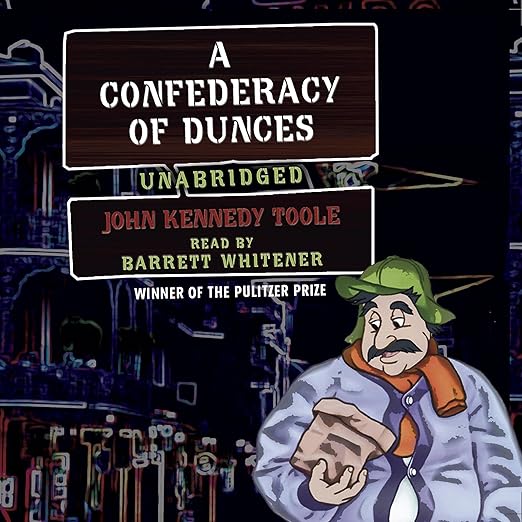
Ignatius J. Reilly announces himself within the first few minutes through a green hunting cap, a set of flatulent digestive complaints, and a moustache full of disapproval and potato chip crumbs, and narrator Barrett Whitener has to sustain that same absurd energy across thirteen and a half hours without ever letting the joke go stale. A Confederacy of Dunces, John Kennedy Toole's Pulitzer Prize winning comic novel, follows its obese, self-absorbed hero through a chain of disastrous jobs and misadventures among the lower denizens of New Orleans, and this audiobook is one of the more technically demanding comic narration jobs in the whole catalog.
Keeping Ignatius Funny Instead of Just Insufferable
Whitener's central challenge is Ignatius himself: a character who has to remain simultaneously insufferable and genuinely funny for the entire runtime, since the moment the pomposity curdles into pure irritation without any comic lift underneath it, the whole novel stops working. Whitener leans into the character's grandiosity, the medieval philosophizing, the operatic self-pity, without ever winking at the audience, which is exactly the right choice; Ignatius has to believe every word of his own nonsense completely for the satire to land.
Beyond Ignatius, the novel demands a genuinely large ensemble of distinct New Orleans voices, Irene Reilly's long-suffering exasperation, the street vendor Burma Jones's sharp survival wit, a small parade of police officers, bar owners, and factory workers each with their own register. Whitener differentiates this cast clearly enough that a listener can track who is speaking without visual cues even in the novel's more chaotic, overlapping-plotline stretches, which becomes increasingly important as Toole's separate storylines start colliding into each other in the back half of the book.
The novel's structure itself poses a narration challenge beyond just voice differentiation: Toole builds toward a genuinely elaborate farce in the final stretch, multiple separate plotlines, Ignatius's disastrous stint as a hot dog vendor, a nightclub owner's shady dealings, a factory workers' near-revolt, all converging within the same chaotic sequence of chapters. Whitener has to keep the comic momentum accelerating through that convergence without letting any single thread become confusing against the others, a pacing challenge closer to farcical stage comedy than to the steadier rhythm most literary fiction narration requires.
Ignatius's Mock-Historical Essays as a Second Comic Layer
The New York Times Book Review put it directly: 'A masterwork . . . the novel astonishes with its inventiveness . . . it is nothing less than a grand comic fugue.' That is not faint or generic praise, and more than four decades after its Pulitzer win, the novel's reputation as a genuine landmark of American comic fiction has only solidified. One reviewer captures the book's essential quality succinctly, describing it as funny, wise, and as close to a perfect novel as a reader is likely to find, a claim the book itself backs up through sheer sustained comic invention rather than one or two standout set pieces.
Another reviewer, going by Cabin Dweller, highlights the novel's specific style of embedded comedy: Ignatius's own writings, delivered as mock-historical, wildly overwrought essays railing against the modern commercial world, function almost like a laugh track running underneath the main plot, distinct little comic set pieces a listener can look forward to returning to. That layered structure, plot comedy plus a second, textual layer of Ignatius's own absurd prose, gives the novel more comic density per hour than a more conventionally structured comic novel typically manages, and Whitener's narration makes the shift between those two registers clean and easy to follow.
The novel's reputation among literary fiction readers extends well beyond a typical Pulitzer winner's usual shelf life; more than four decades on, it remains a frequently recommended entry point into American comic fiction specifically, cited alongside writers like Twain for its density of purely verbal comedy. Whitener's narration treats the material with exactly the right amount of seriousness, taking Ignatius's absurd logic completely straight, never signaling to the listener that a joke is coming, which is precisely why the comedy lands as hard as it does rather than feeling telegraphed.
An Unlikable Protagonist Who Never Learns Anything
Ignatius Reilly is deliberately, aggressively unlikable by design, and listeners allergic to spending thirteen-plus hours with a protagonist who is lazy, self-righteous, and frequently cruel to the people around him, even in service of satire, tend to abandon this one earlier than they expect to. The novel is not interested in redeeming him in any conventional sense, and knowing that going in matters more here than it does for most comic fiction, since the entire joke depends on Ignatius never actually learning anything.
This is also a period piece set in early-1960s New Orleans, and some of the social attitudes and dialogue reflect that era honestly rather than through a contemporary, sanitized lens, which occasionally sits uncomfortably alongside the comedy for a modern listener. None of it reads as endorsement so much as unflinching period satire, but it is worth knowing the novel does not soften its historical setting for present-day comfort.
Listeners should also expect genuinely long, digressive sentences and paragraphs, Toole's prose favors elaborate, winding construction over economy, which places real demands on sustained audio attention in a way more plot-forward contemporary fiction does not. This is not a book that rewards half-attention during a commute; missing a clause in one of Ignatius's extended rants can mean missing the specific joke that clause was building toward, and the density rewards focused listening more than background listening.
Sample One Chapter Before Committing Thirteen Hours
Fans of dense, character-driven comic fiction in the tradition of writers like Flannery O'Connor or Mark Twain at his most satirical, and anyone curious about one of the more celebrated Pulitzer winners in the comedy category, will find a genuinely rewarding, demanding listen here. Whitener's performance is strong enough on its own merits that this works equally well as a first encounter with the novel or as a way to revisit a book you already know from the page, since so much of Ignatius's voice benefits specifically from being heard rather than read silently.
First-time visitors to New Orleans literary fiction more broadly, curious about the city's specific comic voice beyond more famous entries like Tennessee Williams's dramatic work, will also find this a rewarding, if demanding, entry point into a distinctly regional American comic tradition.
Impatience with unlikable protagonists is the single biggest risk factor here; anyone who has struggled with willfully unlikable narrators in the past, regardless of comic intent, or who generally prefers plot-forward, briskly paced fiction, should sample an early chapter before committing to the full thirteen and a half hours. The comedy here is dense, digressive, and builds slowly rather than delivering quick, easy laughs, and a listener who bails in the first hour is not necessarily wrong about the book, just possibly not its intended audience.
- Read by: Barrett Whitener sustains Ignatius Reilly's grandiose absurdity across a large, clearly differentiated New Orleans cast.
- At its heart: Comic misadventure, New Orleans satire, an insufferable anti-hero
- Vibe: Chaotic, digressive, and genuinely funny once it finds its rhythm
- Short version: A demanding but rewarding listen for comic fiction fans, tougher going for anyone impatient with unlikable protagonists.
A Few Questions About A Confederacy of Dunces
How does Barrett Whitener handle the large cast in this audiobook?
He keeps a genuinely wide ensemble, Irene Reilly, Burma Jones, assorted police officers and shopkeepers, clearly differentiated by voice, which matters once Toole's separate storylines start colliding in the back half.
Is Ignatius Reilly meant to be likable in this audiobook?
No. He is deliberately insufferable throughout, and the novel is not interested in redeeming him in any conventional way; the comedy depends on that refusal.