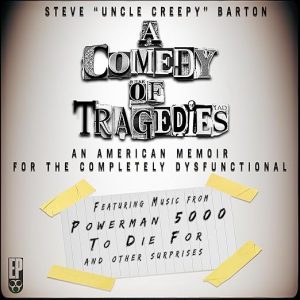
Steve Barton, known to horror communities as Unc Creepy, co-founded Dread Central at a time when horror journalism on the internet was not yet a recognized career path. A Comedy of Tragedies is the audiobook account of what that building looked like from the inside: the mentorships, the failures, the industry relationships, and the personal losses that accumulated alongside the professional wins. Tom Jordan narrates nine hours and twelve minutes of memoir that earns its title not because the tragedies are performed for effect but because they happened, and Barton writes about them with the kind of unfiltered emotional honesty that distinguishes autobiography worth hearing from autobiography as promotional exercise.
The range of experience Barton covers is genuinely striking. He writes about the personal reality of 9/11 not as historical context but as something that changed the actual course of his life in specific and lasting ways. He describes being mentored by George A. Romero and Sid Haig, two figures whose influence on horror cinema is nearly impossible to overstate for anyone who takes that world seriously. And he recounts playing a central role in the success of the Terrifier film franchise, a series that has become one of the more improbable commercial success stories in recent horror history. These are not name-drops arranged for credibility; they are chapters in a life that genuinely intersected with horror's creative and commercial evolution across several decades of significant change in how the genre functions.
Comedy as Structure, Not a Guarantee of Happiness
The title's paradox is the memoir's structural principle. Barton is writing from a position that includes real loss and genuine hardship, but the mode of the book is comedy in the classical sense: not a guarantee of happiness but a commitment to finding the humor and meaning in what would otherwise be purely grim. Reviewers describe the book as tearing your heart apart and then mending it with laughter, which is an accurate account of the emotional experience. The rawness one reviewer highlights as a defining quality, raw and funny and tragic in their description, is not an aesthetic pose but the actual texture of Barton's material across nine hours. The memoir does not sand the edges down to make the difficult parts more comfortable.
The insider view of Dread Central's creation and the coverage of Bloody Disgusting's inner workings give the memoir a specificity that general horror fans and industry observers will find valuable beyond the personal narrative. This is not a surface-level account of what horror culture looks like from outside; it is an account of the decisions, relationships, and accidents that shaped how horror news and criticism developed in the early internet era, told by someone who was making those decisions in real time and living with their consequences. For listeners interested in how niche media operations actually function from inside, the level of operational detail is rare and worth the listening investment.
Tom Jordan's Delivery Balances Grief and Humor
Tom Jordan's narration handles the emotional range of the material with genuine skill throughout the full runtime. Horror memoir requires a narrator who can move between comedic anecdote and genuine grief without either register undermining the other, and Jordan earns that balance consistently across nine-plus hours. The audio format serves the memoir particularly well because Barton's voice, as Jordan conveys it, is conversational rather than literary: these are stories told with the natural rhythm of someone who has told versions of them aloud many times and knows where the laughs and the silences belong. That rhythm is something audio captures more faithfully than print.
The Romero and Haig mentorship sections deserve particular attention in the listening experience. Both figures are gone now, and Barton's accounts of those relationships carry the weight of someone writing about mentors he has lost and cannot thank again. Jordan's delivery in these passages is appropriately measured, and the contrast with the more brash comedic sections gives the memoir its tonal depth and its emotional stakes beyond the industry storytelling.
A Complicated Life, Not a Triumphant Success Story
Listeners without existing investment in horror film culture and online genre journalism will find some sections require context they may not carry into the listening. The interior look at Dread Central's editorial culture, the convention circuit dynamics, and the specific production histories Barton references are richest for listeners who already know the genre landscape and its key figures. That is a feature of the memoir's honesty about its specific world, not a flaw, but it is worth knowing before committing nine hours to an unfamiliar community.
The memoir's emotional commitment to honesty about personal failure and loss means some sections are genuinely difficult listening. Barton is not writing a success story with obstacles; he is writing a complicated life with wins inside it. Listeners who come expecting a triumphant entrepreneurship narrative will find something more ambivalent and, arguably, more honest about what building something actually costs.
For Followers of Dread Central's Real History
Horror fans with genuine investment in the genre's history, particularly in how online horror journalism developed from fan sites to professional media operations, will find this audiobook a rare first-person account of that transition told without self-aggrandizement. Listeners interested in creative entrepreneurship memoir, particularly of the build-it-against-the-odds variety, will find Barton's story resonant beyond its genre-specific content. Anyone who has followed Dread Central, Bloody Disgusting, or the Terrifier franchise and wondered about the human stories behind those institutions will find direct access here that no outside account could provide.
Listeners seeking a conventional celebrity memoir structure, with a clear arc from obscurity to success to tidy reflection, will find Barton's approach less tidy and more honest than that framework allows.
Key Details
- Performance: Tom Jordan delivers Steve Barton's autobiography with enough emotional range to honor both the comedic and genuinely painful passages. The performance captures Barton's voice without parodying the genre sensibility that runs through the memoir.
- What it covers: horror journalism and genre fandom, creative ambition against difficult odds, the personal cost of building something from nothing
- Feel: Raw and candid, alternating between sharp humor and genuine grief
- Our call: A frank, emotionally honest memoir from one of horror journalism's founding online voices, strongest for listeners already inside the genre community but accessible to anyone interested in creative ambition and its costs.