
- Voice: Patrick Lawlor's delivery suits Haun's unpretentious, plainspoken prose; he matches the book's reflective pace without over-dramatizing material that works precisely because it refuses to perform.
- Big ideas: craft knowledge as cultural memory, the built environment as autobiography, simplicity and ecological respect in American construction
- Atmosphere: Meditative and quietly elegy-like, with practical grounding
- Worth it?: Larry Haun's 12-house memoir is the kind of audiobook that rewards listeners who want to think about what American homes have meant, not just how they were built.
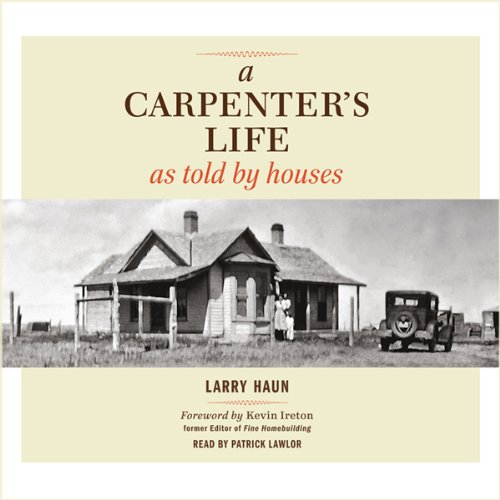
Larry Haun died in September 2011 at the age of 80, and A Carpenter's Life as Told by Houses, narrated by Patrick Lawlor across seven hours and 20 minutes, carries the particular quality of a book that knows it is making a record. Haun was a carpenter's carpenter by most accounts, a man who had spent decades contributing to Fine Homebuilding magazine and producing instructional videos that defined how a generation of builders learned their trade. This audiobook is something different from those instructional works: it is a memoir structured around 12 houses, from the sod house in Nebraska where his mother was born to the Habitat for Humanity homes he gave his final years to, and it uses those houses as chapters in a life that moved across a century of American building practice.
The context for this book is important. Haun witnessed American housing construction transform from necessity-built, materials-honest structures to the production houses of the San Fernando Valley, built fast and cheap for a postwar population boom. He built those production houses himself, and his account of that work is without the romanticism that someone outside the trade might bring to it. He knows what was gained in efficiency and what was lost in craft, and the book holds both things simultaneously without resolving them into a simple lesson about the good old days.
The Sod House Chapter Isn't About His Mother
The book's formal conceit, organizing a life around 12 houses rather than chronological autobiography, is more than structural cleverness. For Haun, houses are not backdrops to human events; they are events themselves. The sod house chapter is not about his mother's life in a house made of earth; it is about what it meant to build a shelter from the material immediately at hand, without pretension and without the assumption that something better would come along. That quality of attention, the carpenter's specificity about how things are made and why they hold together or fall apart, runs through the entire audiobook and gives it an unusually grounded quality for memoir.
Lawlor's narration is well-matched to Haun's voice. Haun wrote plainly, without literary ornamentation, and Lawlor doesn't add any. Reviewers who knew Haun from his instructional videos noted that reading the book felt like listening to him narrate directly, which suggests the prose preserves his cadence. Lawlor captures that quality without impersonating it, maintaining a pace that is reflective without being lugubrious.
Lawlor Resists Pacing This for Momentum
The audiobook format works particularly well for this material because Haun's prose rewards a listening pace rather than a reading one. His sentences are built the way he describes building houses: without waste, with everything earning its place. Rushing through them on the page loses the quality that makes them valuable; hearing them spoken gives them the time they need. Lawlor understands this and resists the urge to pace the narration for momentum; the book earns its seven hours and 20 minutes by accumulation of specific, considered observation.
The Habitat for Humanity chapters, which cover Haun's work in his final years, are where the memoir's moral concerns become most explicit. He is not sentimental about poverty housing in the way that advocacy writing sometimes is; he is practical. He describes what good construction means for families who cannot afford errors, and his account of working alongside people who have never held a hammer is both generous and specific about what changes when the stakes are that direct. These chapters benefit from being heard rather than read.
A Structural Reprise in His Final Years
Haun's treatment of the Habitat for Humanity work in the final chapters is worth noting separately from the memoir's earlier material. By the time the book reaches this section, Haun has described decades of building for efficiency and scale, and the return to building carefully for people who need durable shelter functions as a kind of structural reprise. The skills are the same; the purpose is clarified. Lawlor's narration here is at its warmest, matching the tone of a man in his final years who found work that finally makes sense of everything that came before it.
Neither Nostalgia nor Critique for the Valley Houses
The production house chapters, covering Haun's work in the San Fernando Valley building subdivisions at speed, are the book's most ambivalent section. He does not condemn the work or the conditions that produced it; he simply reports what it required and what it resulted in. Listeners who approach this section expecting either nostalgia for craftsmanship or critique of mass production will find Haun more complicated than either position. He built those houses and he knows they sheltered families; he also knows what was sacrificed in building them the way they were built.
The period photographs mentioned in the book's print edition do not translate to audio format, which is the audiobook's primary limitation. Haun's descriptions of specific structural elements, sod wall construction, balloon framing, post-and-beam joinery, are clear enough to visualize if you have any building vocabulary, but listeners without that background may find some technical passages more abstract in audio than they would be with visual support. The audiobook is complete as a memoir without the photographs; their absence is only felt during the most technical passages.
From Sod House to Subdivision to Habitat
Builders, carpenters, and trades professionals will find Haun's insider specificity unusually satisfying for a memoir. Architectural and cultural history readers who want an account of American housing from someone who built it at multiple scales, from sod to subdivision to Habitat, will find the century-spanning perspective valuable. General memoir readers who appreciate plainspoken, observational prose without literary pretension will also be at home here. Listeners who want dramatic incident or narrative arc in the traditional sense may find the house-by-house structure more meditative than they prefer.







