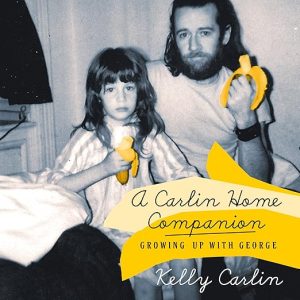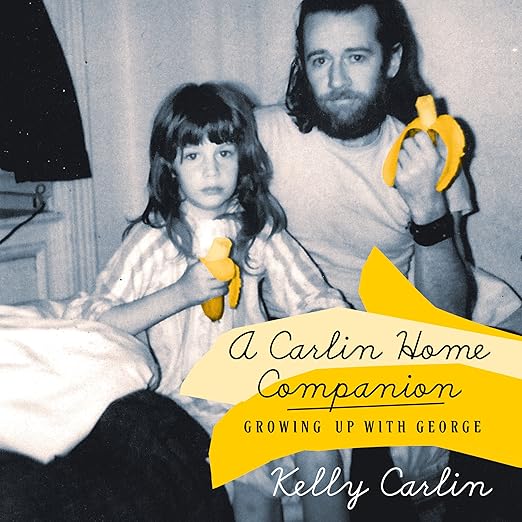
Kelly Carlin's memoir earns its place beside her father's own bestsellers, and this audiobook, narrated by Kelly herself, is the better way to experience it. A Carlin Home Companion follows George Carlin's only child from the back seat of an old Dodge Dart touring 'hell gigs' in the earliest days of his career through decades of addiction, financial collapse, and her own long struggle to become something other than his daughter. It's a story that needed to be told in her own voice, literally, and the audiobook delivers exactly that.
Riffing on Prairie Home Companion's Cozy Brand
What makes this memoir work is how unflinching Kelly Carlin is about the cost of growing up inside her father's genius. Reviewer Henry Two Door describes her as raised by 'absentee, fall-down-drunk, and coke-devouring parents,' and the book doesn't soften that record for the sake of legacy protection. Alcoholism, cocaine addiction, life-threatening health scares, and a crushing IRS debt all get named directly, alongside moments of real tenderness, like Kelly talking her father down from a bad acid trip with the line 'the sun has exploded and we have eight, no, seven-and-a-half minutes to live.'
The structure moves chronologically alongside George Carlin's own reinventions, from the Seven Dirty Words era through decades of reworking his stage persona, but the actual center of gravity stays on Kelly's parallel struggle to build an identity outside his shadow. Reviewer sloov, who describes going in a George Carlin fan and coming out a Kelly Carlin fan, captures the book's real achievement: it succeeds as a story in its own right, not just as an appendix to a more famous life.
The title itself is a deliberate joke worth unpacking: A Carlin Home Companion plays directly off A Prairie Home Companion, Garrison Keillor's long-running public radio institution built on gentle Midwestern nostalgia and wholesome storytelling, about as far from George Carlin's confrontational stage persona as American broadcasting gets. That collision, Keillor's cozy radio-hour brand grafted onto Carlin's household, signals the book's real tonal ambition from the cover alone: warmth and transgression sitting in the same sentence, which turns out to be a fair summary of what growing up Carlin actually felt like.
Seven Dirty Words as the Household's Touchstone
A 4.3 rating from 442 ratings reflects a well-received but not universally rapturous reception, consistent with a memoir this willing to sit inside genuine discomfort rather than smoothing every rough edge into easy inspiration for the sake of a higher score.
The Seven Dirty Words routine gets referenced early and often throughout, not as a punchline but as a genuine touchstone for understanding what George Carlin's household actually revolved around: a running, lifelong argument with authority that shaped everything from his career choices to his parenting style.
Direct Access to George Carlin's Own Voice
Self-narration matters enormously for a memoir this personal. Kelly Carlin knows exactly which lines carry weight and which need a lighter touch, an instinct no outside narrator could fully replicate for material this specific to her own memory. The audiobook edition also includes something print simply cannot offer: bonus audio recordings of George Carlin himself, plus a full conversation between Kelly and Garry Shandling, giving listeners direct access to voices the text can only describe secondhand.
Reviewer timothy m wetzel compares this favorably to George Carlin's own memoir, Last Words, noting he read that book first and found real value in seeing the formation of a comic from the outside this time rather than the inside. That comparison is useful for prospective listeners: this isn't a rehash of territory George already covered in his own book, it's a genuinely different vantage point on overlapping decades, filtered through the person who actually lived in the house rather than on the stage.
Garry Shandling's own outsized influence on modern comedy, from The Larry Sanders Show through his mentorship of a generation of comedians, makes the bonus conversation with Kelly more than a nostalgic extra. It's two people who each grew up adjacent to comedy's inner workings comparing notes on an industry that shaped both of their lives from very different angles.
Listeners who've found real value in comedians' memoirs that use humor as a direct tool for processing genuinely difficult family and mental health material, rather than pure entertainment, will recognize a kindred approach here. Kelly Carlin isn't performing comedy for its own sake; she's using the instincts she inherited from her father to make an otherwise very heavy story bearable to sit with for twelve hours.
As Honest as a Daughter's Account Can Be
At nearly twelve hours, this is a substantial listen, and the pacing reflects real memoir density rather than a quick celebrity-adjacent cash-in. Listeners expecting a breezy collection of George Carlin anecdotes should recalibrate: large stretches deal directly with addiction, family dysfunction, and financial ruin, and while reviewer NancyD calls the result 'compelling, shocking, and informative,' the material earns that description through genuine difficulty rather than glossing past it.
Henry Two Door's review, titled 'As Honest as She Could Be, Given Who She Is,' gets at a fair caveat worth naming directly: this is, unavoidably, a daughter's account of her own father, and even at its most unflinching it carries a favorable bias no outside biography would. That doesn't diminish its value as a firsthand record, but listeners wanting a fully independent assessment of George Carlin's life and legacy should treat this as one perspective, deeply informed but not neutral.
Specific content warnings are worth naming plainly for listeners deciding whether this is the right time to start: detailed accounts of a parent's active addiction, a childhood shaped by genuine financial instability including the IRS debt mentioned directly in the synopsis, and health scares serious enough to threaten the family more than once. None of this is exploitative or gratuitous, but it is sustained and specific rather than briefly alluded to and moved past.
Growing Up in a Famous Parent's Shadow
George Carlin fans get obvious value here, hearing routines like 'A Place for My Stuff' and his famous confrontations with censorship reframed through his daughter's eyes, plus rare access to his actual voice in the bonus material. But the audience is genuinely broader than that: anyone interested in memoirs about growing up in the shadow of a famous, difficult parent, or in addiction and recovery stories told with real humor intact, will find plenty here even without deep George Carlin fandom.
Skip this one if celebrity-family memoirs built around addiction and dysfunction aren't your genre regardless of the famous name attached, since that territory, not George Carlin's stand-up career itself, is the actual center of the book.
Good to Know
Do I need to be a George Carlin fan to enjoy this audiobook?
No. Reviewer sloov specifically describes going in as a George Carlin fan and coming out a Kelly Carlin fan, and the memoir works as Kelly's own story first.
Does this audiobook include any of George Carlin's actual voice or material?
Yes. It includes bonus audio recordings of George Carlin himself and a full conversation between Kelly Carlin and Garry Shandling, both exclusive to the audio edition.
How does this audiobook compare to George Carlin's own memoir, Last Words?
Reviewer timothy m wetzel, who read Last Words first, found real value in seeing the same decades from Kelly's outside vantage rather than George's own perspective.
Is this audiobook appropriate for listeners sensitive to addiction and family dysfunction themes?
Approach with that awareness. Alcoholism, cocaine addiction, and financial collapse are all covered directly and are not softened for the sake of legacy protection.